
题目
Dashboard 2025 O1 Term 2 - Reading Test
多项填空题
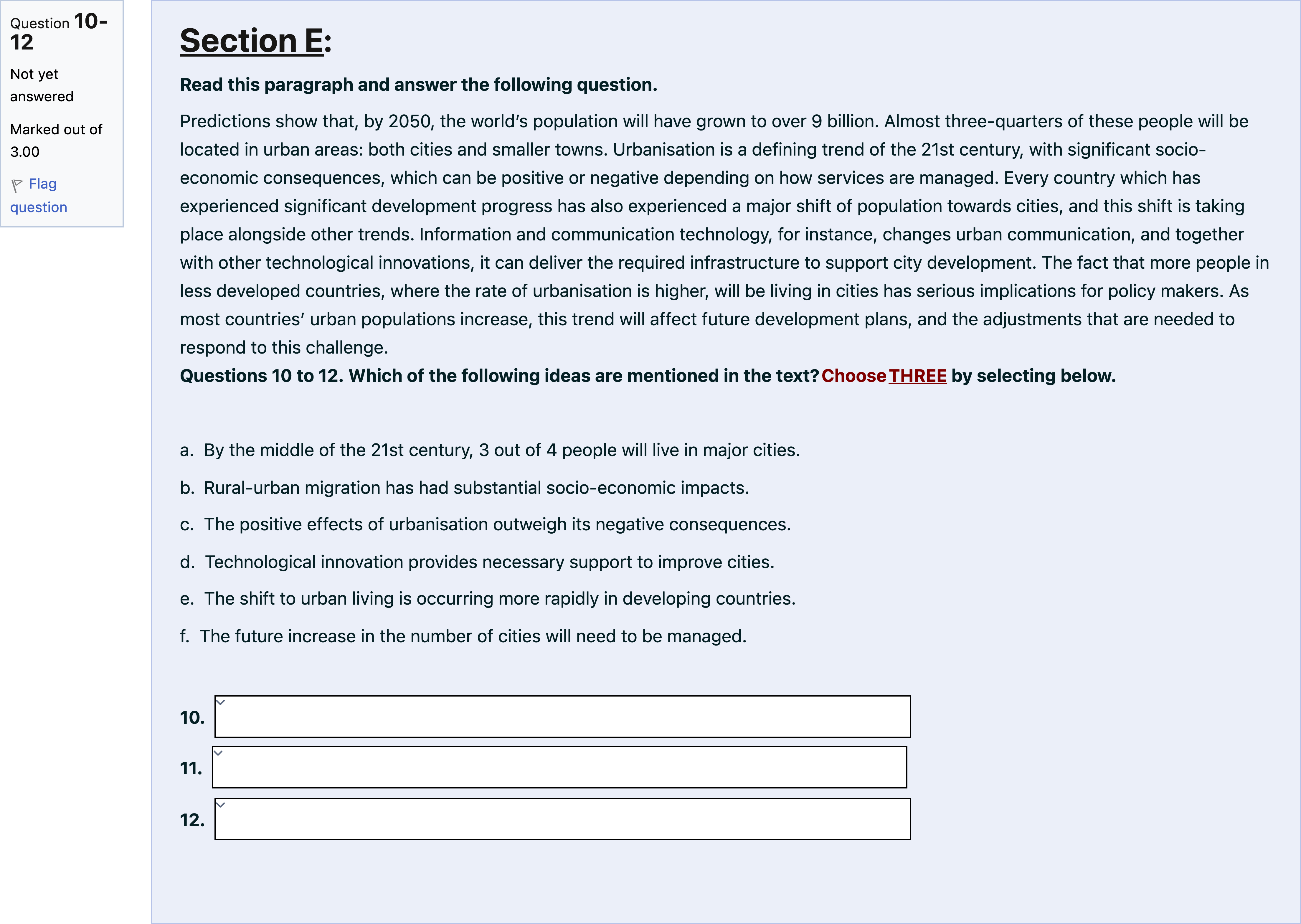
Question textSection E: Read this paragraph and answer the following question. Predictions show that, by 2050, the world’s population will have grown to over 9 billion. Almost three-quarters of these people will be located in urban areas: both cities and smaller towns. Urbanisation is a defining trend of the 21st century, with significant socio-economic consequences, which can be positive or negative depending on how services are managed. Every country which has experienced significant development progress has also experienced a major shift of population towards cities, and this shift is taking place alongside other trends. Information and communication technology, for instance, changes urban communication, and together with other technological innovations, it can deliver the required infrastructure to support city development. The fact that more people in less developed countries, where the rate of urbanisation is higher, will be living in cities has serious implications for policy makers. As most countries’ urban populations increase, this trend will affect future development plans, and the adjustments that are needed to respond to this challenge. Questions 10 to 12. Which of the following ideas are mentioned in the text? Choose THREE by selecting below. a. By the middle of the 21st century, 3 out of 4 people will live in major cities. b. Rural-urban migration has had substantial socio-economic impacts. c. The positive effects of urbanisation outweigh its negative consequences. d. Technological innovation provides necessary support to improve cities. e. The shift to urban living is occurring more rapidly in developing countries. f. The future increase in the number of cities will need to be managed.10. Answer 1 Question 10-12[select: , a. By the middle of the 21st century, 3 out of 4 people will live in major cities., b. Rural-urban migration has had substantial socio-economic impacts., c. The positive effects of urbanisation outweigh its negative consequences., d. Technological innovation provides necessary support to improve cities., e. The shift to urban living is occurring more rapidly in developing countries., f. The future increase in the number of cities will need to be managed.]11. Answer 2 Question 10-12[select: , a. By the middle of the 21st century, 3 out of 4 people will live in major cities., b. Rural-urban migration has had substantial socio-economic impacts., c. The positive effects of urbanisation outweigh its negative consequences., d. Technological innovation provides necessary support to improve cities., e. The shift to urban living is occurring more rapidly in developing countries., f. The future increase in the number of cities will need to be managed.]12. Answer 3 Question 10-12[select: , a. By the middle of the 21st century, 3 out of 4 people will live in major cities., b. Rural-urban migration has had substantial socio-economic impacts., c. The positive effects of urbanisation outweigh its negative consequences., d. Technological innovation provides necessary support to improve cities., e. The shift to urban living is occurring more rapidly in developing countries., f. The future increase in the number of cities will need to be managed.]

查看解析
标准答案
Please login to view
思路分析
Question 10–12 asks: Which ideas are mentioned in the text? Choose THREE by selecting from the options.
Option a. By the middle of the 21st century, 3 out of 4 people will live in major cities.
- The passage states that by 2050 the world’s population will exceed 9 billion and that almost three-quarters will be located in urban areas (cities and smaller towns). However, it does not specify that those three-quarters will all live in 'major cities' specifically, nor does it limit the figure to only 'major cities' as opposed to urban areas including towns. The wording in the text supports a large share......Login to view full explanation登录即可查看完整答案
我们收录了全球超50000道考试原题与详细解析,现在登录,立即获得答案。
类似问题
Urbanization refers to which of the following processes?
Question at position 1 Choose the most suitable option. According to UN-Habitat (2015), urbanisation is responsible for the development of social services and urban communities. 80% of the world’s population now living in urban centres. global social, economic and environmental problems. the overpopulation of cities in developing countries.
Question at position 1 Choose the most suitable option. According to UN-Habitat (2015), urbanisation is responsible for 80% of the world’s population now living in urban centres. global social, economic and environmental problems. the overpopulation of cities in developing countries. the development of social services and urban communities.
Question at position 1 Choose the most suitable option. According to UN-Habitat (2015), urbanisation is responsible for 80% of the world’s population now living in urban centres. the development of social services and urban communities. the overpopulation of cities in developing countries. global social, economic and environmental problems.
更多留学生实用工具
希望你的学习变得更简单
加入我们,立即解锁 海量真题 与 独家解析,让复习快人一步!