
题目
EESC1120.01|.02 Summer 2025 Our Home Amongst the Cosmos [Kruckenberg] Week 6 Quiz
单项选择题
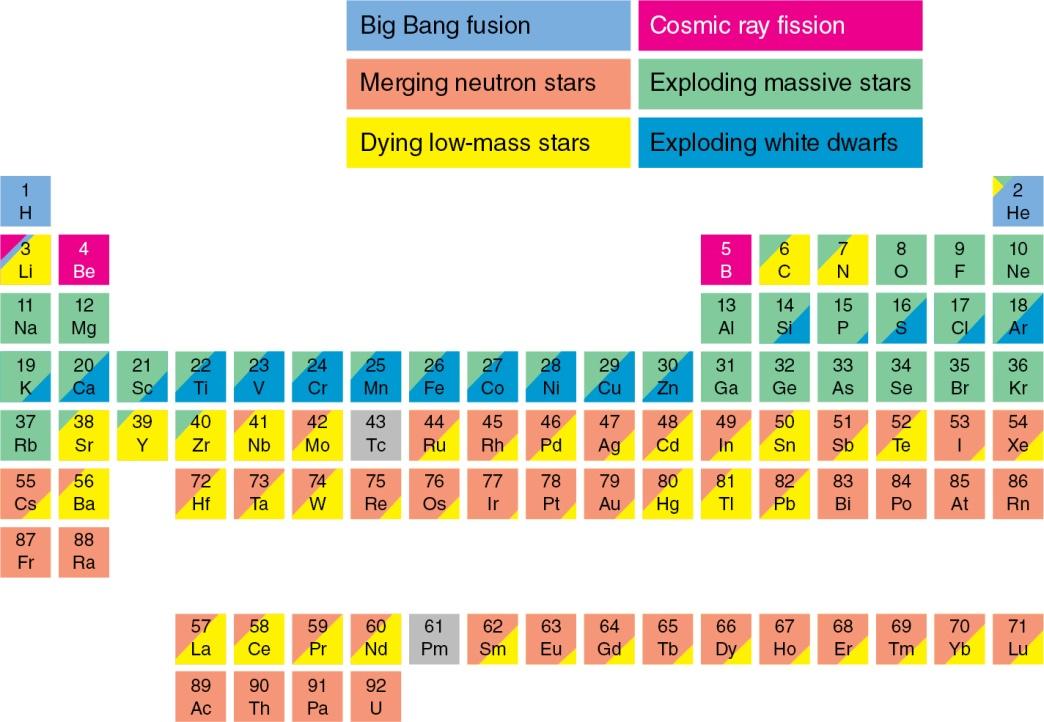
It is hypothesized that carbon and silicon could form the “backbone” of DNA. Using the figure below, which of the following scenarios might lead to a star system that has more silicon than carbon?
选项
A.It formed near low-mass stars, but no high-mass stars.
B.It formed in proximity to many high-mass stars, but few low-mass stars.
C.It is a binary star system.
D.It formed from “raw” material from the Big Bang.
E.It formed near a large number of exploding white dwarf stars.

查看解析
标准答案
Please login to view
思路分析
To tackle this question, let's think about how elements like carbon and silicon get into the interstellar medium from generations of stars.
Option 1: 'It formed near low-mass stars, but no high-mass stars.' Low-mass stars do contribute carbon later in their lifetimes, but the absence of high-mass stars means fewer supernovae that synthesize and eject silicon; this would not strongly favor silicon......Login to view full explanation登录即可查看完整答案
我们收录了全球超50000道考试原题与详细解析,现在登录,立即获得答案。
类似问题
A massive star goes supernova, creating a large nebula. This nebula eventually goes on to form a new set of stars. What can we say about the composition of this new set of stars compared to the one that went supernova?
What is the heaviest element that can be made in the core of a star?
What process produced carbon and iron?
Massive stars synthesize chemical elements going from helium up to iron
更多留学生实用工具
希望你的学习变得更简单
加入我们,立即解锁 海量真题 与 独家解析,让复习快人一步!