你还在为考试焦头烂额?找我们就对了!
我们知道现在是考试月,你正在为了考试复习到焦头烂额。为了让更多留学生在备考与学习季更轻松,我们决定将Gold会员限时免费开放至2025年12月31日!原价£29.99每月,如今登录即享!无门槛领取。
助你高效冲刺备考!

题目
GEOL0012_25-26 **********GEOL0012 Moodle Test (unassessed) 2025/26**********
多项填空题
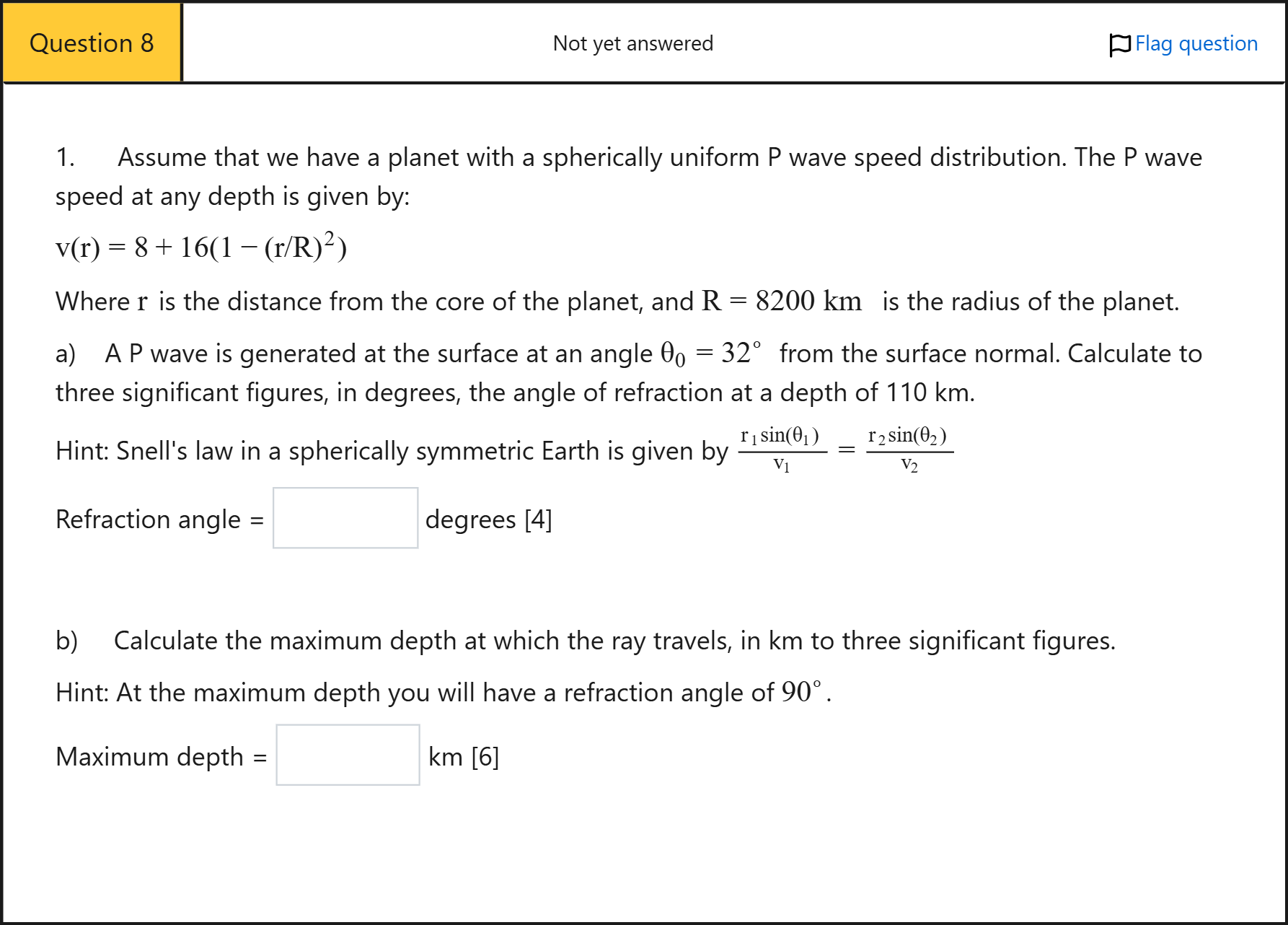
Question text1. Assume that we have a planet with a spherically uniform P wave speed distribution. The P wave speed at any depth is given by: [math: v(r)=8+16(1−(r/R)2)] Where [math: r] is the distance from the core of the planet, and [math: R=8200km] is the radius of the planet. a) A P wave is generated at the surface at an angle [math: θ0=32∘] from the surface normal. Calculate to three significant figures, in degrees, the angle of refraction at a depth of 110 km. Hint: Snell's law in a spherically symmetric Earth is given by [math: r1sin(θ1)v1=r2sin(θ2)v2] Refraction angle = Answer 1 Question 8[input] degrees [4] b) Calculate the maximum depth at which the ray travels, in km to three significant figures. Hint: At the maximum depth you will have a refraction angle of [math: 90∘].Maximum depth = Answer 2 Question 8[input] km [6]

查看解析
标准答案
Please login to view
思路分析
We begin by restating the problem and the given data so we can apply the appropriate wave-s propagation relations step by step.
- The P-wave speed distribution is v(r) = 8 + 16(1 − (r/R)^2), with R = 8200 km. The radial coordinate r is measured from the planet’s center, so at the surface r = R and at a depth d below the surface we have r = R − d.
- An initial P-wave ray is generated at the surface at an angle θ0 = 32° from the surface normal.
- We are asked to (a) find the angle of refraction θ2 at a depth of 110 km, and (b) find the maximum depth that the ray reaches (where the refraction angle would be 90°).
- Snell’s law in a spherically symmetric Earth can be written in the form r1 sin(θ1) / v1 = r2 sin(θ2) / v2, where r is the distance from t......Login to view full explanation登录即可查看完整答案
我们收录了全球超50000道考试原题与详细解析,现在登录,立即获得答案。
类似问题
Question at position 1 Given the figure below where light travels from one medium to another, and with Snell's Law in mind as well as the difference between the angles apparent; what is the relationship between the refractive indices n_1 and n_2? n_1 > n_2n_1 < n_2n_1 = n_2Not enough information
A light ray passes from water (refractive index ( n1 = 1.33 )) into diamond (refractive index ( n2 = 2.42 )). If the angle of incidence in water is ( 300 ), what is the angle of refraction in diamond?
Which of the following statements best describes Snell's Law and its application in determining the path of light as it passes from one medium to another?
A light ray in glass arrives at the glass-water interface at an angle of θ = 48° with the normal. The refracted ray in water makes an angle φ = 72° with the normal, as shown in the figure. The index of refraction of water is 1.33. The angle of incidence is now changed to θ = 37°. What is the new angle of refraction φ in the water? Hint: Start by calculating the index of refraction of the glass.
更多留学生实用工具
希望你的学习变得更简单
为了让更多留学生在备考与学习季更轻松,我们决定将Gold 会员限时免费开放至2025年12月31日!