
题目
多项填空题
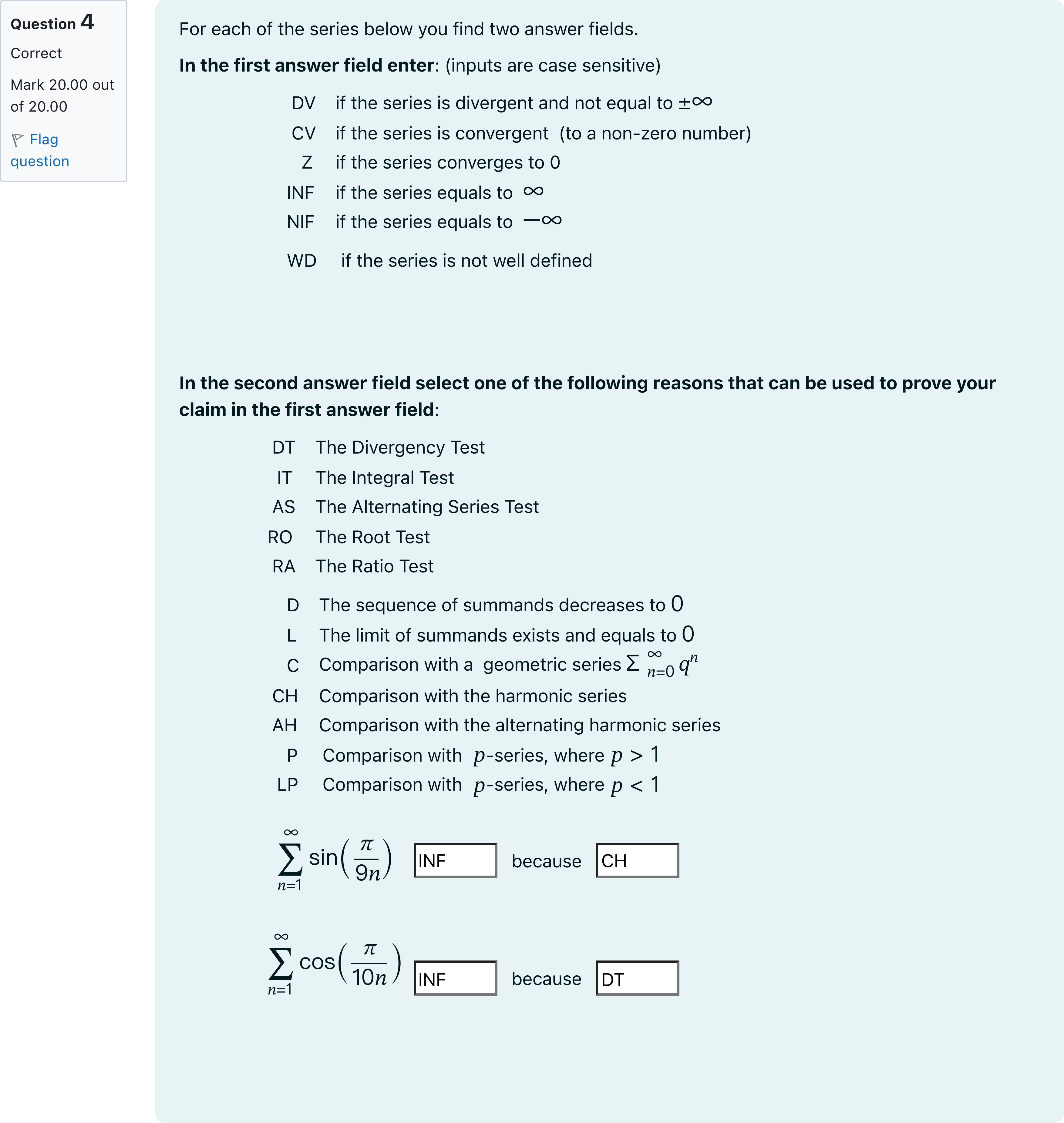
Question textFor each of the series below you find two answer fields. In the first answer field enter: (inputs are case sensitive) [table] DV | | if the series is divergent and not equal to ±∞±∞\pm\infty CV | | if the series is convergent (to a non-zero number) Z | | if the series converges to 0 INF | | if the series equals to ∞∞ \infty NIF | | if the series equals to −∞−∞ -\infty [/table] [table] WD | | if the series is not well defined | | [/table] In the second answer field select one of the following reasons that can be used to prove your claim in the first answer field: [table] DT | | The Divergency Test IT | | The Integral Test AS | | The Alternating Series Test RO | | The Root Test RA | | The Ratio Test [/table] [table] D | | The sequence of summands decreases to 00 0 L | | The limit of summands exists and equals to 00 0 C | | Comparison with a geometric series ∑∞𝑛=0𝑞𝑛∑n=0∞qn \sum_{n=0}^{\infty}q^n CH | | Comparison with the harmonic series AH | | Comparison with the alternating harmonic series [/table] [table] P | | Comparison with 𝑝pp-series, where 𝑝>1p>1p > 1 LP | | Comparison with 𝑝pp-series, where 𝑝<1p<1p < 1 [/table] [table] ∑𝑛=1∞sin(𝜋9𝑛)∑n=1∞sin(π9n) \sum_{n=1}^\infty \sin\left( \frac{\pi }{ {9} n } \right) | | because ∑𝑛=1∞cos(𝜋10𝑛)∑n=1∞cos(π10n) \sum\limits_{n=1}^{\infty} \cos\left( \frac{\pi }{ {10} n } \right) | | because [/table]

查看解析
标准答案
Please login to view
思路分析
Question restatement and options:
- In the first answer field enter the category for the series: DV, CV, Z, INF, NIF, WD, with the second field selecting a justification from DT, IT, AS, RO, RA, followed by a second pair of selections (D, L, C, CH, AH, P, LP) and finally two target series to classify.
- For the given response, the first blank is INF and the second blank is INF, with the reasons provided as CH and DT respectively.
Analysis of the first claim: INF because CH
- The statement INF indicates the series diverges to infinity. A common approach to justify this is by a Comparison with a geometric-like or harmonic-like divergent benchma......Login to view full explanation登录即可查看完整答案
我们收录了全球超50000道考试原题与详细解析,现在登录,立即获得答案。
类似问题
Question textFor each of the series below you find two answer fields. In the first answer field enter: (inputs are case sensitive) [table] DV | | if the series is divergent and not equal to ±∞±∞\pm\infty CV | | if the series is convergent (to a non-zero number) Z | | if the series converges to 0 INF | | if the series equals to ∞∞ \infty NIF | | if the series equals to −∞−∞ -\infty [/table] [table] WD | | if the series is not well defined | | [/table] In the second answer field select one of the following reasons that can be used to prove your claim in the first answer field: [table] DT | | The Divergency Test IT | | The Integral Test AS | | The Alternating Series Test RO | | The Root Test RA | | The Ratio Test [/table] [table] D | | The sequence of summands decreases to 00 0 L | | The limit of summands exists and equals to 00 0 C | | Comparison with a geometric series ∑∞𝑛=0𝑞𝑛∑n=0∞qn \sum_{n=0}^{\infty}q^n CH | | Comparison with the harmonic series AH | | Comparison with the alternating harmonic series [/table] [table] P | | Comparison with 𝑝pp-series, where 𝑝>1p>1p > 1 LP | | Comparison with 𝑝pp-series, where 𝑝<1p<1p < 1 [/table] [table] ∑𝑛=1∞(𝑛+1)7(8⋅𝑛!)2(2𝑛)!∑n=1∞(n+1)7(8⋅n!)2(2n)! \sum_{n=1}^\infty (n+1)^{{7}} \,\, \frac{({8}\cdot n!)^2 }{ (2n)! } | | because ∑𝑛=1∞(1−6𝑛)2𝑛2∑n=1∞(1−6n)2n2 \sum\limits_{n=1}^{\infty} \left(1- \frac{{6} }{ n } \right)^{ {2}n^2} | | because [/table]
Question textFor each of the series below you find two answer fields. In the first answer field enter: (inputs are case sensitive) [table] DV | | if the series is divergent and not equal to ±∞±∞\pm\infty CV | | if the series is convergent (to a non-zero number) Z | | if the series converges to 0 INF | | if the series equals to ∞∞ \infty NIF | | if the series equals to −∞−∞ -\infty [/table] [table] WD | | if the series is not well defined | | [/table] In the second answer field select one of the following reasons that can be used to prove your claim in the first answer field: [table] DT | | The Divergency Test IT | | The Integral Test AS | | The Alternating Series Test RO | | The Root Test RA | | The Ratio Test [/table] [table] D | | The sequence of summands decreases to 00 0 L | | The limit of summands exists and equals to 00 0 C | | Comparison with a geometric series ∑∞𝑛=0𝑞𝑛∑n=0∞qn \sum_{n=0}^{\infty}q^n CH | | Comparison with the harmonic series AH | | Comparison with the alternating harmonic series [/table] [table] P | | Comparison with 𝑝pp-series, where 𝑝>1p>1p > 1 LP | | Comparison with 𝑝pp-series, where 𝑝<1p<1p < 1 [/table] [table] ∑𝑛=1∞3𝑛3+15𝑛12+1‾‾‾‾‾‾‾√3+𝑛∑n=1∞3n3+15n12+13+n \sum_{n=1}^\infty \frac{{3}n^{3}+1}{{5}\sqrt[{3}]{ n^{12}+1}+n} | | because ∑𝑛=1∞(𝑛ln𝑛)24𝑛∑n=1∞(nlnn)24n \sum\limits_{n=1}^{\infty} \frac{(n \ln n)^{2}}{{4}^n} | | because [/table]
Question textFor each of the series below you find two answer fields. In the first answer field enter: (inputs are case sensitive) [table] DV | | if the series is divergent CV | | if the series is convergent (to a number ∉{0,1,tan(1/6)}∉{0,1,tan(1/6)}\not\in \{0, 1, \tan(1/{6}) \}) Z | | if the series converges to 0 ON | | if the series converges to 111 IN | | if the series equals to tan(1/6)tan(1/6)\tan(1/{6}) [/table] [table] WD | | if the series is not well defined | | [/table] In the second answer field select one of the following reasons that can be used to prove your claim in the first answer field: [table] DT | | The Divergency Test IT | | The Integral Test AST | | The Alternating Series Test RO | | The Root Test RA | | The Ratio Test [/table] [table] D | | The sequence of summands decreases to 00 0 L | | The limit of summands exists and equals to 00 0 C | | Comparison with a geometric series ∑∞𝑛=0𝑞𝑛∑n=0∞qn \sum_{n=0}^{\infty}q^n CH | | Comparison with the harmonic series AH | | Comparison with the alternating harmonic series [/table] [table] P | | Comparison with 𝑝pp-series, where 𝑝>1p>1p > 1 LP | | Comparison with 𝑝pp-series, where 𝑝<1p<1p < 1 [/table] [table] ∑𝑛=1∞(−1)𝑛tan(16𝑛)∑n=1∞(−1)ntan(16n) \sum\limits_{n=1}^{\infty} (-1)^n \tan \left(\frac{1}{{6} n}\right) | | because ∑𝑛=1∞(−1)𝑛(1−7𝑛)𝑛∑n=1∞(−1)n(1−7n)n\sum\limits_{n=1}^{\infty} (-1)^n \left(1-\frac{{7}}{n}\right)^n | | because [/table]
Question textFor each of the series below you find two answer fields. In the first answer field enter: (inputs are case sensitive) [table] DV | | if the series is divergent CV | | if the series is convergent (to a number ∉{0,1,5‾√}∉{0,1,5}\not\in \{0, 1, \sqrt{{5}} \}) Z | | if the series converges to 0 ON | | if the series converges to 111 IN | | if the series equals to 5‾√5\sqrt{{5}} [/table] [table] WD | | if the series is not well defined | | [/table] In the second answer field select one of the following reasons that can be used to prove your claim in the first answer field: [table] DT | | The Divergency Test IT | | The Integral Test AST | | The Alternating Series Test RO | | The Root Test RA | | The Ratio Test [/table] [table] D | | The sequence of summands decreases to 00 0 L | | The limit of summands exists and equals to 00 0 C | | Comparison with a geometric series ∑∞𝑛=0𝑞𝑛∑n=0∞qn \sum_{n=0}^{\infty}q^n CH | | Comparison with the harmonic series AH | | Comparison with the alternating harmonic series [/table] [table] P | | Comparison with 𝑝pp-series, where 𝑝>1p>1p > 1 LP | | Comparison with 𝑝pp-series, where 𝑝<1p<1p < 1 [/table] [table] ∑𝑛=3∞(−1)𝑛5−4𝑛2‾‾‾‾‾‾‾√∑n=3∞(−1)n5−4n2 \sum\limits_{n=3}^{\infty} (-1)^n\sqrt{ {5}-\frac{ {4}}{n^2} } | | because ∑𝑛=1∞(−1)𝑛ln(1+17𝑛)∑n=1∞(−1)nln(1+17n) \sum\limits_{n=1}^{\infty} (-1)^n \, \ln\left(1 + \frac{{17}}{n}\right) | | because [/table]
更多留学生实用工具
希望你的学习变得更简单
加入我们,立即解锁 海量真题 与 独家解析,让复习快人一步!