
题目
多项填空题
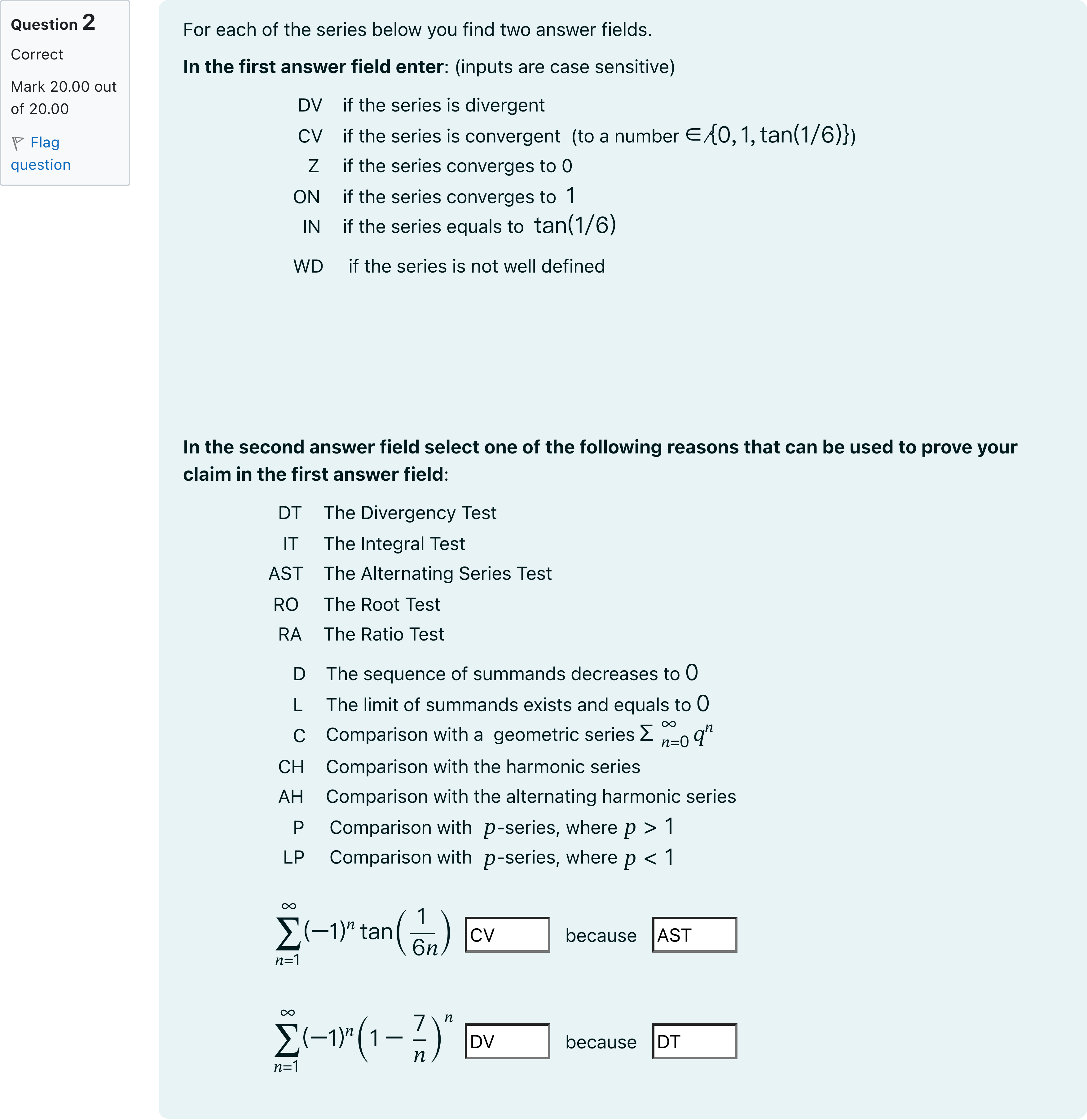
Question textFor each of the series below you find two answer fields. In the first answer field enter: (inputs are case sensitive) [table] DV | | if the series is divergent CV | | if the series is convergent (to a number ∉{0,1,tan(1/6)}∉{0,1,tan(1/6)}\not\in \{0, 1, \tan(1/{6}) \}) Z | | if the series converges to 0 ON | | if the series converges to 111 IN | | if the series equals to tan(1/6)tan(1/6)\tan(1/{6}) [/table] [table] WD | | if the series is not well defined | | [/table] In the second answer field select one of the following reasons that can be used to prove your claim in the first answer field: [table] DT | | The Divergency Test IT | | The Integral Test AST | | The Alternating Series Test RO | | The Root Test RA | | The Ratio Test [/table] [table] D | | The sequence of summands decreases to 00 0 L | | The limit of summands exists and equals to 00 0 C | | Comparison with a geometric series ∑∞𝑛=0𝑞𝑛∑n=0∞qn \sum_{n=0}^{\infty}q^n CH | | Comparison with the harmonic series AH | | Comparison with the alternating harmonic series [/table] [table] P | | Comparison with 𝑝pp-series, where 𝑝>1p>1p > 1 LP | | Comparison with 𝑝pp-series, where 𝑝<1p<1p < 1 [/table] [table] ∑𝑛=1∞(−1)𝑛tan(16𝑛)∑n=1∞(−1)ntan(16n) \sum\limits_{n=1}^{\infty} (-1)^n \tan \left(\frac{1}{{6} n}\right) | | because ∑𝑛=1∞(−1)𝑛(1−7𝑛)𝑛∑n=1∞(−1)n(1−7n)n\sum\limits_{n=1}^{\infty} (-1)^n \left(1-\frac{{7}}{n}\right)^n | | because [/table]

查看解析
标准答案
Please login to view
思路分析
Let's parse the structure of the task first. For each series, there are two parts: (1) the label that describes the convergence/divergence behavior in the first field, and (2) the label that identifies which test or criterion justifies that claim in the second field. The first group of labels defines the outcome of the series (divergent, convergent to 0, convergent to a nonzero number, etc.), while the second group provides a test name to support that claim.
Option analysis for the first blank (the first answer field):
- CV: This label means the series is convergent to a specific finite number, explicitly allowed to be 0, 1, or tan(1/6) according to the problem’s stated table. If the actual series converges to one of those values, CV is the correct descriptive category for the first field.
- DV: This label means the series is divergent (i.e., it does not converge to any finite value). If the series does not converge, DV would be the appropriate category in the first field.
To decide between CV and DV, one would need the actual series value......Login to view full explanation登录即可查看完整答案
我们收录了全球超50000道考试原题与详细解析,现在登录,立即获得答案。
类似问题
Question textFor each of the series below you find two answer fields. In the first answer field enter: (inputs are case sensitive) [table] DV | | if the series is divergent and not equal to ±∞±∞\pm\infty CV | | if the series is convergent (to a non-zero number) Z | | if the series converges to 0 INF | | if the series equals to ∞∞ \infty NIF | | if the series equals to −∞−∞ -\infty [/table] [table] WD | | if the series is not well defined | | [/table] In the second answer field select one of the following reasons that can be used to prove your claim in the first answer field: [table] DT | | The Divergency Test IT | | The Integral Test AS | | The Alternating Series Test RO | | The Root Test RA | | The Ratio Test [/table] [table] D | | The sequence of summands decreases to 00 0 L | | The limit of summands exists and equals to 00 0 C | | Comparison with a geometric series ∑∞𝑛=0𝑞𝑛∑n=0∞qn \sum_{n=0}^{\infty}q^n CH | | Comparison with the harmonic series AH | | Comparison with the alternating harmonic series [/table] [table] P | | Comparison with 𝑝pp-series, where 𝑝>1p>1p > 1 LP | | Comparison with 𝑝pp-series, where 𝑝<1p<1p < 1 [/table] [table] ∑𝑛=1∞(𝑛+1)7(8⋅𝑛!)2(2𝑛)!∑n=1∞(n+1)7(8⋅n!)2(2n)! \sum_{n=1}^\infty (n+1)^{{7}} \,\, \frac{({8}\cdot n!)^2 }{ (2n)! } | | because ∑𝑛=1∞(1−6𝑛)2𝑛2∑n=1∞(1−6n)2n2 \sum\limits_{n=1}^{\infty} \left(1- \frac{{6} }{ n } \right)^{ {2}n^2} | | because [/table]
Question textFor each of the series below you find two answer fields. In the first answer field enter: (inputs are case sensitive) [table] DV | | if the series is divergent and not equal to ±∞±∞\pm\infty CV | | if the series is convergent (to a non-zero number) Z | | if the series converges to 0 INF | | if the series equals to ∞∞ \infty NIF | | if the series equals to −∞−∞ -\infty [/table] [table] WD | | if the series is not well defined | | [/table] In the second answer field select one of the following reasons that can be used to prove your claim in the first answer field: [table] DT | | The Divergency Test IT | | The Integral Test AS | | The Alternating Series Test RO | | The Root Test RA | | The Ratio Test [/table] [table] D | | The sequence of summands decreases to 00 0 L | | The limit of summands exists and equals to 00 0 C | | Comparison with a geometric series ∑∞𝑛=0𝑞𝑛∑n=0∞qn \sum_{n=0}^{\infty}q^n CH | | Comparison with the harmonic series AH | | Comparison with the alternating harmonic series [/table] [table] P | | Comparison with 𝑝pp-series, where 𝑝>1p>1p > 1 LP | | Comparison with 𝑝pp-series, where 𝑝<1p<1p < 1 [/table] [table] ∑𝑛=1∞sin(𝜋9𝑛)∑n=1∞sin(π9n) \sum_{n=1}^\infty \sin\left( \frac{\pi }{ {9} n } \right) | | because ∑𝑛=1∞cos(𝜋10𝑛)∑n=1∞cos(π10n) \sum\limits_{n=1}^{\infty} \cos\left( \frac{\pi }{ {10} n } \right) | | because [/table]
Question textFor each of the series below you find two answer fields. In the first answer field enter: (inputs are case sensitive) [table] DV | | if the series is divergent and not equal to ±∞±∞\pm\infty CV | | if the series is convergent (to a non-zero number) Z | | if the series converges to 0 INF | | if the series equals to ∞∞ \infty NIF | | if the series equals to −∞−∞ -\infty [/table] [table] WD | | if the series is not well defined | | [/table] In the second answer field select one of the following reasons that can be used to prove your claim in the first answer field: [table] DT | | The Divergency Test IT | | The Integral Test AS | | The Alternating Series Test RO | | The Root Test RA | | The Ratio Test [/table] [table] D | | The sequence of summands decreases to 00 0 L | | The limit of summands exists and equals to 00 0 C | | Comparison with a geometric series ∑∞𝑛=0𝑞𝑛∑n=0∞qn \sum_{n=0}^{\infty}q^n CH | | Comparison with the harmonic series AH | | Comparison with the alternating harmonic series [/table] [table] P | | Comparison with 𝑝pp-series, where 𝑝>1p>1p > 1 LP | | Comparison with 𝑝pp-series, where 𝑝<1p<1p < 1 [/table] [table] ∑𝑛=1∞3𝑛3+15𝑛12+1‾‾‾‾‾‾‾√3+𝑛∑n=1∞3n3+15n12+13+n \sum_{n=1}^\infty \frac{{3}n^{3}+1}{{5}\sqrt[{3}]{ n^{12}+1}+n} | | because ∑𝑛=1∞(𝑛ln𝑛)24𝑛∑n=1∞(nlnn)24n \sum\limits_{n=1}^{\infty} \frac{(n \ln n)^{2}}{{4}^n} | | because [/table]
Question textFor each of the series below you find two answer fields. In the first answer field enter: (inputs are case sensitive) [table] DV | | if the series is divergent CV | | if the series is convergent (to a number ∉{0,1,5‾√}∉{0,1,5}\not\in \{0, 1, \sqrt{{5}} \}) Z | | if the series converges to 0 ON | | if the series converges to 111 IN | | if the series equals to 5‾√5\sqrt{{5}} [/table] [table] WD | | if the series is not well defined | | [/table] In the second answer field select one of the following reasons that can be used to prove your claim in the first answer field: [table] DT | | The Divergency Test IT | | The Integral Test AST | | The Alternating Series Test RO | | The Root Test RA | | The Ratio Test [/table] [table] D | | The sequence of summands decreases to 00 0 L | | The limit of summands exists and equals to 00 0 C | | Comparison with a geometric series ∑∞𝑛=0𝑞𝑛∑n=0∞qn \sum_{n=0}^{\infty}q^n CH | | Comparison with the harmonic series AH | | Comparison with the alternating harmonic series [/table] [table] P | | Comparison with 𝑝pp-series, where 𝑝>1p>1p > 1 LP | | Comparison with 𝑝pp-series, where 𝑝<1p<1p < 1 [/table] [table] ∑𝑛=3∞(−1)𝑛5−4𝑛2‾‾‾‾‾‾‾√∑n=3∞(−1)n5−4n2 \sum\limits_{n=3}^{\infty} (-1)^n\sqrt{ {5}-\frac{ {4}}{n^2} } | | because ∑𝑛=1∞(−1)𝑛ln(1+17𝑛)∑n=1∞(−1)nln(1+17n) \sum\limits_{n=1}^{\infty} (-1)^n \, \ln\left(1 + \frac{{17}}{n}\right) | | because [/table]
更多留学生实用工具
希望你的学习变得更简单
加入我们,立即解锁 海量真题 与 独家解析,让复习快人一步!