
题目
单项选择题
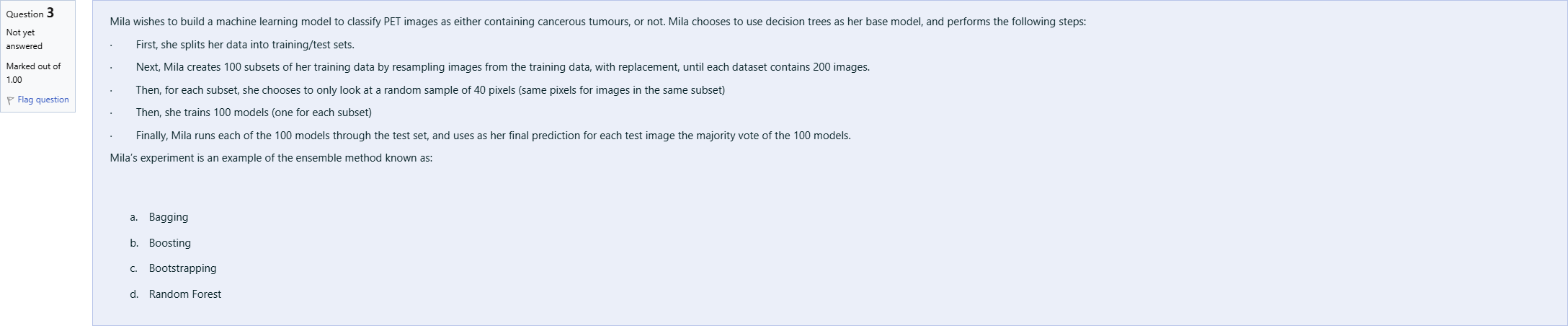
Mila wishes to build a machine learning model to classify PET images as either containing cancerous tumours, or not. Mila chooses to use decision trees as her base model, and performs the following steps: · First, she splits her data into training/test sets. · Next, Mila creates 100 subsets of her training data by resampling images from the training data, with replacement, until each dataset contains 200 images. · Then, for each subset, she chooses to only look at a random sample of 40 pixels (same pixels for images in the same subset) · Then, she trains 100 models (one for each subset) · Finally, Mila runs each of the 100 models through the test set, and uses as her final prediction for each test image the majority vote of the 100 models. Mila’s experiment is an example of the ensemble method known as:
选项
A.a. Bagging
B.b. Boosting
C.c. Bootstrapping
D.d. Random Forest

查看解析
标准答案
Please login to view
思路分析
To understand Mila's setup, consider the key components of ensemble methods in supervised learning.
Option a: Bagging. This is close, because Mila uses bootstrap-like resampling of the training data and trains multiple models. However, in standard bagging, the features (or pixels, in image data) are not deliberately restricted per subset. Here, Mila also selects a random subset of 40 pixe......Login to view full explanation登录即可查看完整答案
我们收录了全球超50000道考试原题与详细解析,现在登录,立即获得答案。
类似问题
Your bank wants to build a system that automatically approves or denies small consumer loans. Analysts have a historical dataset with applicant age, income, marital status, and number of dependents, along with a labeled outcome (“good” vs. “bad” borrower). The team is considering using either a single decision tree or a random forest, and they show you the decision tree diagram below as an example of how the logic works. Which model should the bank choose if they want higher accuracy and more stability in predictions, especially when detecting risky or fraudulent applications?
Mila wishes to build a machine learning model to classify PET images as either containing cancerous tumours, or not. Mila chooses to use decision trees as her base model, and performs the following steps: · First, she splits her data into training/test sets. · Next, Mila creates 100 subsets of her training data by resampling images from the training data, with replacement, until each dataset contains 200 images. · Then, for each subset, she chooses to only look at a random sample of 40 pixels (same pixels for images in the same subset) · Then, she trains 100 models (one for each subset) · Finally, Mila runs each of the 100 models through the test set, and uses as her final prediction for each test image the majority vote of the 100 models. Mila’s experiment is an example of the ensemble method known as:
Mila wishes to build a machine learning model to classify PET images as either containing cancerous tumours, or not. Mila chooses to use decision trees as her base model, and performs the following steps: · First, she splits her data into training/test sets. · Next, Mila creates 100 subsets of her training data by resampling images from the training data, with replacement, until each dataset contains 200 images. · Then, for each subset, she chooses to only look at a random sample of 40 pixels (same pixels for images in the same subset) · Then, she trains 100 models (one for each subset) · Finally, Mila runs each of the 100 models through the test set, and uses as her final prediction for each test image the majority vote of the 100 models. Mila’s experiment is an example of the ensemble method known as:
Mila wishes to build a machine learning model to classify PET images as either containing cancerous tumours, or not. Mila chooses to use decision trees as her base model, and performs the following steps: · First, she splits her data into training/test sets. · Next, Mila creates 100 subsets of her training data by resampling images from the training data, with replacement, until each dataset contains 200 images. · Then, for each subset, she chooses to only look at a random sample of 40 pixels (same pixels for images in the same subset) · Then, she trains 100 models (one for each subset) · Finally, Mila runs each of the 100 models through the test set, and uses as her final prediction for each test image the majority vote of the 100 models. Mila’s experiment is an example of the ensemble method known as:
更多留学生实用工具
希望你的学习变得更简单
加入我们,立即解锁 海量真题 与 独家解析,让复习快人一步!