
题目
STAT0004_25-26 Monday Dec 8th ICA - ALL GROUPS (12:10-12:50)
多项选择题
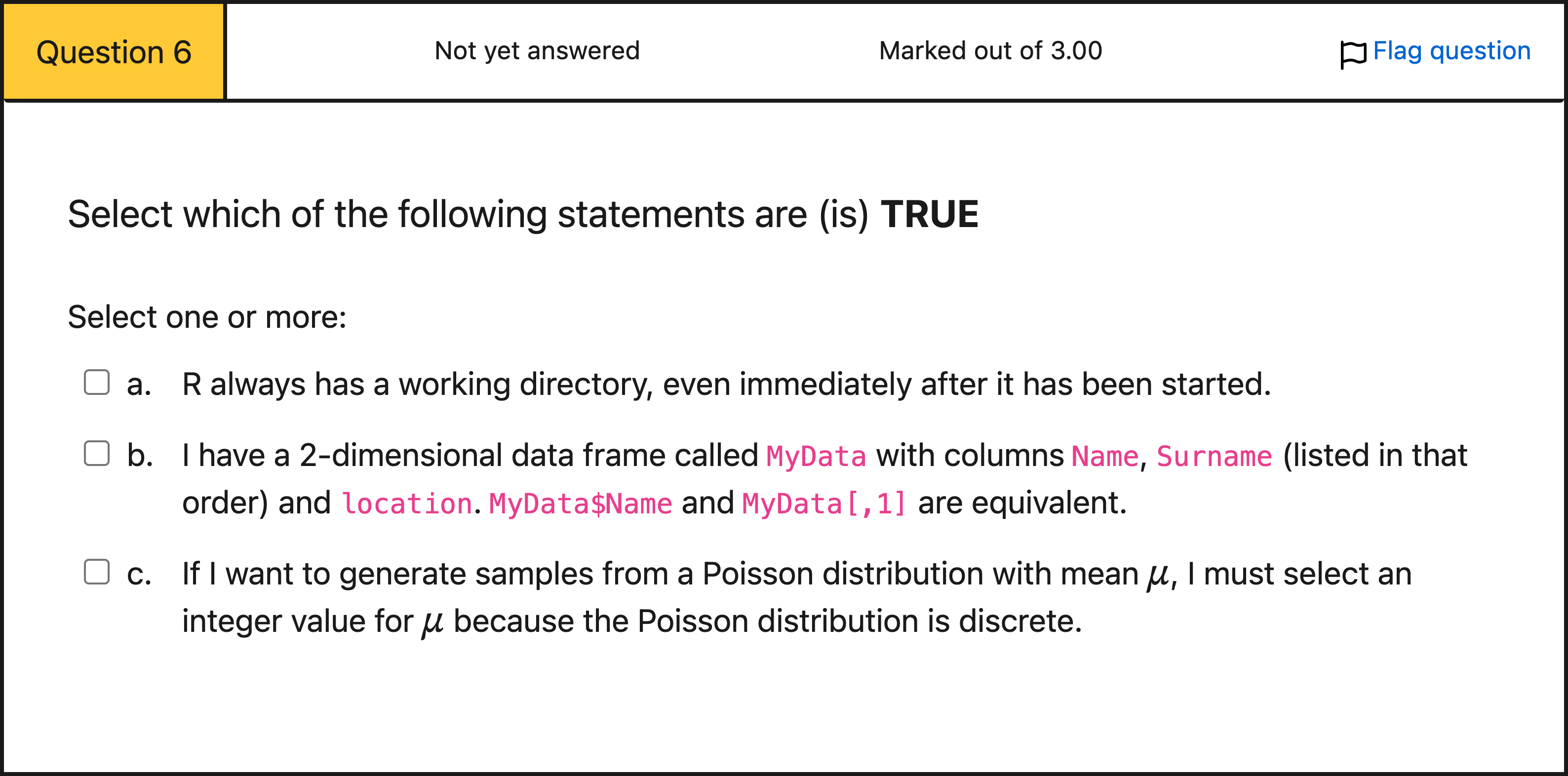
Select which of the following statements are (is) TRUE
选项
A.a. R always has a working directory, even immediately after it has been started.
B.b. I have a 2-dimensional data frame called MyData with columns Name, Surname (listed in that order) and location. MyData$Name and MyData[,1] are equivalent.
C.c. If I want to generate samples from a Poisson distribution with mean [math: μ], I must select an integer value for [math: μ] because the Poisson distribution is discrete.

查看解析
标准答案
Please login to view
思路分析
Reviewing the statements in this question requires evaluating each option on its own merits before deciding which are true.
Option a: 'R always has a working directory, even immediately after it has been started.' In R, a working directory is established when the session starts and remains the current working directory unless you change it with setwd(). Therefore, it is indeed true t......Login to view full explanation登录即可查看完整答案
我们收录了全球超50000道考试原题与详细解析,现在登录,立即获得答案。
类似问题
Suppose you have given a subset of our North American Stock Market dataset in a data frame called compdf. There are all the 50 columns. Similar to our North American Stock Market dataset, gvkey and fyear combination uniquely identifies each observation in compdf. If you execute length(unique(compdf$loc)), you are returned 7. If you execute compdf %>% group_by(gvkey) %>% summarise(count = n()) , all the values under count column are 20. Suppose you executed the following code successfully. df1 <- compdf %>% group_by(loc, fyear) %>% summarise(stat1 = mean(at, na.rm = TRUE), stat2 = max(stat1)) df1 should have [Fill in the blank] rows and 4 columns. If the information provided in the question is not sufficient, please type "not enough information".
Suppose you had a dataset (assigned to data frame object called df). You know that it has 100 observations with a single numerical column called a. All observations for a are equal to 100. You then run the following code: df$b <- df$a df$a <- 0 mean(df$a != df$b) What did R output when the entire code was executed successfully? [Fill in the blank]
Suppose df has 30 rows with 3 numeric columns named d, e, and f. When you executed length(which(df$d >= 5)) the output returned is 20. Then, you executed df <- df %>% mutate(d = if_else(d >= 5, 5, 0)) TRUE/FALSE: When you execute the following line of code, the result returned can be less than 10. length(which(df$d == 0))
Suppose you had a dataset (assigned to data frame object called df). df has 100 observations with a single numerical column called col1. col1 value of each observation is equal to 10. You then run the following code: df$col2 <- df$col1 df$col1 <- 0 mean(df$col2) What did R output when the entire code was executed successfully? [Fill in the blank]
更多留学生实用工具
希望你的学习变得更简单
加入我们,立即解锁 海量真题 与 独家解析,让复习快人一步!