
题目
单项选择题
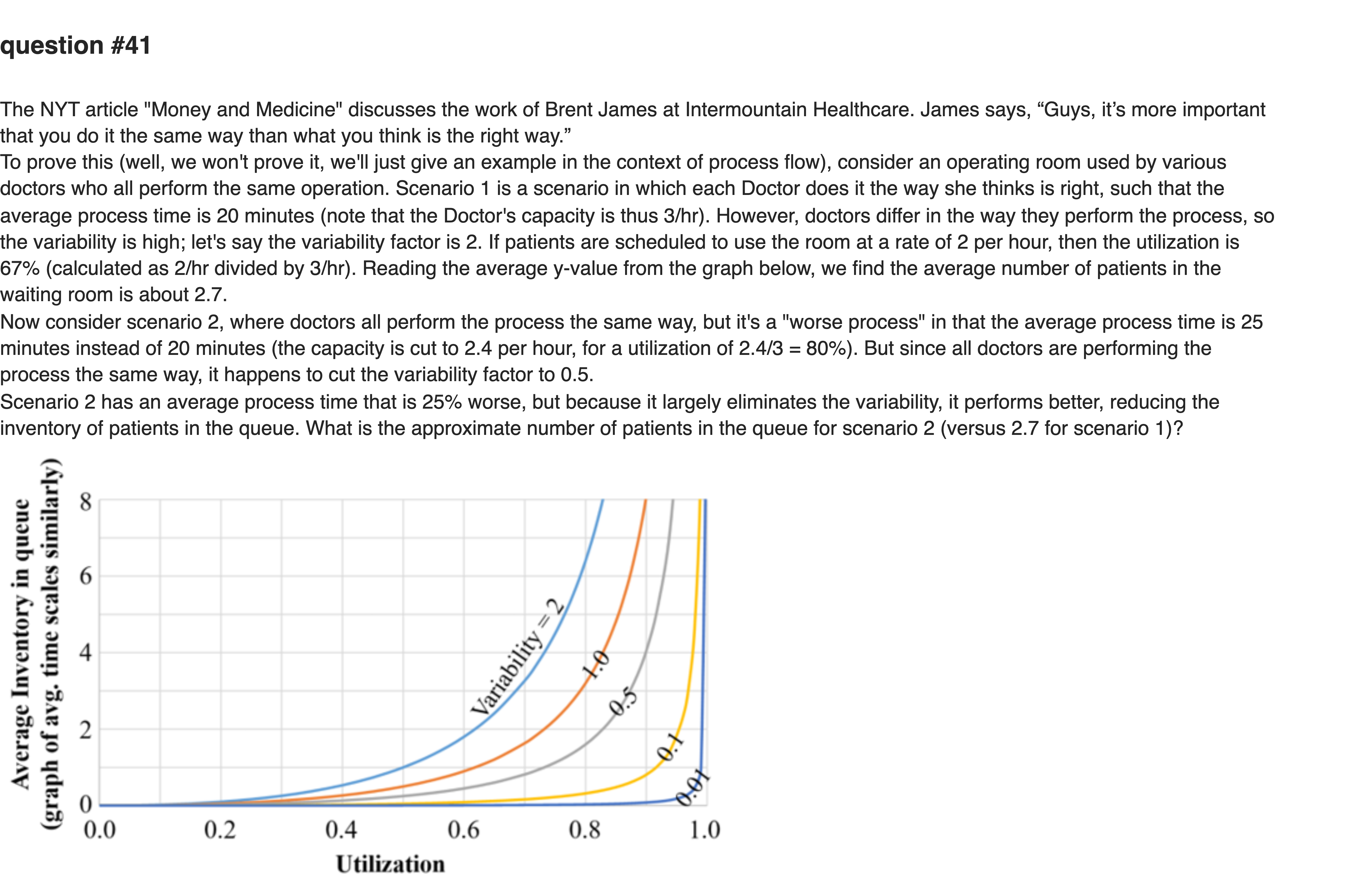
question #41 The NYT article "Money and Medicine" discusses the work of Brent James at Intermountain Healthcare. James says, “Guys, it’s more important that you do it the same way than what you think is the right way.” To prove this (well, we won't prove it, we'll just give an example in the context of process flow), consider an operating room used by various doctors who all perform the same operation. Scenario 1 is a scenario in which each Doctor does it the way she thinks is right, such that the average process time is 20 minutes (note that the Doctor's capacity is thus 3/hr). However, doctors differ in the way they perform the process, so the variability is high; let's say the variability factor is 2. If patients are scheduled to use the room at a rate of 2 per hour, then the utilization is 67% (calculated as 2/hr divided by 3/hr). Reading the average y-value from the graph below, we find the average number of patients in the waiting room is about 2.7. Now consider scenario 2, where doctors all perform the process the same way, but it's a "worse process" in that the average process time is 25 minutes instead of 20 minutes (the capacity is cut to 2.4 per hour, for a utilization of 2.4/3 = 80%). But since all doctors are performing the process the same way, it happens to cut the variability factor to 0.5. Scenario 2 has an average process time that is 25% worse, but because it largely eliminates the variability, it performs better, reducing the inventory of patients in the queue. What is the approximate number of patients in the queue for scenario 2 (versus 2.7 for scenario 1)? quiz41
选项
A.About 1 patient in the queue
B.About 2.5 patients in the queue
C.About 1.6 patients in the queue
D.About 0.3 patients in the queue

查看解析
标准答案
Please login to view
思路分析
Let’s unpack the scenario and compare the two cases by focusing on how utilization and variability shape the average queue length.
Option A: About 1 patient in the queue. This would imply a very small queue despite the given utilization near its high end. However, with utilization around 0.8–0.9 and notable variability in scenario 1, the average queue was already about 2.7. Reducing variability in scenario 2 lowers the queue, but not all the way to just one patient, given the still substantial load and the n......Login to view full explanation登录即可查看完整答案
我们收录了全球超50000道考试原题与详细解析,现在登录,立即获得答案。
类似问题
Question at position 7 Customer priority sequencing allows some customers to be served before others even if they arrived later.TrueFalse
Why does pooling multiple queues typically reduce total average waiting time?
Cont. from previous questions. The market is evaluating an innovative technology that helps reduce the variation in the checkout process (i.e., CVp), 6. Will the adoption of the new technology bring down the average customer waiting time?
Cont. from previous questions. The market is evaluating an innovative technology that helps reduce the variation in the checkout process (i.e., CVp), 5. Will the adoption of the new technology bring down the utilization of the checkout line?
更多留学生实用工具
希望你的学习变得更简单
加入我们,立即解锁 海量真题 与 独家解析,让复习快人一步!