
题目
单项选择题
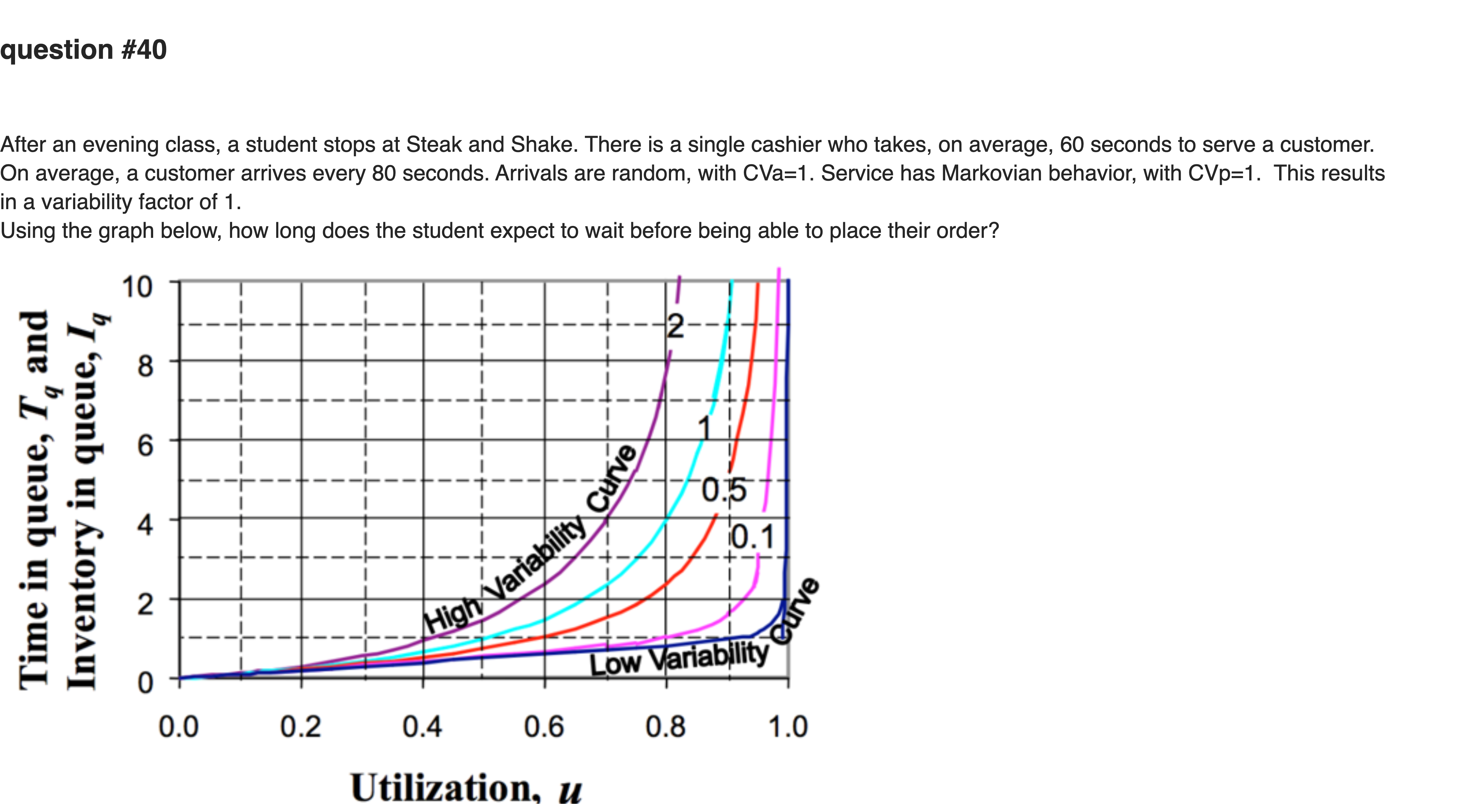
question #40 After an evening class, a student stops at Steak and Shake. There is a single cashier who takes, on average, 60 seconds to serve a customer. On average, a customer arrives every 80 seconds. Arrivals are random, with CVa=1. Service has Markovian behavior, with CVp=1. This results in a variability factor of 1. Using the graph below, how long does the student expect to wait before being able to place their order? quiz40
选项
A.Since utilization is less than 100%, the customer does not expect to wait
B.2 time units
C.1 time unit
D.3 or more time units

查看解析
标准答案
Please login to view
思路分析
To tackle this question, I’ll break down the scenario and compare each choice before pointing to the given answer.
Option 1: 'Since utilization is less than 100%, the customer does not expect to wait.' While ρ = 0.75 (less than 1) means the system is stable and a queue can form, it does not imply there is no waiting. Even with ρ < 1, an arriving customer can experience a waiting time in the queue depending on the traffic intensity and variability. This......Login to view full explanation登录即可查看完整答案
我们收录了全球超50000道考试原题与详细解析,现在登录,立即获得答案。
类似问题
Question at position 7 Customer priority sequencing allows some customers to be served before others even if they arrived later.TrueFalse
Why does pooling multiple queues typically reduce total average waiting time?
Cont. from previous questions. The market is evaluating an innovative technology that helps reduce the variation in the checkout process (i.e., CVp), 6. Will the adoption of the new technology bring down the average customer waiting time?
Cont. from previous questions. The market is evaluating an innovative technology that helps reduce the variation in the checkout process (i.e., CVp), 5. Will the adoption of the new technology bring down the utilization of the checkout line?
更多留学生实用工具
希望你的学习变得更简单
加入我们,立即解锁 海量真题 与 独家解析,让复习快人一步!