
题目
单项选择题
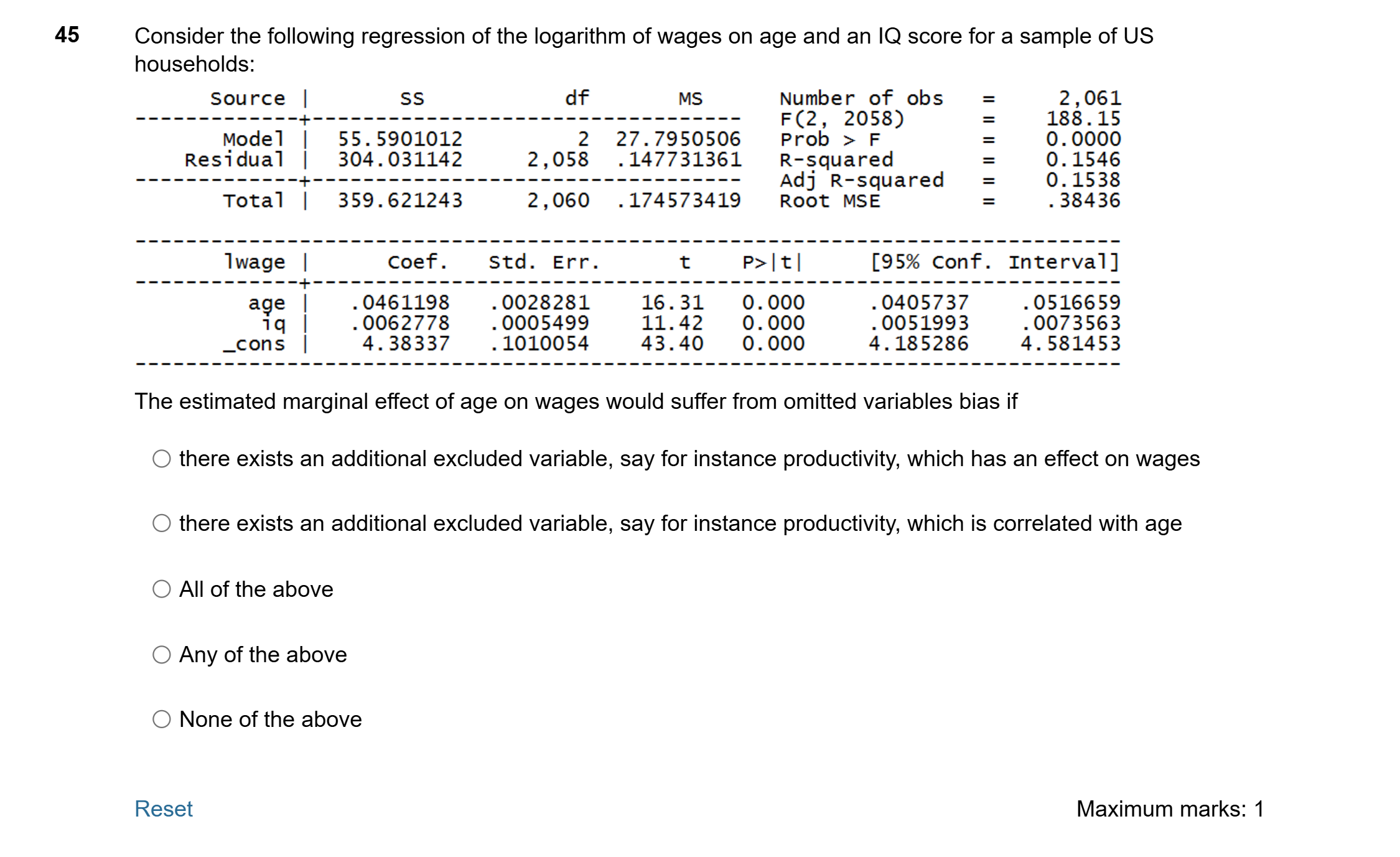
Question45 Consider the following regression of the logarithm of wages on age and an IQ score for a sample of US households: The estimated marginal effect of age on wages would suffer from omitted variables bias if there exists an additional excluded variable, say for instance productivity, which has an effect on wages there exists an additional excluded variable, say for instance productivity, which is correlated with age All of the above Any of the above None of the above ResetMaximum marks: 1 Flag question undefined
选项
A.there exists an additional excluded variable, say for instance productivity, which has an effect on wages
B.there exists an additional excluded variable, say for instance productivity, which is correlated with age
C.All of the above
D.Any of the above
E.None of the above

查看解析
标准答案
Please login to view
思路分析
Question content: Consider the regression of the logarithm of wages on age and an IQ score for a sample of US households. The estimated marginal effect of age on wages would suffer from omitted variables bias if
- there exists an additional excluded variable, say for instance productivity, which has an effect on wages
- there exists an additional excluded variable, say for instance productivity, which is correlated with age
- All of the above
- Any of the above
- None of the above
Option 1: there exists an additional excluded variable, say for instance productivity, which has an effect on wages
This statement describes one essential condition for omitted variable bias: an omitted variable must influence the dependent variable (wages)......Login to view full explanation登录即可查看完整答案
我们收录了全球超50000道考试原题与详细解析,现在登录,立即获得答案。
类似问题
Consider the following general model specification: 𝑌 = 𝑓 ( 𝑋 1 , 𝑋 2 , 𝑋 3 𝑋 4 , 𝑋 5 , 𝑋 6 , 𝑋 7 , 𝑋 8 ) . Where the 9 variables are: Y = Test score of the mid-term exam X1 = Time spent studying for the exam X2 = Degree of course difficulty (measured by an index #) X3 = Class size (number of students) X4 = Experience/knowledge of the teacher X5 = Student’s college experience (college credits previously earned) X6 = Quantity of the student’s outside (non-academic) activities X7 = Level of the student’s determination to succeed (measured by an index #) X8 = Dummy (=1 if the course is face-to-face; 0 otherwise (online)) For each of the 2 cases of omitted variables below, determine the sign (positive/negative) of the bias – you must complete columns 3, 4, and 5 in the table below. Case OM IN 𝛽 𝑂 𝑀 𝛼 1 − ℎ 𝑎 𝑡 BIAS 1 X5 X6 Sign is [ Select ] negative positive Sign is [ Select ] negative positive Bias is [ Select ] negative positive 2 X4 X1 Sign is [ Select ] negative positive Sign is [ Select ] negative positive Bias is [ Select ] negative positive
The bias caused by leaving a variable out of an equation is called
Consider the following specification "situation:" In an equation explaining student GPAs at HUTB, the bias imparted to the coefficient of hours devoted to study (per course) of omitting the number of campus social organizations is
When we regress y on x1, we obtain the following simple regression line: 𝑦 ~ = 𝛽 ~ 0 + 𝛽 ~ 1 𝑥 1 (1). When we regress y on x1 and x2, we obtain the following multiple regression line: 𝑦 ^ = 𝛽 ^ 0 + 𝛽 ^ 1 𝑥 1 + 𝛽 ^ 2 𝑥 2 (2). The relationship between 𝛽 ~ 1 and 𝛽 ^ 1 is: 𝛽 ~ 1 = 𝛽 ^ 1 + 𝛽 ^ 2 𝛿 1 ~ (3), where 𝛿 1 ~ is the slope coefficient of the regression of x2 on x1, 𝑥 ~ 2 = 𝛿 ~ 0 + 𝛿 ~ 1 𝑥 1 (4). Let y = ln(wage), x1 = educ, and x2 = exper, where wage is hourly wage (measured in dollars), educ is years of formal education, and exper is years of labor market experience. Assuming 𝛽 ^ 1 , 𝛽 ^ 2 > 0, which of the following statements is correct?
更多留学生实用工具
希望你的学习变得更简单
加入我们,立即解锁 海量真题 与 独家解析,让复习快人一步!