
题目
单项选择题
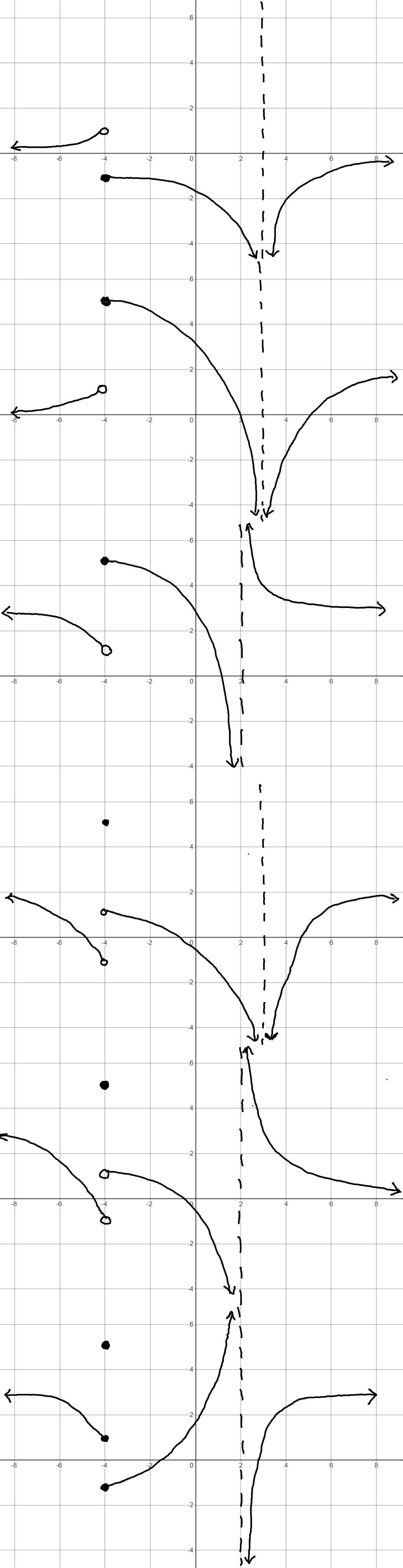
Determine which graph satisfies all of the following conditions: lim 𝑥 ⟶ − 4 − 𝑓 ( 𝑥 ) = − 1 lim 𝑥 ⟶ − 4 + 𝑓 ( 𝑥 ) = 1 lim 𝑥 ⟶ 3 𝑓 ( 𝑥 ) = − ∞ lim 𝑥 ⟶ − ∞ 𝑓 ( 𝑥 ) = 2 lim 𝑥 ⟶ + ∞ 𝑓 ( 𝑥 ) = 2 𝑓 ( − 4 ) = 5
选项
A.
B.
C.
D.
E.
F.

查看解析
标准答案
Please login to view
思路分析
To determine which graph satisfies all given conditions, let's parse each condition and compare it to the features a graph would need to display.
- Condition: lim_{x -> -4^-} f(x) = -1 and lim_{x -> -4^+} f(x) = 1, with f(-4) = 5.
This implies a jump discontinuity at x = -4: the left-hand limit should approach -1, the right-hand limit should approach 1, and there should be a solid point at x = -4 with y = 5 indicating the function value there.
A correct graph must show a vertical gap or jump as x passes -4, with the two one-sided limits approaching the specified values, and ......Login to view full explanation登录即可查看完整答案
我们收录了全球超50000道考试原题与详细解析,现在登录,立即获得答案。
类似问题
Suppose that with a certain phone company, an international long distance phone call from Canada to Brazil costs $0.90 for the first minute (up to and including 60 seconds), plus $0.50 for each additional minute or part of a minute. Note: "Part of a minute" means that if a new minute is started even just by one second, a full minute is charged. For example, a 5 min 1 sec phone call costs the same as a 5 min 50 sec phone call and the same as a 6 min 0 sec phone call. Suppose 𝐶 ( 𝑡 ) is the function that gives the cost of making a 𝑡 minute long phone call. On a piece of paper, sketch a graph showing 𝐶 ( 𝑡 ) (with 𝐶 on the 𝑦 -axis and 𝑡 on the 𝑥 -axis). Then use your graph to evaluate each of the following: (Write DNE for undefined.) 𝐶 ( 2.5 ) = [ Select ] DNE 1.9 1.4 2.4 2.9 𝐶 ( 4 ) = [ Select ] 3.4 1.9 2.9 2.4 DNE lim 𝑥 → 3.1 𝐶 ( 𝑡 ) = [ Select ] 1.9 1.4 2.9 2.4 DNE lim 𝑥 → 4 − 𝐶 ( 𝑡 ) = [ Select ] 2.4 1.4 2.9 1.9 DNE lim 𝑥 → 4 + 𝐶 ( 𝑡 ) = [ Select ] DNE 2.9 2.4 3.4 1.9 lim 𝑥 → 4 𝐶 ( 𝑡 ) = [ Select ] 1.9 2.9 DNE 3.4 2.4
Consider this graph of the function 𝑓 ( 𝑥 ) . Which of the following statements are true and which are false? lim 𝑥 → 3 − 𝑓 ( 𝑥 ) = lim 𝑥 → 3 + 𝑓 ( 𝑥 ) [ Select ] False True lim 𝑥 → 1 𝑓 ( 𝑥 ) = 𝑓 ( 1 ) [ Select ] True False 𝑓 ( 𝑥 ) has a vertical asymptote at 𝑥 = 4 . [ Select ] False True 𝑓 ( 𝑥 ) has a vertical asymptote at 𝑥 = 6 . [ Select ] False True lim 𝑥 → 4 − 𝑓 ( 𝑥 ) = lim 𝑥 → 4 + 𝑓 ( 𝑥 ) [ Select ] False True lim 𝑥 → 4 𝑓 ( 𝑥 ) = ∞ [ Select ] True False lim 𝑥 → 6 𝑓 ( 𝑥 ) = ∞ [ Select ] False True The limit lim 𝑥 → 4 𝑓 ( 𝑥 ) exists, but lim 𝑥 → 6 𝑓 ( 𝑥 ) does not exist. [ Select ] False True
Consider the function 𝑓 ( 𝑥 ) = { 𝑥 2 + 1 𝑖 𝑓 𝑥 < 2 3 𝑖 𝑓 𝑥 = 2 7 − 𝑥 𝑖 𝑓 𝑥 > 2 . We aim to find out if 𝑓 ( 𝑥 ) has a discontinuity at 𝑥 = 2 , and if so, of what type. In order to do that, first find the following information: 𝑓 ( 2 ) = [ Select ] 5 3 2 7 lim 𝑥 ⟶ 2 − 𝑓 ( 𝑥 ) = [ Select ] 7 3 2 5 lim 𝑥 ⟶ 2 + 𝑓 ( 𝑥 ) = [ Select ] 5 7 2 3 Is 𝑓 ( 𝑥 ) continuous or discontinuous at 𝑥 = 2 ? [ Select ] discontinuous continuous If 𝑓 ( 𝑥 ) is discontinuous at 𝑥 = 2 , what type of discontinuity is it? [ Select ] f is continuous An infinite discontinuity A removable discontinuity A jump discontinuity
Consider this graph of the function 𝑓 ( 𝑥 ) . Which of the following statements are true and which are false? lim 𝑥 → 3 − 𝑓 ( 𝑥 ) = lim 𝑥 → 3 + 𝑓 ( 𝑥 ) [ Select ] False True lim 𝑥 → 1 𝑓 ( 𝑥 ) = 𝑓 ( 1 ) [ Select ] False True 𝑓 ( 𝑥 ) has a vertical asymptote at 𝑥 = 4 . [ Select ] True False 𝑓 ( 𝑥 ) has a vertical asymptote at 𝑥 = 6 . [ Select ] False True lim 𝑥 → 4 − 𝑓 ( 𝑥 ) = lim 𝑥 → 4 + 𝑓 ( 𝑥 ) [ Select ] True False lim 𝑥 → 4 𝑓 ( 𝑥 ) = ∞ [ Select ] False True lim 𝑥 → 6 𝑓 ( 𝑥 ) = ∞ False The limit lim 𝑥 → 4 𝑓 ( 𝑥 ) exists, but lim 𝑥 → 6 𝑓 ( 𝑥 ) does not exist. [ Select ] True False
更多留学生实用工具
希望你的学习变得更简单
加入我们,立即解锁 海量真题 与 独家解析,让复习快人一步!