
题目
PHYS 1, Section 001: Science of Phys (22581--HB---P-PHYS----1---------001-) Quiz - Section 1.2
单项选择题
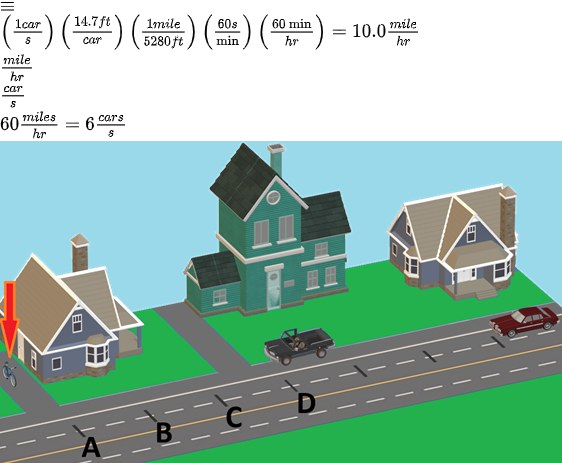
Fun fact: the average car length is 14.7 ft, (15 ft to 2 significant figures.) Just for fun, let 1 car 14.7 feet and convert 1 car/s to miles per hour: That's very convenient. In other words, to convert to , divide by 10, for example, You are in the red car in the figure to the right, traveling 30 miles/hour in a residential neighborhood. Six car lengths in front of you a young boy is on his bicycle, heading to his friend's house across the street. At that moment you get a text message. It takes you 2 seconds to check who it is from (about average - try it after the quiz.) Where is the front of your car when you are no longer distracted?

查看解析
标准答案
Please login to view
思路分析
Before delving into choices, note that the provided data for this question is incomplete: the answer options list contains only "A" and the answer_options field is empty. Without the full set of options to compare, we cannot definitively state which option is correct. What we can do is show how you would approach solving the underlying physics/geometry problem if the visual labels (A, B, C, D) correspond to specific front-rear positions along the street.
First, convert the car’s speed to a consistent unit for distance over time. At 30 miles per hour, the speed in feet per second is 30 miles/hour × 5280 feet/mile ÷ 3600 seconds/hour ≈ 44 feet/second. This gives a usable scale for both......Login to view full explanation登录即可查看完整答案
我们收录了全球超50000道考试原题与详细解析,现在登录,立即获得答案。
类似问题
An automobile of mass 2000 kg moving at 20 m/s is braked suddenly with a constant braking force of 10,000 N. How far does the car travel before stopping?
What is the meaning of subscript i in vi and subscript f in vf?
What is the difference between average and instantaneous velocity?
What is the difference between velocity and acceleration?
更多留学生实用工具
希望你的学习变得更简单
加入我们,立即解锁 海量真题 与 独家解析,让复习快人一步!