
题目
MUF0121 Physics Unit 1 - Semester 2, 2025
单项选择题
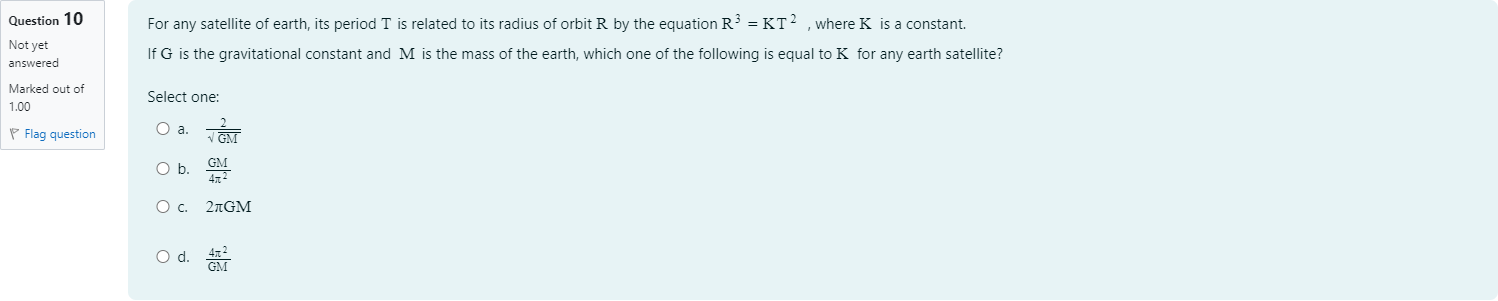
For any satellite of earth, its period [math: T] is related to its radius of orbit [math: R] by the equation [math: R3=KT2] R^{3}=KT^{2} , where [math: K] is a constant. If [math: G] is the gravitational constant and [math: M] is the mass of the earth, which one of the following is equal to [math: K] for any earth satellite?
选项
A.a. [math: 2GM]\frac{2}{\sqrt{GM}}
B.b. [math: GM4π2] \frac{GM}{4\pi^2}
C.c. [math: 2πGM] 2\pi GM \\
D.d. [math: 4π2GM] \frac{4\pi^2}{GM}

查看解析
标准答案
Please login to view
思路分析
We start by recognizing the standard relation for a satellite in orbit: T^2 is proportional to R^3, with the proportionality constant involving G and M. The problem states R^3 = K T^2, so K must be the factor that converts T^2 to R^3.
First, recall the classical formula for orbital motion in a gravitational field: T^2 = ......Login to view full explanation登录即可查看完整答案
我们收录了全球超50000道考试原题与详细解析,现在登录,立即获得答案。
类似问题
By using either the Doppler or Transit methods, you can determine the orbital period of the planet. Using just that information, what else can you determine about the planet? (Hint: think Kepler's laws).
A planet in our solar system whose orbital semi-major axis is larger than that of the Earth's will have an orbital period, compared to the Earth, which is
Kepler's third law states that the square of the orbital period of a planet is proportional to
How do Astronomers measure the mass of the Sun (about 2x1030kg!)?
更多留学生实用工具
希望你的学习变得更简单
加入我们,立即解锁 海量真题 与 独家解析,让复习快人一步!