
题目
BFC3240 - S2 2025 Mock Exam
多项选择题
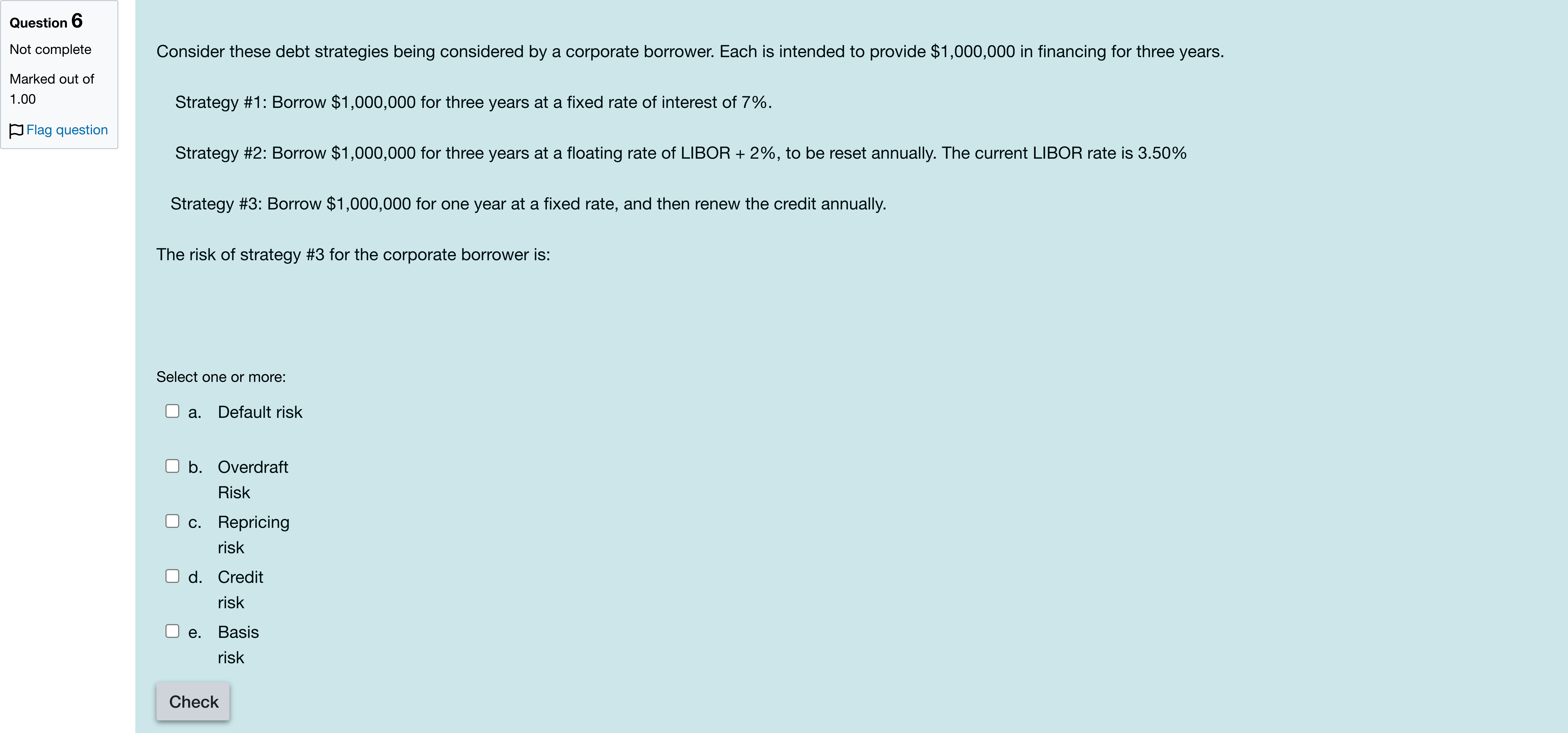
Consider these debt strategies being considered by a corporate borrower. Each is intended to provide $1,000,000 in financing for three years. Strategy #1: Borrow $1,000,000 for three years at a fixed rate of interest of 7%. Strategy #2: Borrow $1,000,000 for three years at a floating rate of LIBOR + 2%, to be reset annually. The current LIBOR rate is 3.50% Strategy #3: Borrow $1,000,000 for one year at a fixed rate, and then renew the credit annually. The risk of strategy #3 for the corporate borrower is:
选项
A.a. Default risk
B.b. Overdraft Risk
C.c. Repricing risk
D.d. Credit risk
E.e. Basis risk

查看解析
标准答案
Please login to view
思路分析
The prompt asks us to evaluate the risks associated with Strategy #3 from the perspective of the corporate borrower, and then to pick all applicable risks from the list.
Option a. Default risk: This is the risk that the borrower will fail to repay. While default risk is always a consideration for any financing, Strategy #3’s main distinctive risk is not the default risk inherent in the agreement itself, but rather how the financing burden might be affected by future renewal terms. In other words, the question targets risks that are specifically ass......Login to view full explanation登录即可查看完整答案
我们收录了全球超50000道考试原题与详细解析,现在登录,立即获得答案。
类似问题
Suppose you were in charge of prudential regulation and encountered this bank: Assets Liabilities Loans to SMEs $ 60 Retail Deposits $40 T-bills $30 Seven-year long-term bonds: $40 Cash $10 Equity Paid in capital: $5 Retained earnings: $15 The loans, bonds and deposits are all floating rate. The bank pays fixed for seven years on a interest rate swap with a notional of $40 to secure its funding costs. What would you tell the bank?
The repricing gap model has significant limitations including all of the following EXCEPT:
A bank has $500 millionin rate-sensitive assetsand, 400million in rate-sensitive liabilities within a one-year time horizon. If interest rates increase by 1.5% (150 basis points), what is the predicted change in annual net interest income?
Question3 Which of the following statements is FALSE? Select one alternative: a. For a typical depository institution, interest rate risk can be minimised if duration of assets is always maintained above the leverage adjusted duration of the liabilities. b. Immunisation requires portfolio rebalancing when interest rates move. c. Measurement of an FI's interest rate risk is rendered inaccurate due to the presence of off-balance sheet assets and liabilities. d. Duration model estimates the change in market value of an FI when interest rate changes. e. A manager should consider the cost of restructuring the balance sheet before deciding to immunise the interest rate risk sensitivity gap of the FI. ResetMaximum marks: 2 Flag question undefined
更多留学生实用工具
希望你的学习变得更简单
加入我们,立即解锁 海量真题 与 独家解析,让复习快人一步!