
题目
AVBS2001 (ND) Prep for Microscopy Prac 2 in week 3 (1%): Disorders of Growth and Circulatory
多重下拉选择题
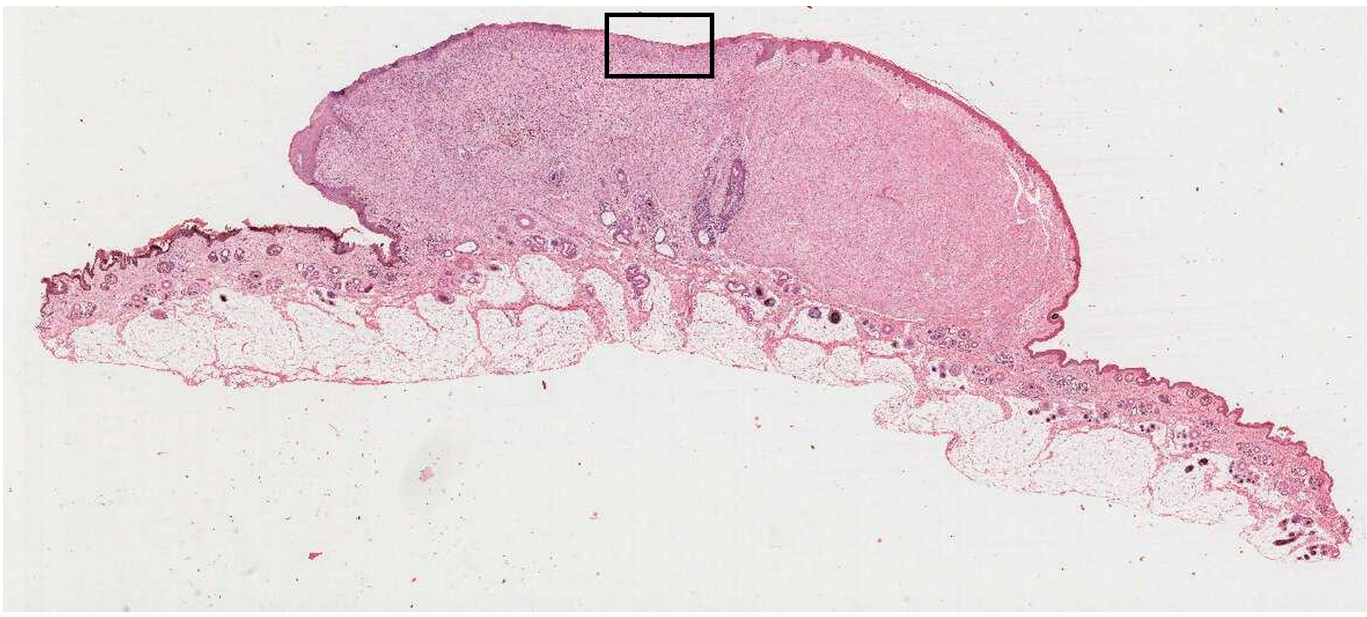
In one area, there is a raised, dome-like lesion. The mass is well demarcated and doesn’t extend into the subcutis. The lesion is covered by a thin layer of epidermis, which has become ulcerated and shows superficial infiltration by individual round cells with a lobulated nucleus (neutrophils) and plump spindle-shaped mesenchymal cells (likely fibroblasts and vascular endothelial cells in repair). Label the features: A: Mesenchymal cells (fibroblasts or endothelial cells) , B: Neutrophils , C: Collagen Fibres

查看解析
标准答案
Please login to view
思路分析
The task asks us to label the features A, B, and C on the histology image based on what is visible in the lesion.
Option A: Mesenchymal cells (fibroblasts or endothelial cells)
- In a healing or repair setting, mesenchymal cells such as fibroblasts and vascular endothelial cells are prominent components of granulation tissue. They appear as spindle-shaped cells within the connective tissue and are responsible for laying down new extracellular matrix and forming new blood vessels. In the image, the presence of plum......Login to view full explanation登录即可查看完整答案
我们收录了全球超50000道考试原题与详细解析,现在登录,立即获得答案。
类似问题
Question at position 20 Which one of the following requires magnification to study? Histology Regional anatomy Gross anatomy Surface anatomy
In the colon, the muscularis externa is primarily composed of Blank 1 Question 17[select: , skeletal muscle, smooth muscle, dense connective tissue, lamina propria] , while the mucosal epithelium consists of Blank 2 Question 17[select: , stratified cuboidal, simple squamous, simple columnar, stratified squamous] cells.
The best place to view the primary pathological process in action is generally on the edge of the lesion- in the middle it will often be confused by secondary changes, such as necrosis and haemorrhage. Normal lung to left of image. On right note infiltration of alveolar spaces by cells. Note different sizes and shapes of cells (pleiomorphism), some binucleated cells, some joined and others not (degrees of de-differentiation) Name the labels for the section below: A: Alveolar wall , B: Cells forming a line , C: Cells within alveolar spaces .
Name the endocrine organ featured in this micrograph (histological image)
更多留学生实用工具
希望你的学习变得更简单
加入我们,立即解锁 海量真题 与 独家解析,让复习快人一步!