
题目
BIO 181 (001&002) FALL 2025 FA25: Cumulative Exam 4 covers the most important content from Units 1-4: You can do this!!! : ) [Grade is out of 150/900 pts, the same am't of pts for the active learning "easy points" classwork.]
单项选择题
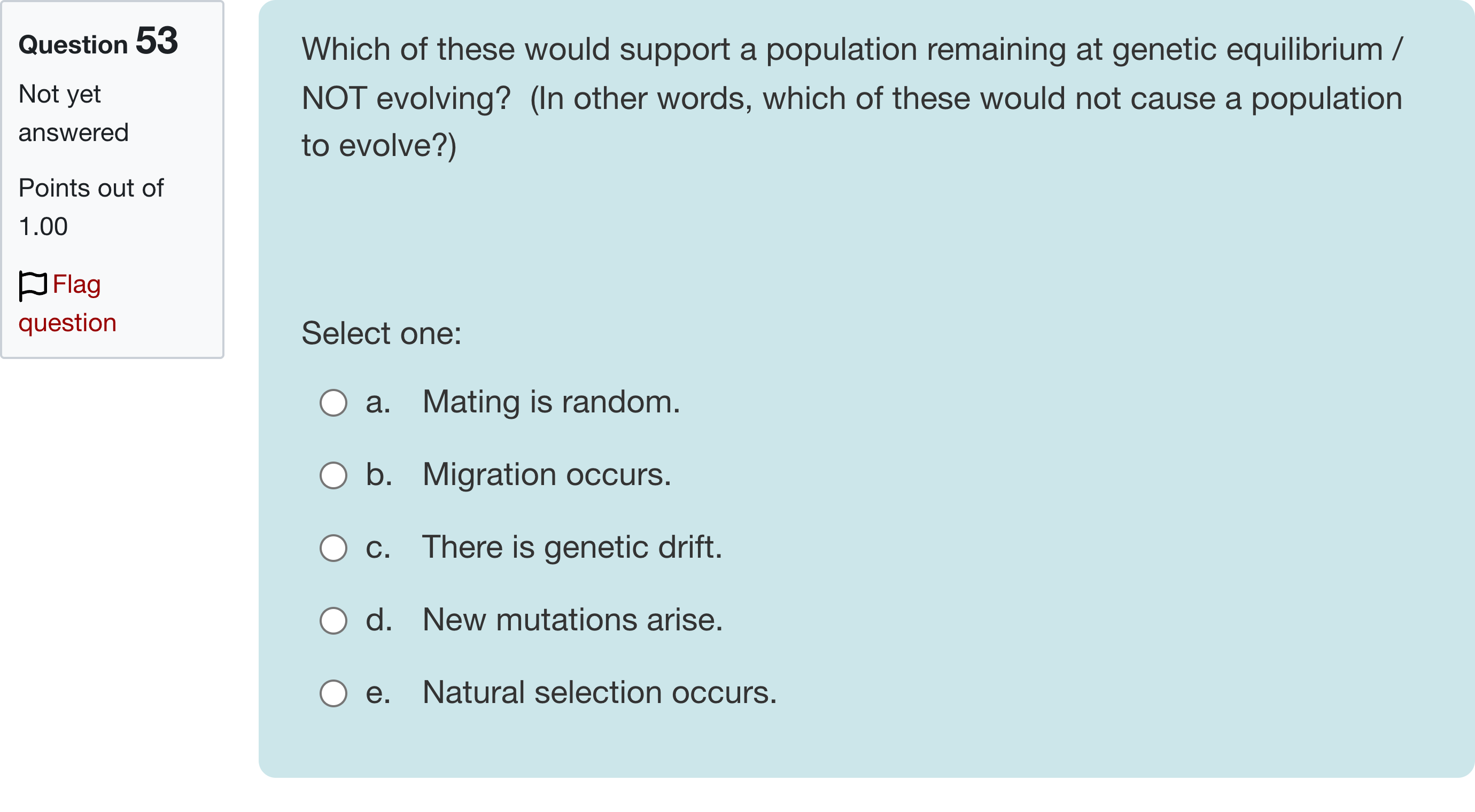
Which of these would support a population remaining at genetic equilibrium / NOT evolving? (In other words, which of these would not cause a population to evolve?)
选项
A.a. Mating is random.
B.b. Migration occurs.
C.c. There is genetic drift.
D.d. New mutations arise.
E.e. Natural selection occurs.

查看解析
标准答案
Please login to view
思路分析
Question restatement: Which of these would support a population remaining at genetic equilibrium / NOT evolving? (In other words, which of these would not cause a population to evolve?)
Option a: Mating is random. When mating is random, allele combinations are produced in the same proportions each generation, assuming other conditions of the Hardy-Weinberg equilibrium are m......Login to view full explanation登录即可查看完整答案
我们收录了全球超50000道考试原题与详细解析,现在登录,立即获得答案。
类似问题
You are researching a population of 100 cows, where 91 of them are grey and 9 are black. You know that black colour is a recessive trait for this type of cow. Using the Hardy-Weinberg Equilibrium equation (p2 + 2pq + q2 = 1), what number would be heterozygous?
Assuming the population is in Hardy-Weinberg equilibrium, if 16% of the individuals in a population show a recessive trait (q2=16%), what is the allelic frequency for the dominant allele?
What occurs to allele frequencies when a population is at Hardy-Weinberg equilibrium?
What would disrupt the conditions required for Hardy-Weinberg equilibrium?
更多留学生实用工具
希望你的学习变得更简单
加入我们,立即解锁 海量真题 与 独家解析,让复习快人一步!