
题目
单项选择题
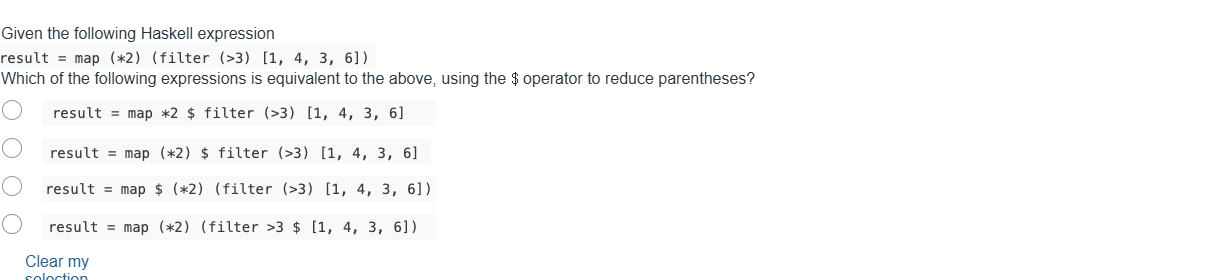
Question at position 11 Given the following Haskell expression Which of the following expressions is equivalent to the above, using the $ operator to reduce parentheses? Clear my selection
选项
A.
B.
C.
D.

查看解析
标准答案
Please login to view
思路分析
We start by restating the question and the available answer forms to compare them clearly.
Question: Given the Haskell expression result = map (*2) $ filter (>3) [1, 4, 3, 6], which of the following expressions is equivalent to the above, using the $ operator to reduce parentheses?
Answer options:
- Option A: result = map *2 $ filter (>3) [1, 4, 3, 6]
- Option B: result = map (*2) $ filter (>3) [1, 4, 3, 6]
- Option C: result = map $ (*2) (filter (>3) [1, 4, 3, 6])
- Option D: result = map (*2) (filter >3) [1, 4, 3, 6]
Optio......Login to view full explanation登录即可查看完整答案
我们收录了全球超50000道考试原题与详细解析,现在登录,立即获得答案。
类似问题
Which of the following statements about functional programming is incorrect? Choices: Functional programming emphasizes the use of pure functions and immutability. In functional programming, side effects are a fundamental part of function execution. Functional programming often uses higher-order functions and recursion. Functional programming emphasizes function composition as a key technique for building complex operations from simpler ones.
Question at position 7 Given the following Haskell function: Which one of the following expressions correctly applies increment to a value of type Maybe Int? Clear my selection
Question at position 3 A programming language must have static typing to support functional programming.TrueFalse
"You cannot use iteration constructs (for, while, do-while) in a purely functional programming language. (ex: Haskell)" True or False?
更多留学生实用工具
希望你的学习变得更简单
加入我们,立即解锁 海量真题 与 独家解析,让复习快人一步!