
题目
MCD4420 - T3 - 2025 Lab 2 In-Class Post-Lab Quiz
单项选择题
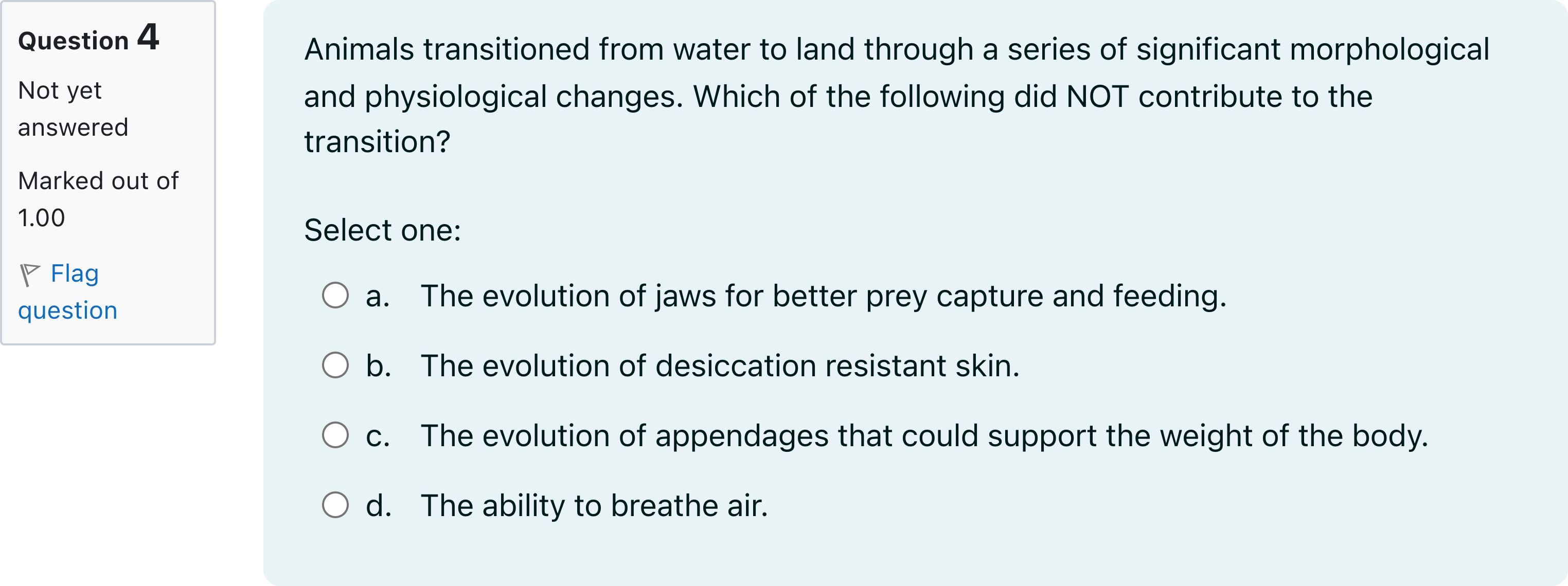
Animals transitioned from water to land through a series of significant morphological and physiological changes. Which of the following did NOT contribute to the transition?
选项
A.a. The evolution of jaws for better prey capture and feeding.
B.b. The evolution of desiccation resistant skin.
C.c. The evolution of appendages that could support the weight of the body.
D.d. The ability to breathe air.

查看解析
标准答案
Please login to view
思路分析
To analyze the question, we first restate what is being asked and list all answer options clearly.
Question: Animals transitioned from water to land through a series of significant morphological and physiological changes. Which of the following did NOT contribute to the transition?
Options:
- a. The evolution of jaws for better prey capture and feeding.
- b. The evolution of desiccation resistant skin.
- c. The evolution of appendages that could support the weight of the body.
- d. The ability to breathe air.
Now, evaluate each option one by one to see whether it would have contributed to the water-to-land transition.
Option ......Login to view full explanation登录即可查看完整答案
我们收录了全球超50000道考试原题与详细解析,现在登录,立即获得答案。
类似问题
Humans are descended from chimpanzees.
Choose the best answer.One way species evolve is by...
Our ancestors had much bigger jaws than we do, which helped them chew a tough diet, tear apart meat, etc. Their teeth also wore down quickly. Wisdom teeth (third molars) grew later in life, and helped our ancestors continue to eat. Today, ~35% of people are born without wisdom teeth. This is an example of:
Please note that spelling matters for this answer.One word answer only: The unit of evolution (what evolves) is the ___.
更多留学生实用工具
希望你的学习变得更简单
加入我们,立即解锁 海量真题 与 独家解析,让复习快人一步!