
题目
单项选择题
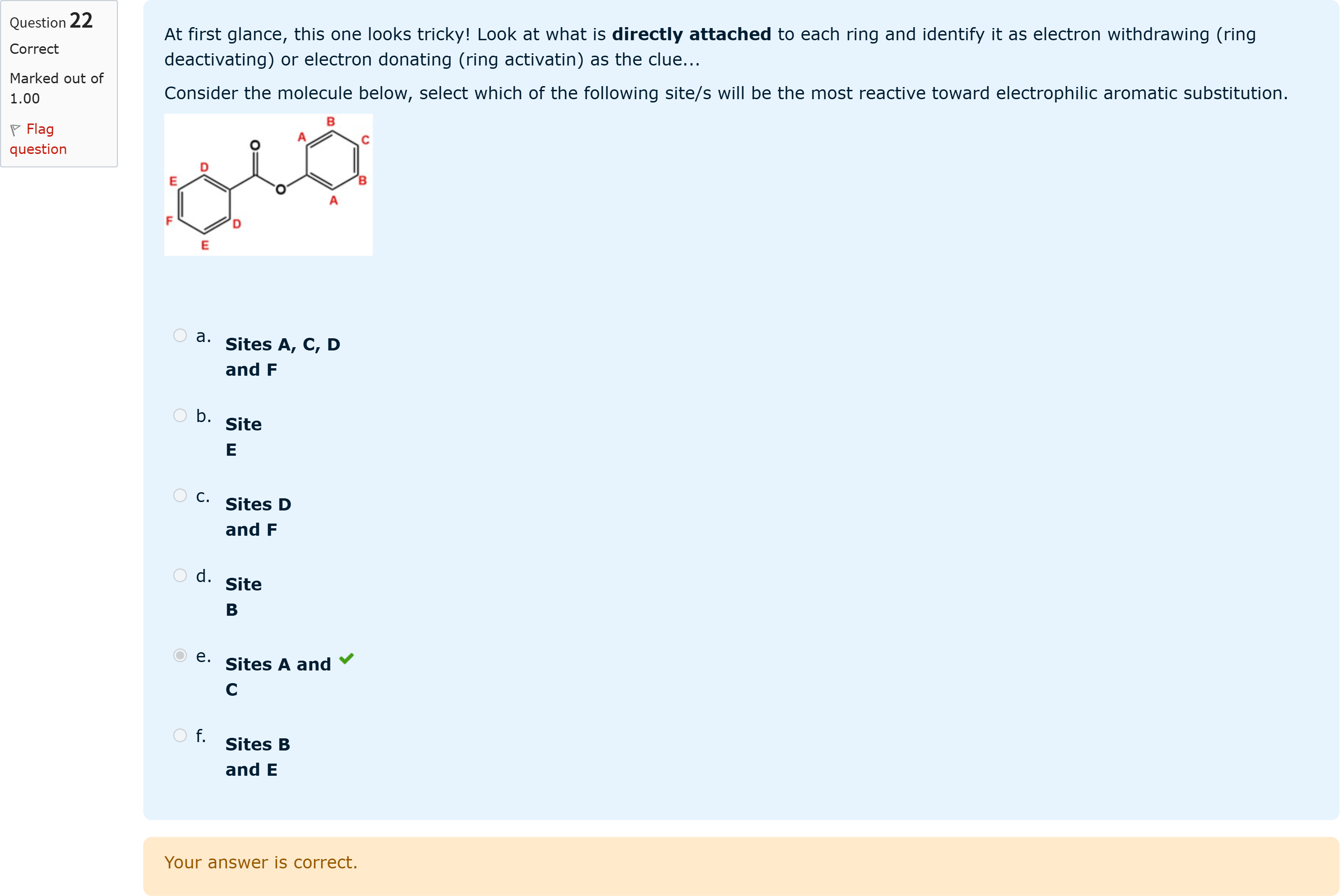
At first glance, this one looks tricky! Look at what is directly attached to each ring and identify it as electron withdrawing (ring deactivating) or electron donating (ring activatin) as the clue...Consider the molecule below, select which of the following site/s will be the most reactive toward electrophilic aromatic substitution.

查看解析
标准答案
Please login to view
思路分析
To approach this question, we first identify the guiding principle: in electrophilic aromatic substitution (EAS), the site reactivity is governed by the local electron density, which is influenced by substituents attached to the ring. Electron-donating groups (EDGs) increase electron density via resonance or inductive effects and activate positions ortho and para to the substituent; electron-withdrawing groups (EWGs) decrease electron density and deactivate those positions.
Option a: Sites A, C, D and F. If this option claimed all four positions A, C, D, and F are activated, we would need to assess each site individually. Typically, only those positions that lie ortho/para to an EDG will be activated relative to competing positions, while positions that are adjacent to EWGs or involved in steric congestion may be less reactive. If D or F are adjacent to a withdrawing group (like a carbonyl or ester linkage)......Login to view full explanation登录即可查看完整答案
我们收录了全球超50000道考试原题与详细解析,现在登录,立即获得答案。
类似问题
Recognising how resonance contribtutes to the arrangement of charge around a ring helps to understand the reactivity of a substituted benzene.Consider the resonance contributors of the following compoundAccording to resonance, is the ring: activated or deactivated to electrophilic substitution. And which site/s are the most susceptible to substitution?
Which of the following, will provide a meta, nitro (NO2) compound, upon nitration with HNO3/H2SO4?
At first glance, this one looks tricky! Look at what is directly attached to each ring and identify it as electron withdrawing (ring deactivating) or electron donating (ring activatin) as the clue...Consider the molecule below, select which of the following site/s will be the most reactive toward electrophilic aromatic substitution.
Recognising how resonance contribtutes to the arrangement of charge around a ring helps to understand the reactivity of a substituted benzene.Consider the resonance contributors of the following compoundAccording to resonance, is the ring: activated or deactivated to electrophilic substitution. And which site/s are the most susceptible to substitution?
更多留学生实用工具
希望你的学习变得更简单
加入我们,立即解锁 海量真题 与 独家解析,让复习快人一步!