
题目
单项选择题
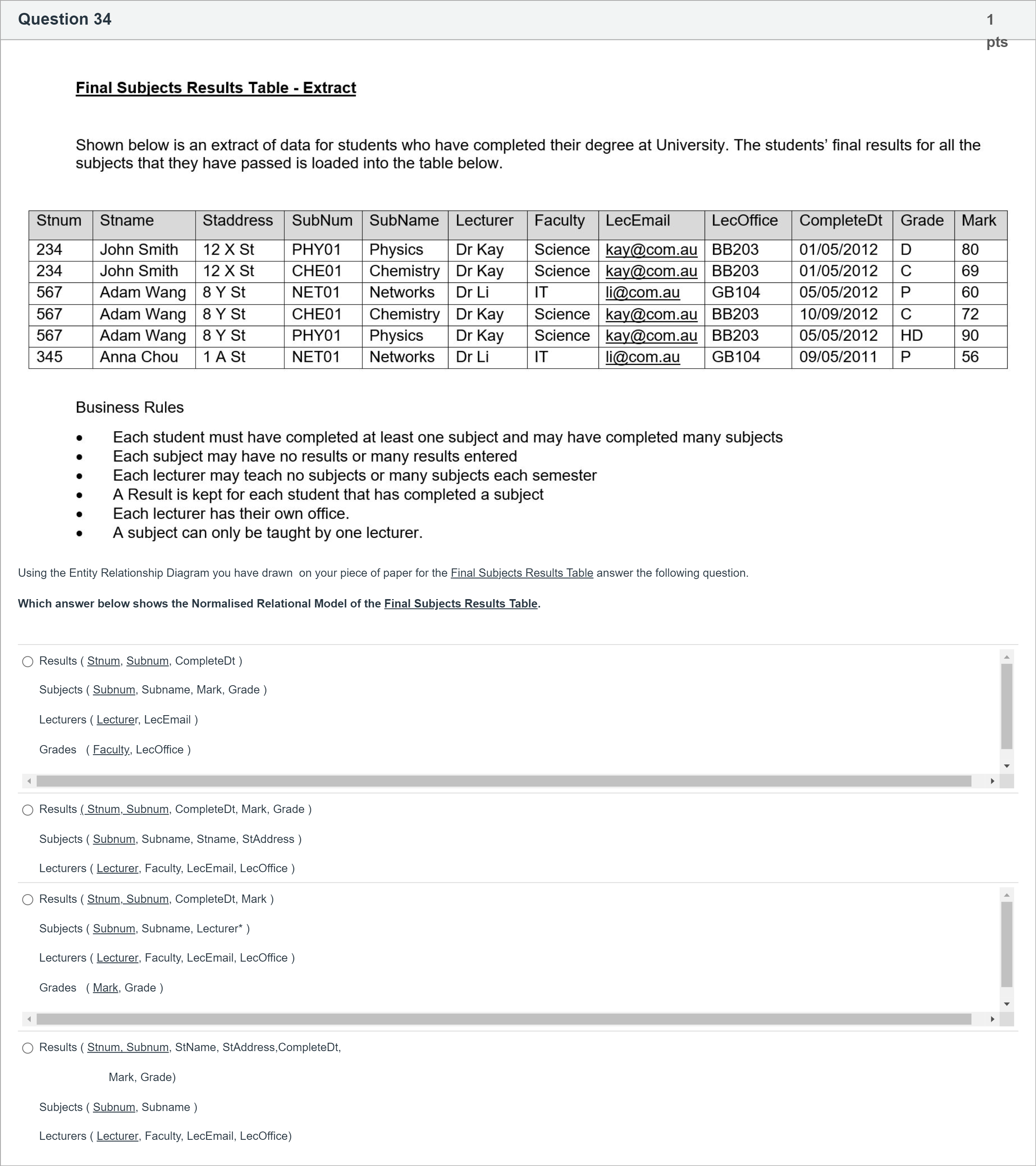
Using the Entity Relationship Diagram you have drawn on your piece of paper for the Final Subjects Results Table answer the following question. Which answer below shows the Normalised Relational Model of the Final Subjects Results Table.
选项
A.Results ( Stnum, Subnum, CompleteDt )
Subjects ( Subnum, Subname, Mark, Grade )
Lecturers ( Lecturer, LecEmail )
Grades ( Faculty, LecOffice )
Students ( Stnum, StName, StAddress )
B.Results ( Stnum, Subnum, CompleteDt, Mark, Grade )
Subjects ( Subnum, Subname, Stname, StAddress )
Lecturers ( Lecturer, Faculty, LecEmail, LecOffice )
C.Results ( Stnum, Subnum, CompleteDt, Mark )
Subjects ( Subnum, Subname, Lecturer* )
Lecturers ( Lecturer, Faculty, LecEmail, LecOffice )
Grades ( Mark, Grade )
Students ( Stnum, StName, StAddress )
D.Results ( Stnum, Subnum, StName, StAddress,CompleteDt,
Mark, Grade)
Subjects ( Subnum, Subname )
Lecturers ( Lecturer, Faculty, LecEmail, LecOffice)

查看解析
标准答案
Please login to view
思路分析
To approach this question, I start by identifying the key entities and their relationships implied by the Final Subjects Results data: students, subjects, lecturers, and the results of students taking subjects, along with marking information.
Option 1: The tables shown place Mark and Grade inside the Subjects table (Subjects (Subnum, Subname, Mark, Grade)) and keep Results only with Stnum, Subnum, CompleteDt. This is problematic because marks/grades are results of a student’s submission, not intrinsic to the subject itself. Storing Mark in Subjects violates normalization by mixing a per-student result with a subject definition. Additionally, Lecturer details are split into a minimal set (Lecturers with Lecturer and LecEmail), which los......Login to view full explanation登录即可查看完整答案
我们收录了全球超50000道考试原题与详细解析,现在登录,立即获得答案。
类似问题
What would be the best normalised relational model for the Entity E? Entity: E (A, B, C, D) Functional Dependencies : A, B → C, D C → B
What is the highest Normal Form of the following table? Each Girl can grow more than one Flower and lives at one Address.
What is the highest Normal Form of the following table? Each Owner can own one or more PetTypes. Each PetType may have one or more Owners. Each Owner has one Address and one Phone Number
What is the highest Normal Form of the following table? Table: Products ( Pnum, Factory , Cost, On_Hand, Colour ) Business rules state that:- No colour is produced by more than one factory and A factory can produce more than one colour. Functional Dependencies Pnum, Factory → Cost, On_Hand, Colour Colour → Factory
更多留学生实用工具
希望你的学习变得更简单
加入我们,立即解锁 海量真题 与 独家解析,让复习快人一步!