
题目
CCST9086_1A_2025 Quiz7
单项选择题
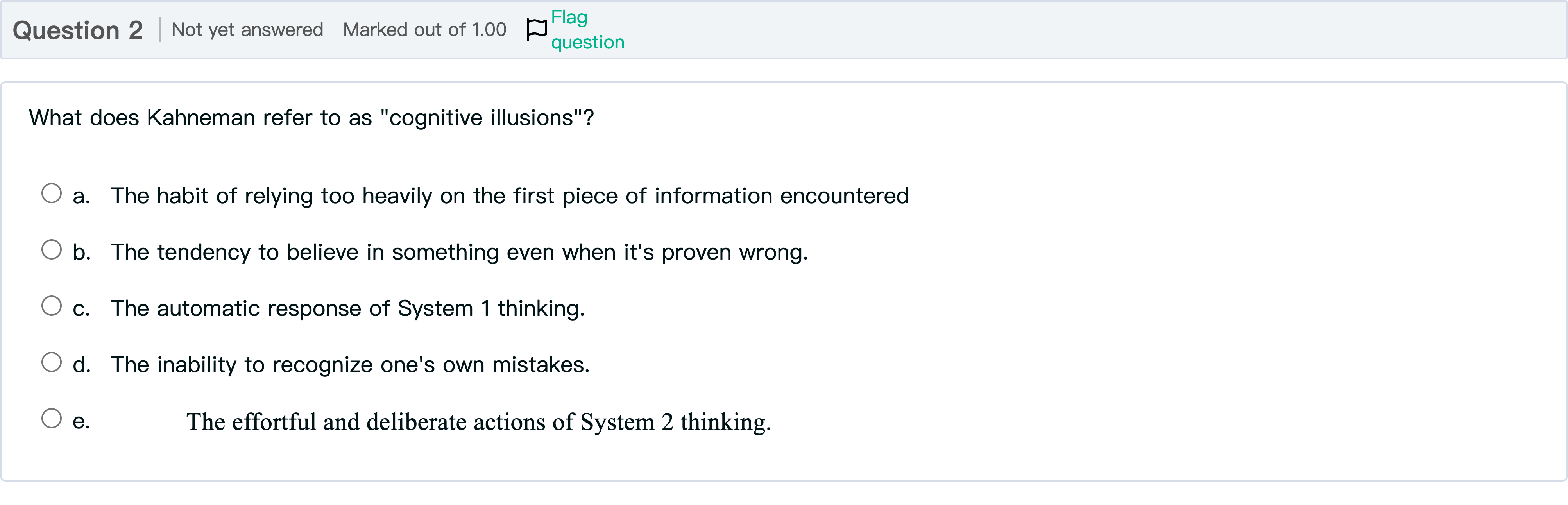
What does Kahneman refer to as "cognitive illusions"?
选项
A.a. The habit of relying too heavily on the first piece of information encountered
B.b. The tendency to believe in something even when it's proven wrong.
C.c. The automatic response of System 1 thinking.
D.d. The inability to recognize one's own mistakes.
E.e. The effortful and deliberate actions of System 2 thinking.

查看解析
标准答案
Please login to view
思路分析
To tackle this question, I will evaluate what Kahneman means by cognitive illusions and how each option aligns with that concept.
Option a: The habit of relying too heavily on the first piece of information encountered. This describes the anchoring effect, a well-known cognitive bias, but it is not the broad definition Kahneman uses for cognitive illusions. So this is related yet not the general term for cognitive......Login to view full explanation登录即可查看完整答案
我们收录了全球超50000道考试原题与详细解析,现在登录,立即获得答案。
类似问题
The opposite of the “halo effect” is:
Question at position 60 Many smokers like to associate themselves to the late George Burns, a famous actor who smoked cigars continuously for many years and lived to be nearly a hundred, as evidence that smoking is relatively harmless. These individuals tend to ignore the thousands of people who die every year from lung cancer. They are illustratinghindsight bias.confirmation bias.the representativeness heuristic.the availability heuristic.
Belicia chooses a designated driver to drive her home whenever she goes out for a party. She believes that this virtue of hers is exceptional and that no one else is as precautious as she is. This scenario best exemplifies
Which statement is correct?
更多留学生实用工具
希望你的学习变得更简单
加入我们,立即解锁 海量真题 与 独家解析,让复习快人一步!