
题目
生物学 1001 (001-013) 第24课学习测验
多重下拉选择题
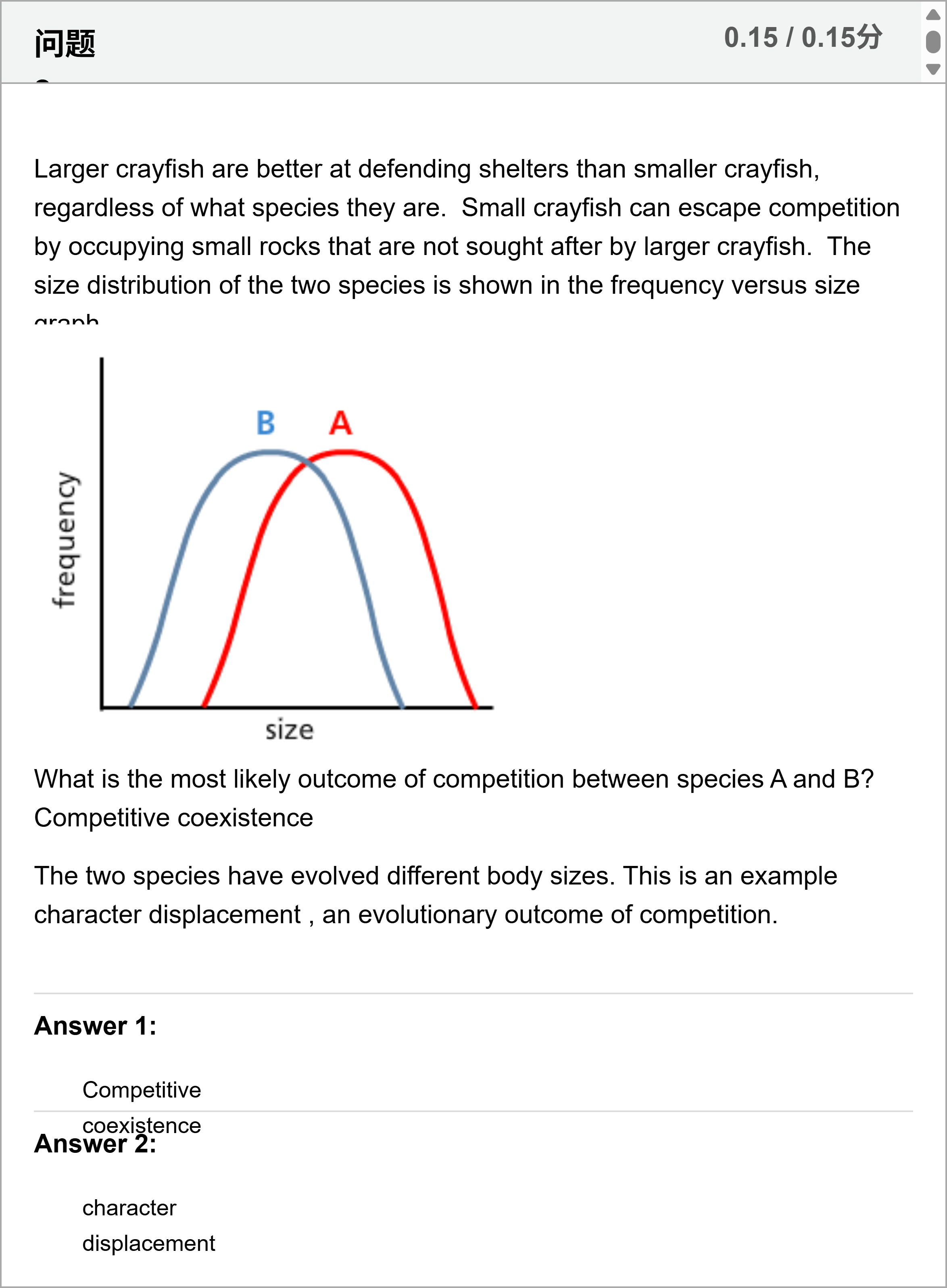
Larger crayfish are better at defending shelters than smaller crayfish, regardless of what species they are. Small crayfish can escape competition by occupying small rocks that are not sought after by larger crayfish. The size distribution of the two species is shown in the frequency versus size graph. What is the most likely outcome of competition between species A and B? Competitive coexistence The two species have evolved different body sizes. This is an example character displacement , an evolutionary outcome of competition.

查看解析
标准答案
Please login to view
思路分析
The question describes two crayfish species with size-based distribution and a graph showing their size frequencies, along with a statement that larger individuals defend shelters better and smaller ones escape competition by occupying smaller rocks. This sets up a scenario about competition and its ecological or evolutionary consequences.
Option 1: Competitive coexistence
- In ecology, competitive coexistence occurs when two species share a habitat but use different resources or occupy different niches in a way that allows them to persist together over time.
- The descr......Login to view full explanation登录即可查看完整答案
我们收录了全球超50000道考试原题与详细解析,现在登录,立即获得答案。
类似问题
Where species with overlapping niches compete, then can diversify through the process of ________ _________, resulting in niche diversification and co-existence (answer is two words)
CHOOSE THE BEST ANSWERS In regions where bobcats and lynx do not co-occur, the two species have similar-sized teeth and catch similar-sized prey. In regions where the two species do co-occur, lynx have much longer teeth and capture larger prey than bobcats. Differences in tooth size between lynx and bobcats that co-occur is an example of [ Select ] Competitive exclusion Competitive interference Competitive exploitation Character displacement , which is an evolutionary outcome of [ Select ] predation competition commensalism mutualism .
Geospiza fortis is a seed-eating finch that lives on Daphne Major, a small island in the Galápagos archipelago. Geospiza fuliginosa is a second species of seed-eating finch found in the Galápagos islands, and this species occurs together with G. fortis on a larger island called Santa Cruz. The graphs below show the distribution of beak sizes of G. fortis when it co-occurs with G. fuliginosa vs. when it occurs alone. Based only on these data, you can conclude that (select all that apply).
On the Galapagos Islands, two species of finches display a character displacement when they occur as sympatric species. Which of the statements correctly interprets the species over time when they are found sympatrically?
更多留学生实用工具
希望你的学习变得更简单
加入我们,立即解锁 海量真题 与 独家解析,让复习快人一步!