
题目
RSM470H1 F LEC0101 In-Class Exercise 10
单项选择题
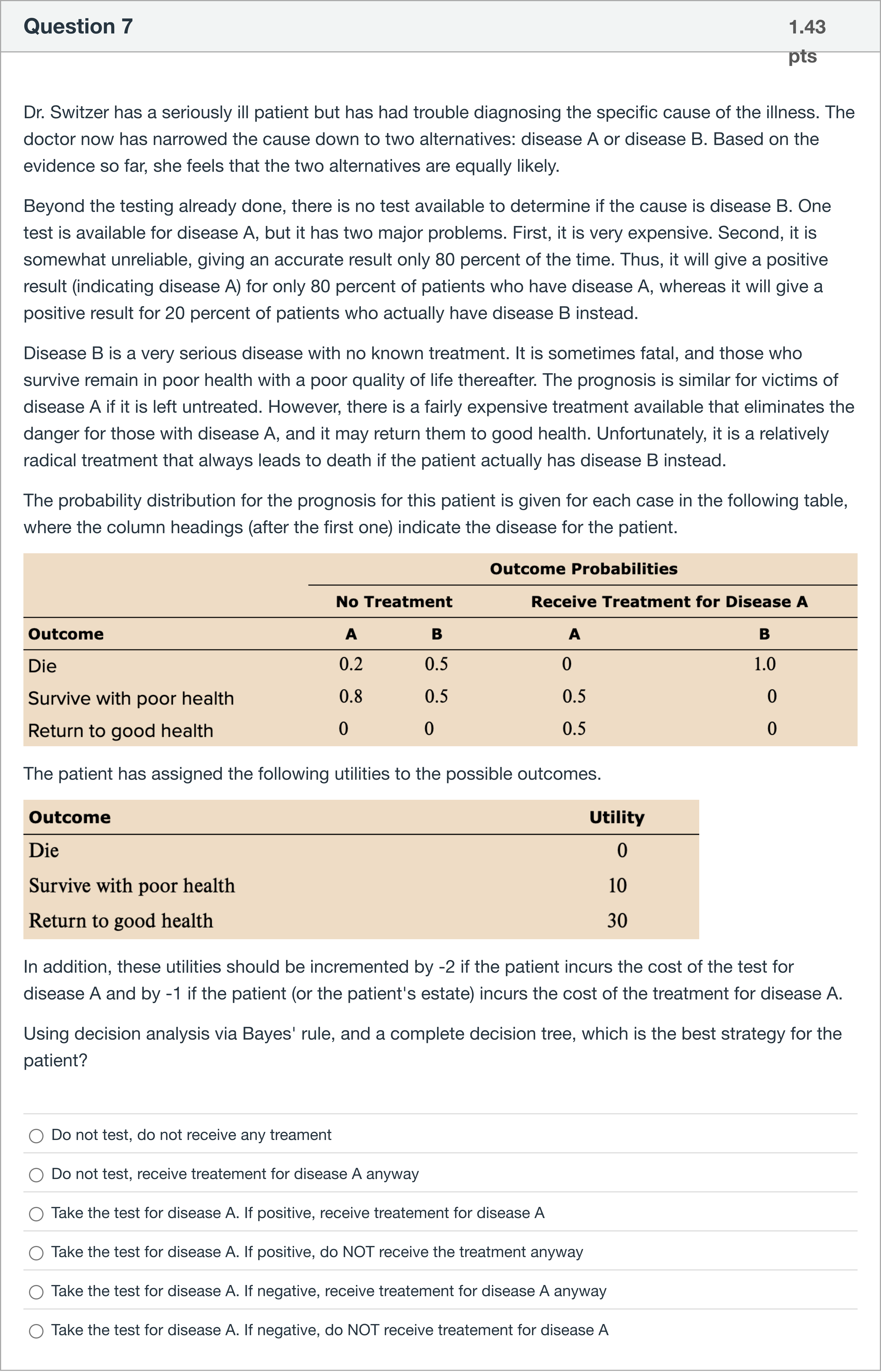
Dr. Switzer has a seriously ill patient but has had trouble diagnosing the specific cause of the illness. The doctor now has narrowed the cause down to two alternatives: disease A or disease B. Based on the evidence so far, she feels that the two alternatives are equally likely. Beyond the testing already done, there is no test available to determine if the cause is disease B. One test is available for disease A, but it has two major problems. First, it is very expensive. Second, it is somewhat unreliable, giving an accurate result only 80 percent of the time. Thus, it will give a positive result (indicating disease A) for only 80 percent of patients who have disease A, whereas it will give a positive result for 20 percent of patients who actually have disease B instead. Disease B is a very serious disease with no known treatment. It is sometimes fatal, and those who survive remain in poor health with a poor quality of life thereafter. The prognosis is similar for victims of disease A if it is left untreated. However, there is a fairly expensive treatment available that eliminates the danger for those with disease A, and it may return them to good health. Unfortunately, it is a relatively radical treatment that always leads to death if the patient actually has disease B instead. The probability distribution for the prognosis for this patient is given for each case in the following table, where the column headings (after the first one) indicate the disease for the patient. The patient has assigned the following utilities to the possible outcomes. In addition, these utilities should be incremented by -2 if the patient incurs the cost of the test for disease A and by -1 if the patient (or the patient's estate) incurs the cost of the treatment for disease A. Using decision analysis via Bayes' rule, and a complete decision tree, which is the best strategy for the patient?
选项
A.Do not test, do not receive any treament
B.Do not test, receive treatement for disease A anyway
C.Take the test for disease A. If positive, receive treatement for disease A
D.Take the test for disease A. If positive, do NOT receive the treatment anyway
E.Take the test for disease A. If negative, receive treatement for disease A anyway
F.Take the test for disease A. If negative, do NOT receive treatement for disease A

查看解析
标准答案
Please login to view
思路分析
The scenario presents a decision analysis problem where the patient weighs testing for disease A versus immediately treating or not treating, given test characteristics (sensitivity and specificity both 0.80) and the severe consequences of misdiagnosis. The utilities provided (Die = 0, Survive with poor health = 10, Return to good health = 30) are augmented by test and treatment costs (-2 for taking the test for disease A, -1 for the treatment cost of disease A). These pieces together drive the expected utilities of each strategy through Bayes’ rule and a decision tree.
Option 1: Do not test, do not receive any treatment
- Why this might be considered: it avoids test cost and avoids potential treatment risks.
- Why it is weak here: disease B has a serious prognosis and there is an available treatment for disease A that can restore health; skipping both testing and treatment forfeits the potential benefit of curing A and accepts potentially poor outcomes if A is present. The lack of treatment for A when A is actually present leads to worse expected outcomes, especially since B has no good treatment and A can be treated with a potentially curative ......Login to view full explanation登录即可查看完整答案
我们收录了全球超50000道考试原题与详细解析,现在登录,立即获得答案。
类似问题
Consider Question (6) again, but this time take into consideration the fact that the manufacturer offers a partial refund of $125 for all computers that are found to be faulty due to factory error. In order to get the refund, you must ship the broken computer back to the manufacturer, who will then run diagnostics to determine if the computer was among the faulty ones (and not broken due to an unrelated reason). Shipping costs $50. If the manufacturer establishes that the computer was faulty due to the manufacturing error, a refund of $125 will be issued to you (no extra compensation for shipping). If you ship the computer and it turns out not to be faulty, no refund will be issued (you will have wasted $50). Set up a Bayesian decision rule for this case. Show that it reduces to comparing the observation (11 months) to a threshold. Express the threshold in months, and and write the result, rounded to the nearest integer, in the space provided below.
Random variable 𝑌 is known to be exponentially distributed, either with the average rate 𝜆 0 = 1 (hypothesis 𝐻 0 ) or with the average rate 𝜆 1 = 𝜆 0 / 10 (hypothesis 𝐻 1 ). A decision 𝐻 0 / 𝐻 1 has to be made based on a single observation 𝑦 of 𝑌 . The cost of missed detection, 𝐶 𝑚 𝑑 = 𝐶 01 is ten times the cost of false alarm 𝐶 𝑓 𝑎 = 𝐶 10 = 10 thousand dollars. Correct decisions cost nothing. If it is known that 𝑃 1 = 0.1 , specify the Bayesian decision rule that will minimize the average cost. What is the resulting average cost? Mark the correct answer (numbers are rounded):
The previous two problems considered the MAP and the ML decision rules. Each of these rules yields a certain probability of false alarm (deciding that SHD was present when in fact it was not) and a certain probability of correct detection (deciding that SHD was present when indeed it was present). Assuming that the exponential distribution models are correct, which of the following statements are true? (Numbers are rounded.)
In a consumer society, many adults channel creativity into buying things
更多留学生实用工具
希望你的学习变得更简单
加入我们,立即解锁 海量真题 与 独家解析,让复习快人一步!