
题目
My LMS Subjects Online quiz 5
单项选择题
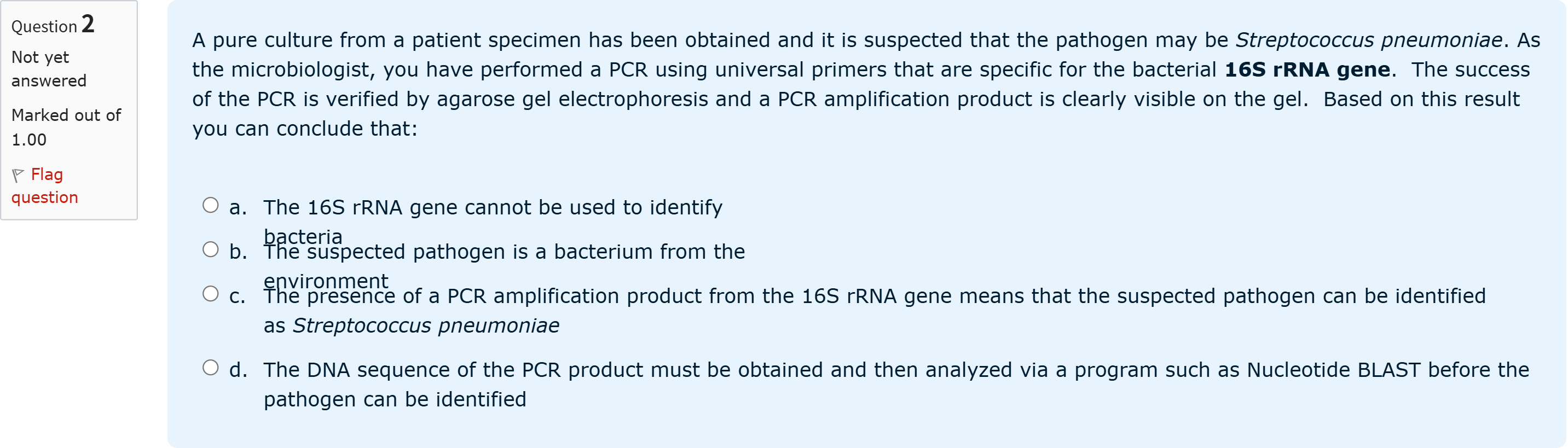
A pure culture from a patient specimen has been obtained and it is suspected that the pathogen may be Streptococcus pneumoniae. As the microbiologist, you have performed a PCR using universal primers that are specific for the bacterial 16S rRNA gene. The success of the PCR is verified by agarose gel electrophoresis and a PCR amplification product is clearly visible on the gel. Based on this result you can conclude that:
选项
A.a. The 16S rRNA gene cannot be used to identify bacteria
B.b. The suspected pathogen is a bacterium from the environment
C.c. The presence of a PCR amplification product from the 16S rRNA gene means that the suspected pathogen can be identified as Streptococcus pneumoniae
D.d. The DNA sequence of the PCR product must be obtained and then analyzed via a program such as Nucleotide BLAST before the pathogen can be identified

查看解析
标准答案
Please login to view
思路分析
In this question, a PCR was run using universal primers for the bacterial 16S rRNA gene, and a product was visualized on the gel. The key is to interpret what this result implies and what further steps are necessary for precise identification.
Option a: 'The 16S rRNA gene cannot be used to identify bacteria' — This is incorrect. The 16S rRNA gene is widely used for bacterial identification because it contains both conserved and var......Login to view full explanation登录即可查看完整答案
我们收录了全球超50000道考试原题与详细解析,现在登录,立即获得答案。
类似问题
In the investigation of microbial community dynamics, what organism is targetted by the use of 16S diversity sequencing?
What gene do we target when investigating the microbiome using next generation sequencing?
In a consumer society, many adults channel creativity into buying things
Economic stress and unpredictable times have resulted in a booming industry for self-help products
更多留学生实用工具
希望你的学习变得更简单
加入我们,立即解锁 海量真题 与 独家解析,让复习快人一步!