
Questions
BIOL3612.MERGED.202610 Activity Questions from the Literature 5B: Harvesting and using electrons
Single choice
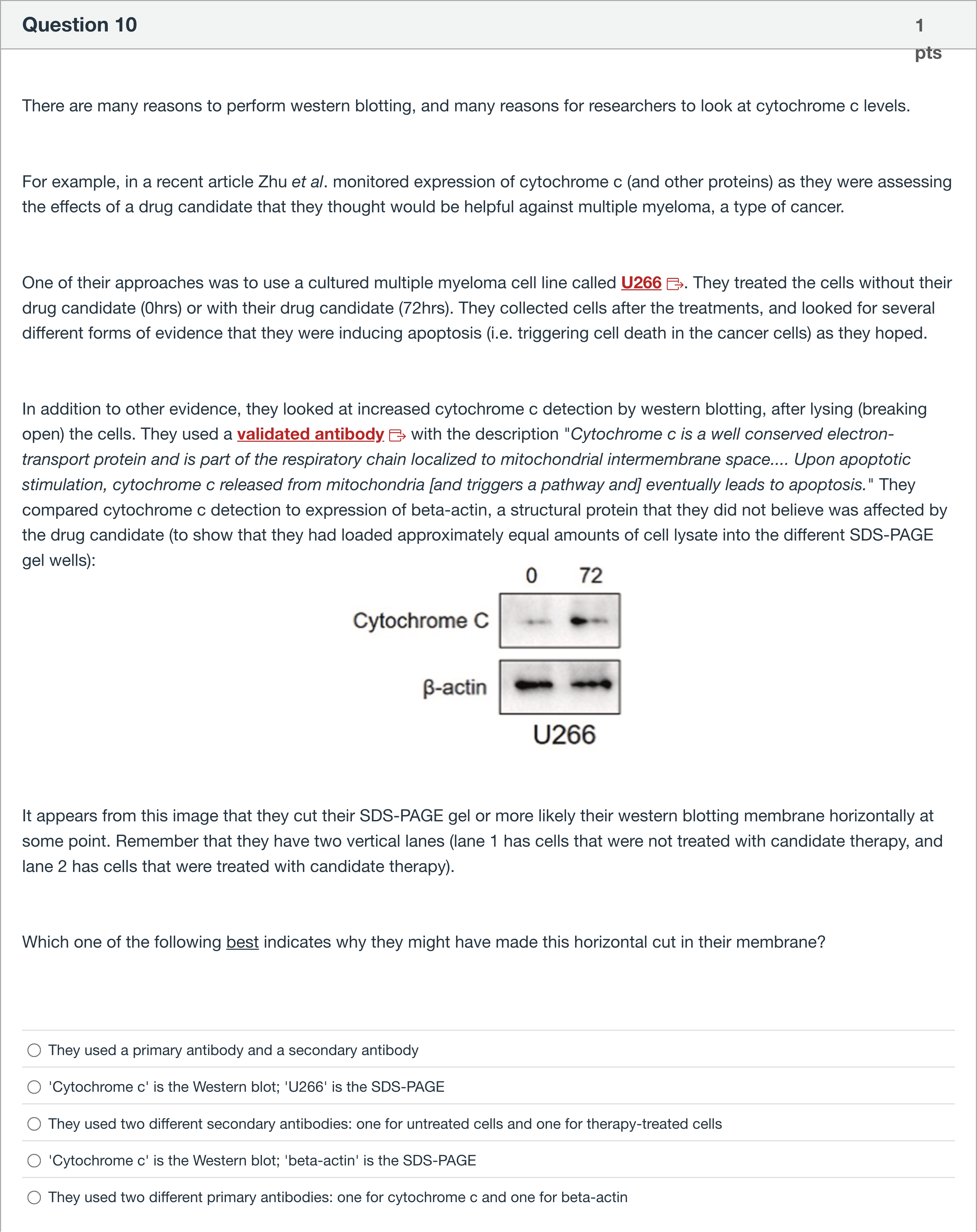
There are many reasons to perform western blotting, and many reasons for researchers to look at cytochrome c levels. For example, in a recent article Zhu et al. monitored expression of cytochrome c (and other proteins) as they were assessing the effects of a drug candidate that they thought would be helpful against multiple myeloma, a type of cancer. One of their approaches was to use a cultured multiple myeloma cell line called U266 Links to an external site. . They treated the cells without their drug candidate (0hrs) or with their drug candidate (72hrs). They collected cells after the treatments, and looked for several different forms of evidence that they were inducing apoptosis (i.e. triggering cell death in the cancer cells) as they hoped. In addition to other evidence, they looked at increased cytochrome c detection by western blotting, after lysing (breaking open) the cells. They used a validated antibody Links to an external site. with the description "Cytochrome c is a well conserved electron-transport protein and is part of the respiratory chain localized to mitochondrial intermembrane space.... Upon apoptotic stimulation, cytochrome c released from mitochondria [and triggers a pathway and] eventually leads to apoptosis." They compared cytochrome c detection to expression of beta-actin, a structural protein that they did not believe was affected by the drug candidate (to show that they had loaded approximately equal amounts of cell lysate into the different SDS-PAGE gel wells): It appears from this image that they cut their SDS-PAGE gel or more likely their western blotting membrane horizontally at some point. Remember that they have two vertical lanes (lane 1 has cells that were not treated with candidate therapy, and lane 2 has cells that were treated with candidate therapy). Which one of the following best indicates why they might have made this horizontal cut in their membrane?
Options
A.They used a primary antibody and a secondary antibody
B.'Cytochrome c' is the Western blot; 'U266' is the SDS-PAGE
C.They used two different secondary antibodies: one for untreated cells and one for therapy-treated cells
D.'Cytochrome c' is the Western blot; 'beta-actin' is the SDS-PAGE
E.They used two different primary antibodies: one for cytochrome c and one for beta-actin

View Explanation
Verified Answer
Please login to view
Step-by-Step Analysis
To start, consider the context: the researchers are running a Western blot to compare cytochrome c and beta-actin across two conditions, and they suspected that cutting the membrane horizontally could help probe different proteins more efficiently.
Option 1: They used two different primary antibodies: one for cytochrome c and one for beta-actin. This is a plausible reason for a horizontal cut: cytochrome c and beta-actin have different molecular weights, and using two distinct primary antibodi......Login to view full explanationLog in for full answers
We've collected over 50,000 authentic exam questions and detailed explanations from around the globe. Log in now and get instant access to the answers!
Similar Questions
Over 30 years ago a new method was published that was referred to as 'western blotting' (Burnette 1981). In that article the author explained that the technique would be called 'western' blotting since a researcher named Southern had coined the analogous RNA blotting technique 'Southern blotting', and then a later DNA blotting technique had been similarly named 'northern blotting'. ("With due respect to Southern..., the established tradition of “geographic” naming of transfer techniques (“Southern,” “Northern”) is continued; the method described in this manuscript is referred to as “Western” blotting.") In that article many of the initial conditions that are still in use were worked out, although it relied on radioactivity in a way that is no longer common. One of the figures is shown below, in which two different cell lines (in lanes A and B) were first subjected to SDS-PAGE and then suitable antibodies for detection of the specific protein: The article explains why there are so many bands detected, what the two cell lines were, and what the function of the protein is. It is mainly notable that since western blotting was not an established method yet (of course), it was not yet possible to purchase antibodies that were 'verified to work for western blotting' like we now often can. Therefore it was relatively difficult to choose a suitable protein for use in this article, and then difficult to obtain the suitable (antibody) reagents. In the discussion section of this article, the author identified some possible challenges with this method. A notable point was "a disadvantage of the Western blot from SDS-gels is the tendency of antigenically reactive sites (epitopes) on the fractionated molecules to be irreversibly denatured by the detergent.... [With some antibodies] the reaction of interest may be abolished by the denaturing effect of the detergent." Based on the information in this module, which one of the following best summarizes this concern?
Which one of the following best describes a question that a western blot aims to answer that SDS-PAGE is not able to answer?
When performing a Western blot, after running an SDS-PAGE gel, a transfer step is performed. The purpose of this transfer is to:
Select the response that correctly fills in the gaps of the following sentence. In a Western blot the primary antibody binds to the __i___ while the secondary antibody binds to the __ii__.
More Practical Tools for Students Powered by AI Study Helper
Making Your Study Simpler
Join us and instantly unlock extensive past papers & exclusive solutions to get a head start on your studies!