
Questions
Multiple fill-in-the-blank
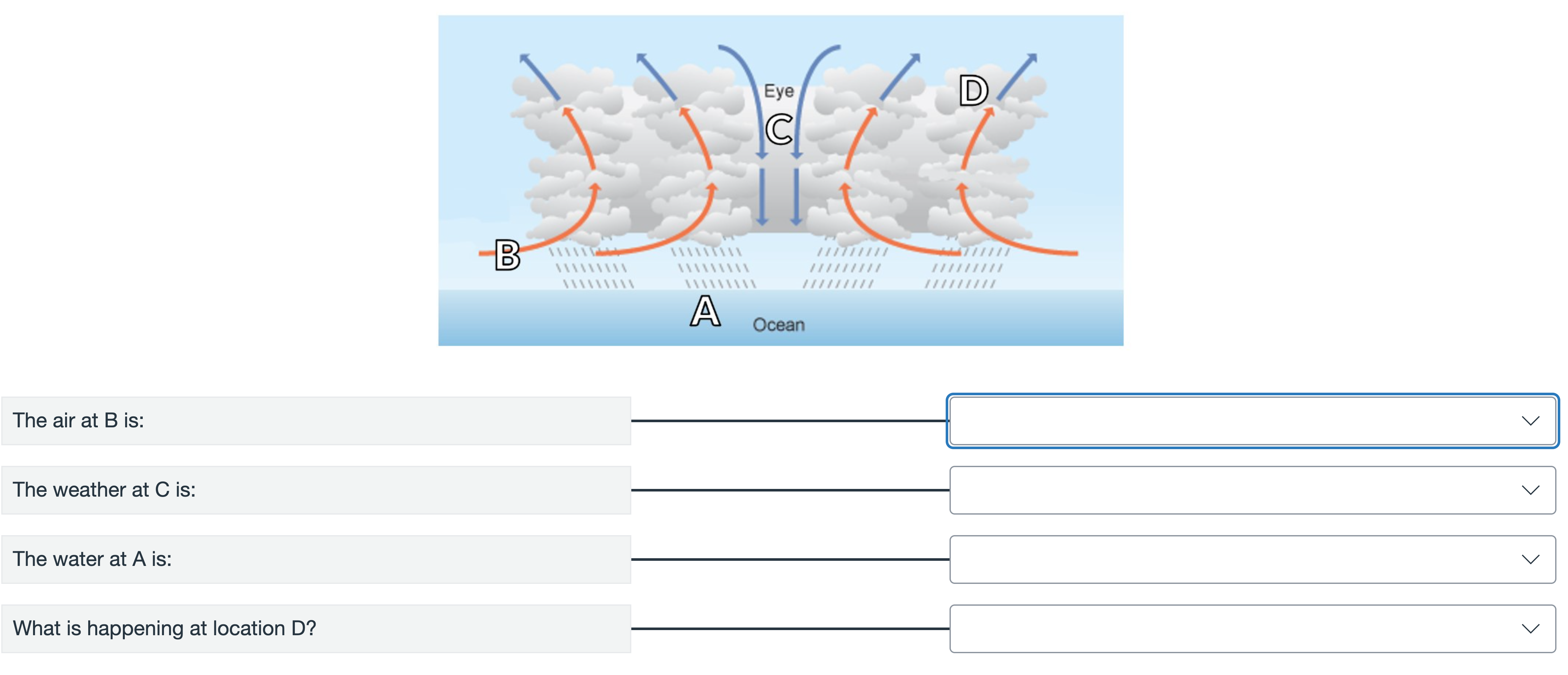
Question at position 43 Prompt 1The air at B is:Answer for prompt 1 The air at B is:[input]Prompt 2The weather at C is:Answer for prompt 2 The weather at C is:[input]Prompt 3The water at A is:Answer for prompt 3 The water at A is:[input]Prompt 4What is happening at location D?Answer for prompt 4 What is happening at location D?[input]Possible answerswarm waterdry aircool watercalm weatherevaporation absorbing latent heat energycondensation releasing latent heat energywindy weatherhumid air
Options
A.warm water
B.dry air
C.cool water
D.calm weather
E.evaporation absorbing latent heat energy
F.condensation releasing latent heat energy
G.windy weather
H.humid air

View Explanation
Verified Answer
Please login to view
Step-by-Step Analysis
We need to assign the correct descriptor to each location based on the diagram and the list of possible choices.
The air at B is:
- warm water: This option refers to water, not air, so it is not appropriate for describing air.
- dry air: The cloud formation above B implies humidity is high rather than dry conditions, so this is unlikely.
- cool water: Again, this describes water, not air, and does not capture the observed air characteristics.
- calm weather: The image shows active convection with rising air and storm development; thus, air at B is not calm.
- evaporation absorbing latent heat energy: Evaporation is about liquid water turning to vapor, not a direct description of the air’s state at B.
- condensation releasing latent heat energy: This describes a process occurring at higher levels in clouds, not the air at B itself.
- windy weather: Wind could be present, but the key visible feature at B is saturated ai......Login to view full explanationLog in for full answers
We've collected over 50,000 authentic exam questions and detailed explanations from around the globe. Log in now and get instant access to the answers!
Similar Questions
You are explaining the hydrologic (water) cycle to a middle school student, and the first thing you want the student to understand is that there are three main stages of the water cycle. What are they?
The global water cycle is primarily driven by:
Here is a diagram of the catchment water cycle important fluxes and stores of water. Select all of the correct answers below about stores.
Over the course of a year, what happens to most of the water that is evaporated from the oceans?
More Practical Tools for Students Powered by AI Study Helper
Making Your Study Simpler
Join us and instantly unlock extensive past papers & exclusive solutions to get a head start on your studies!