
Questions
INEF001 Assessment Quiz 3 - Requires Respondus LockDown Browser
Single choice
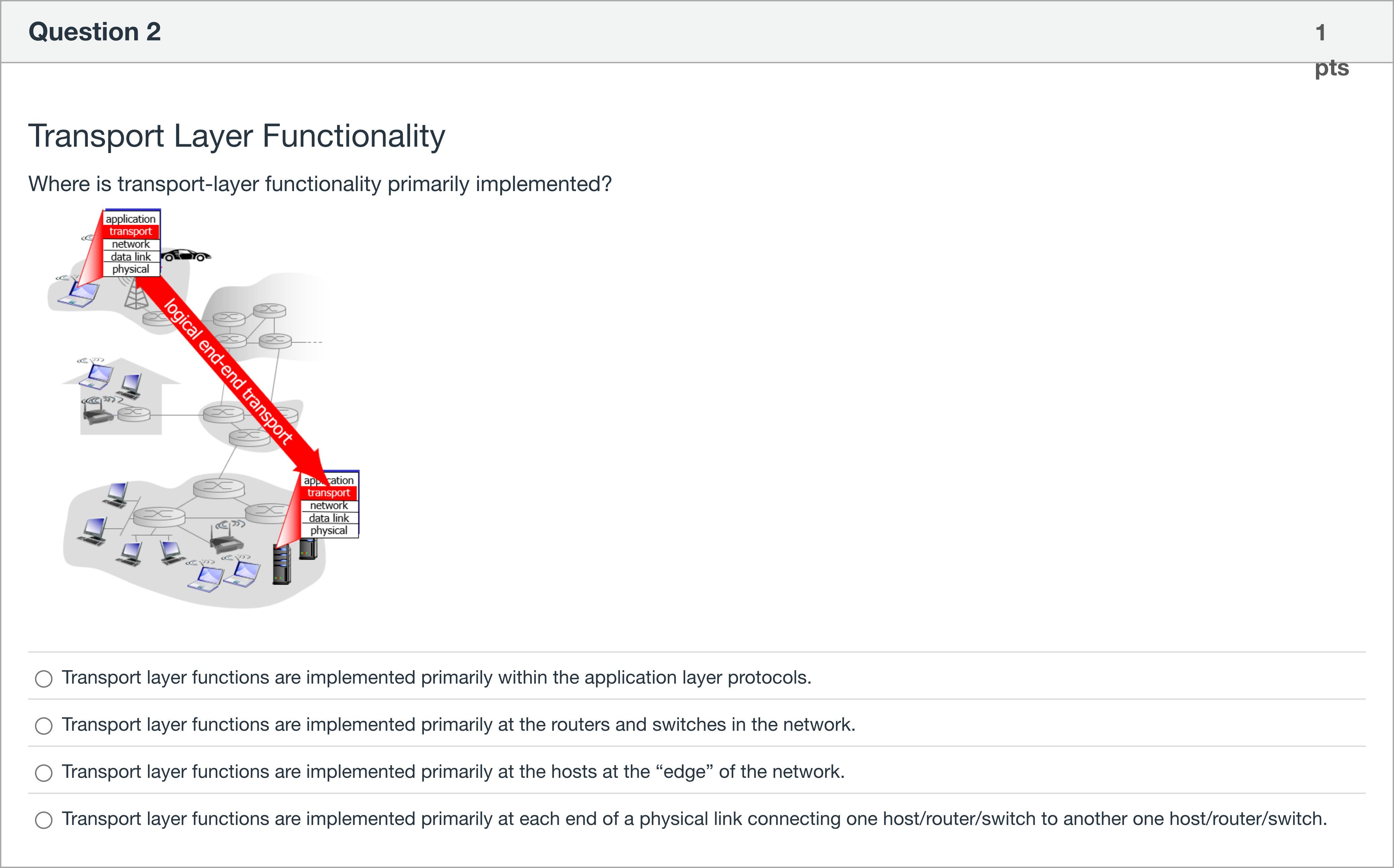
Transport Layer Functionality Where is transport-layer functionality primarily implemented?
Options
A.Transport layer functions are implemented primarily within the application layer protocols.
B.Transport layer functions are implemented primarily at the routers and switches in the network.
C.Transport layer functions are implemented primarily at the hosts at the “edge” of the network.
D.Transport layer functions are implemented primarily at each end of a physical link connecting one host/router/switch to another one host/router/switch.

View Explanation
Verified Answer
Please login to view
Step-by-Step Analysis
To tackle this question, I will evaluate each option in turn and explain why it is or isn’t a good description of where transport-layer functionality is primarily implemented.
Option 1: 'Transport layer functions are implemented primarily within the application layer protocols.' This is not accurate because the transport layer (e.g., TCP/UDP) operates as a distinct layer that sits between the application layer and the network layer. Application protocols may use or rely on transpor......Login to view full explanationLog in for full answers
We've collected over 50,000 authentic exam questions and detailed explanations from around the globe. Log in now and get instant access to the answers!
Similar Questions
A video streaming service must reliably divide data into smaller pieces and reassemble them. Which protocol handles this?
What are the main services in Layer 4?
Which layer controls reliability of the communication?
Transport services and protocols Select the correct option On the sending side, the transport layer receives the application-layer [ Select ] chunk datagram messages segments link-layer frame from a sending application process and converts it into a transport-layer [ Select ] datagrams link layer frame messages segments chunk . The transport layer then sends the [ Select ] message chunk datagram link-layer frame segment to the network layer at the sender’s end system, where it is encapsulated into a network-layer packet called a [ Select ] message segment link-layer frame datagram chunk , and forwarded to the destination. On the receiving side, the network layer extracts the transport-layer [ Select ] chunk datagram link-layer frame segments messages from the [ Select ] datagram chunk messages link-layer frame segments and delivers it to the transport layer.
More Practical Tools for Students Powered by AI Study Helper
Making Your Study Simpler
Join us and instantly unlock extensive past papers & exclusive solutions to get a head start on your studies!