你还在为考试焦头烂额?找我们就对了!
我们知道现在是考试月,你正在为了考试复习到焦头烂额。为了让更多留学生在备考与学习季更轻松,我们决定将Gold会员限时免费开放至2025年12月31日!原价£29.99每月,如今登录即享!无门槛领取。
助你高效冲刺备考!

题目
CLMTGR5001_002_2025_3 - Dynamics of Climate Variability and Chan PRACTICE QUIZ: Week 7 Lecture 3
单项选择题
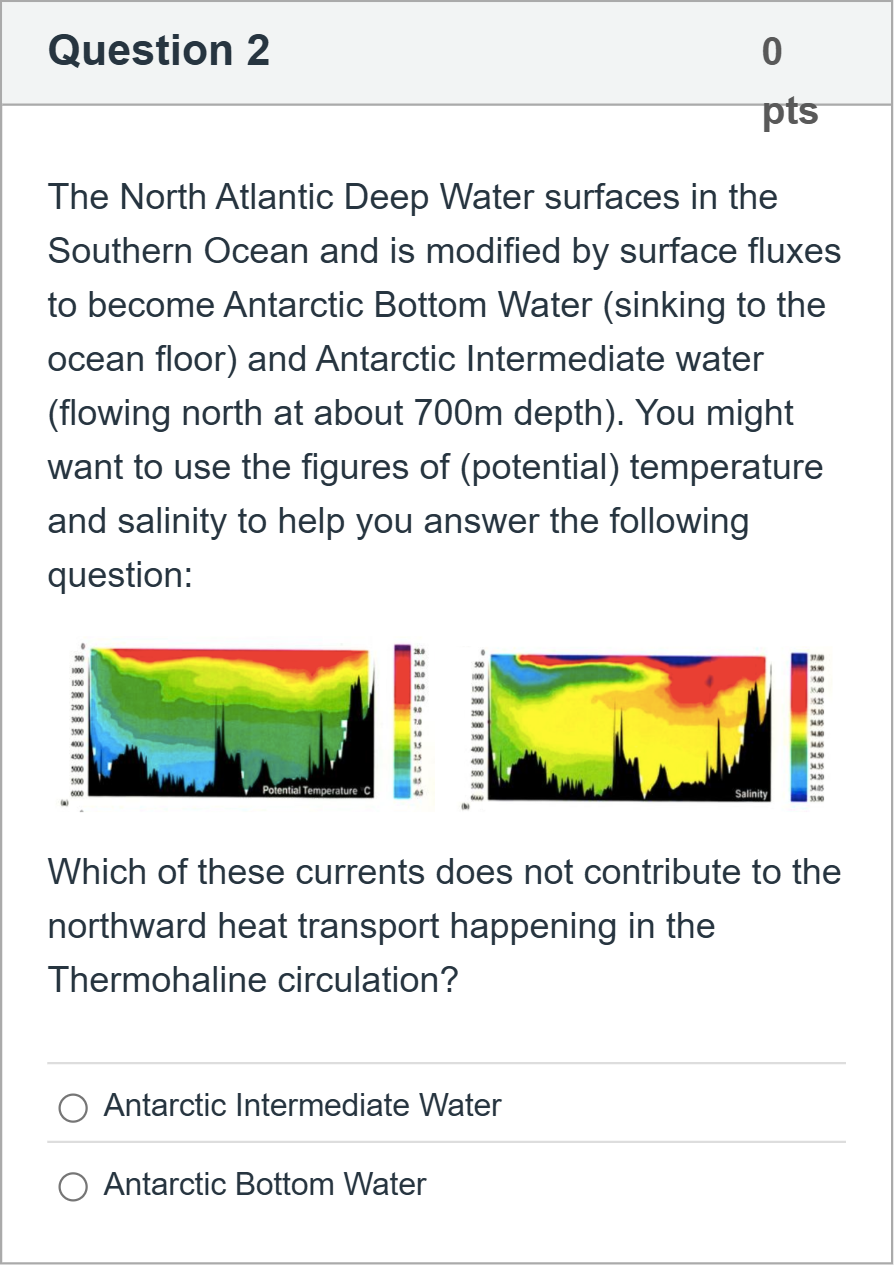
The North Atlantic Deep Water surfaces in the Southern Ocean and is modified by surface fluxes to become Antarctic Bottom Water (sinking to the ocean floor) and Antarctic Intermediate water (flowing north at about 700m depth). You might want to use the figures of (potential) temperature and salinity to help you answer the following question: Which of these currents does not contribute to the northward heat transport happening in the Thermohaline circulation?
选项
A.Antarctic Intermediate Water
B.Antarctic Bottom Water

查看解析
标准答案
Please login to view
思路分析
The question asks us to identify which current does not contribute to the northward heat transport in the Thermohaline circulation.
Option 1: Antarctic Intermediate Water. This layer flows northward at around 700 m depth and moves heat from the Southern Ocean into the higher latitude regions of the Atlantic, contributing to the northwa......Login to view full explanation登录即可查看完整答案
我们收录了全球超50000道考试原题与详细解析,现在登录,立即获得答案。
类似问题
The thermohaline circulation transports heat from one hemisphere to another. In which direction does this energy flow?
Deep Water forms in the North Atlantic because winter storms make surface waters more saline
The thermohaline circulation transports heat further north than the wind-driven circulation.
The thermohaline circulation transports heat in the same direction as the wind-driven circulation in the Northern Hemisphere.
更多留学生实用工具
希望你的学习变得更简单
为了让更多留学生在备考与学习季更轻松,我们决定将Gold 会员限时免费开放至2025年12月31日!