
Questions
Homework:practice exam 2
Multiple fill-in-the-blank
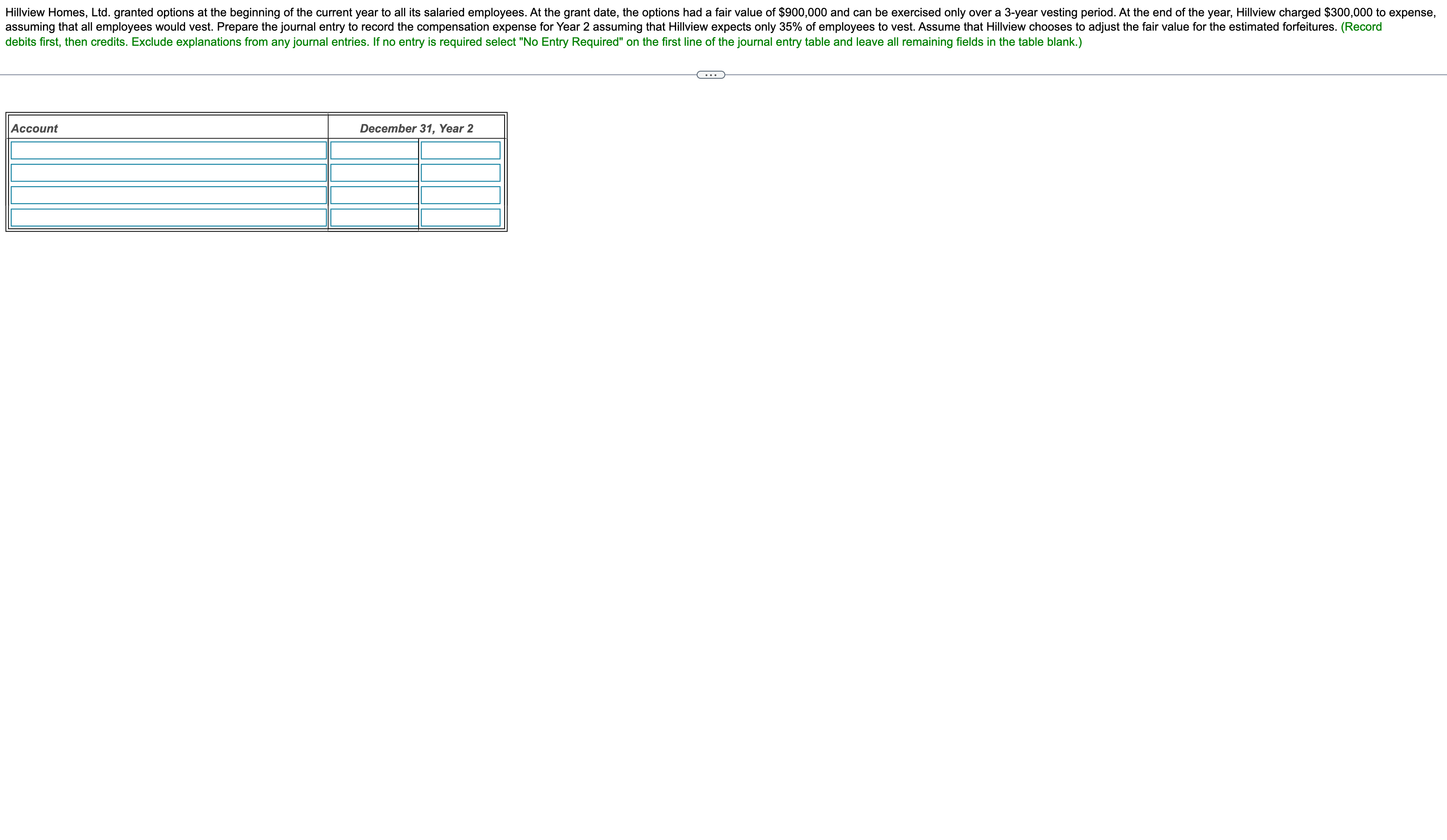
Part 1Hillview Homes, Ltd. granted options at the beginning of the current year to all its salaried employees. At the grant date, the options had a fair value of $ 900,000$900,000 and can be exercised only over a 3-year vesting period. At the end of the year, Hillview charged $ 300,000$300,000 to expense, assuming that all employees would vest. Prepare the journal entry to record the compensation expense for Year 2 assuming that Hillview expects only 35 %35% of employees to vest. Assume that Hillview chooses to adjust the fair value for the estimated forfeitures. (Record debits first, then credits. Exclude explanations from any journal entries. If no entry is required select "No Entry Required" on the first line of the journal entry table and leave all remaining fields in the table blank.) Part 1 [table] | Save Accounting Table... | | + | Copy to Clipboard... | | + [/table] [table] Account | December 31, Year 2 | | | | | | | | [/table] Save Accounting Table...+Copy to Clipboard...+AccountDecember 31, Year 2[Account][Fill in the blank][Fill in the blank][Account][Fill in the blank][Fill in the blank][Account][Fill in the blank][Fill in the blank][Account][Fill in the blank][Fill in the blank] [IMPORTANT INSTRUCTION] When returning answers, provide an array for [Fill in the blank] positions ONLY. Skip [Account] cells (these are dropdowns). If a [Fill in the blank] should be empty, return an empty string "" as a placeholder. The array length should equal the number of [Fill in the blank] cells, not total cells.

View Explanation
Verified Answer
Please login to view
Step-by-Step Analysis
The problem concerns recognizing compensation expense for stock options granted to employees under a vesting schedule, with an adjustment for estimated forfeitures.
First, restating the facts helps: Hillview granted options with a grant-date fair value totaling 900,000, exercisable over a 3-year vesting period. At year-end, the company recorded 300,000 of compensation expense under the assumption that all employees would vest. Now, at Year 2, Hillview expects only 35% of employees to vest and is adjusting the fair value for ......Login to view full explanationLog in for full answers
We've collected over 50,000 authentic exam questions and detailed explanations from around the globe. Log in now and get instant access to the answers!
Similar Questions
Myers Inc. decided to grant stock options as part of their managers' compensation. The company grants 15,000 stock options on January 1, 2013 to a manager. The fair value of each option at the grant date is $3 per share and the exercise price is equal to the current market value of $15. The vesting period is 4 years and the expiration date is January 1, 2019. On January 1, 2018, the manager exercises the stock options (the market value is $23). By how much will Total Shareholder's Equity increase as a result of this transaction?
Copeworth Health, a publicly traded healthcare provider operating across the southeastern United States, partially compensates its executives using stock options. In the current period, Copeworth issues 5,000 options to purchase $1 par value common stock for $5 per share which is the current market price of the share. The vesting period is 2 years. Using the Black-Scholes options pricing model, Copeworth values the options at $2 each. How should Copeworth recognize this compensation expense?
Part 1On January 1, Year 1, Sweeney Company granted an employee options to purchase 100 shares of Sweeney's common stock at $40 per share. The options became exercisable on December 31, Year 1, after the employee had completed 1 year of service and were exercised on that date. Market prices of the stock and fair values of the options were as follows:[table] | Market Price of Stock | Fair Value of Options January 1, Year 1 | $50 | $61 December 31, Year 1 | $65 | $75 [/table]What amount should Sweeney recognize as compensation cost for Year 1? Part 1 A. $2,100 B. $4,000 C. $6,100 D. $0
Part 1On January 1, Year 1, Axis Corporation granted employees 45,50045,500 stock options for 45,50045,500 shares of $ 1$1 par value common stock. The exercise price on the date of issue was equal to the market price of $ 20$20. There is a two year vesting period and the options expire in four years. Employees have the right to sell back the shares to the corporation within six months of exercise. At the time of issue, the fair value of the options is estimated to be $ 32$32 per option. Unfortunately, the company experiences a series of setbacks and the stock price falls in Year 4. At December 31, Year 4, the options have a fair value of $ 16$16 per option. At the end of four years, none of the options have been exercised. What is the appropriate journal entry to record the expiration of the options? Part 1 A. [table] APIC minus− Expired Stock Options | 1,456,0001,456,000 | Compensation Expense | | 1,456,0001,456,000 [/table] B. [table] Liability for Stockminus−based Compensation | 728,000728,000 | APIC minus− Expired Stock Options | | 728,000728,000 [/table] C. [table] APIC minus− Expired Stock Options | 728,000728,000 | Compensation Expense | | 728,000728,000 [/table] D. [table] Liability for Stockminus−based Compensation | 728,000728,000 | Common Stock | | 45,50045,500 APIC minus− Common | | 682,500682,500 [/table]
More Practical Tools for Students Powered by AI Study Helper
Making Your Study Simpler
Join us and instantly unlock extensive past papers & exclusive solutions to get a head start on your studies!