
Questions
EESC1120.01|.02 Summer 2025 Our Home Amongst the Cosmos [Kruckenberg] Week 6 Quiz
Single choice
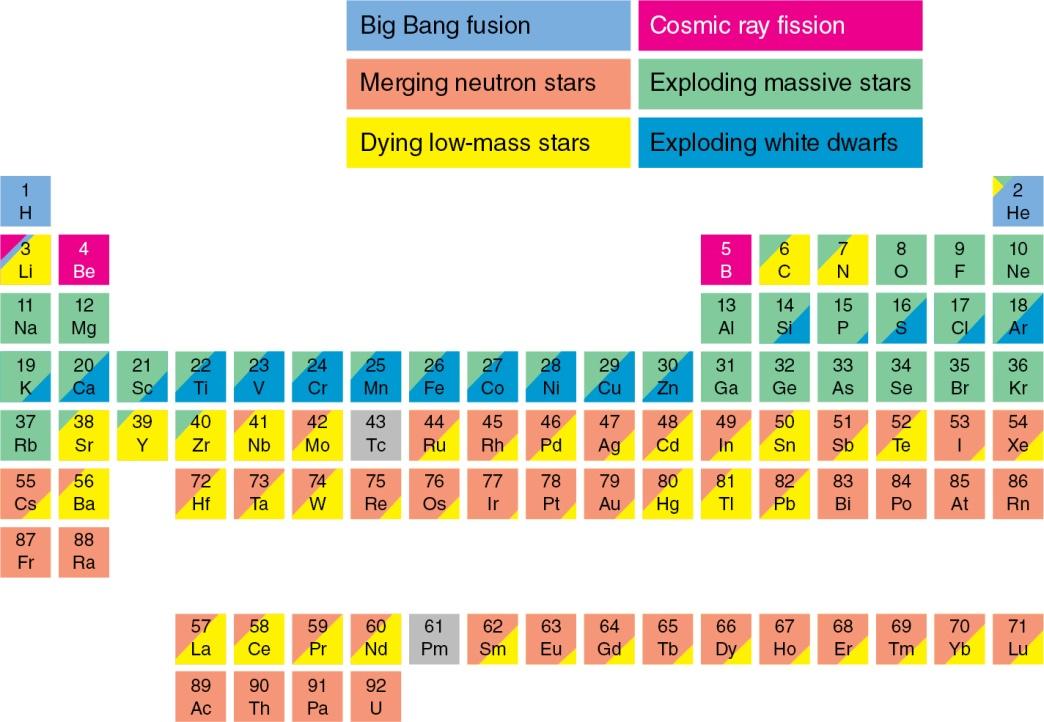
It is hypothesized that carbon and silicon could form the “backbone” of DNA. Using the figure below, which of the following scenarios might lead to a star system that has more silicon than carbon?
Options
A.It formed near low-mass stars, but no high-mass stars.
B.It formed in proximity to many high-mass stars, but few low-mass stars.
C.It is a binary star system.
D.It formed from “raw” material from the Big Bang.
E.It formed near a large number of exploding white dwarf stars.

View Explanation
Verified Answer
Please login to view
Step-by-Step Analysis
To tackle this question, let's think about how elements like carbon and silicon get into the interstellar medium from generations of stars.
Option 1: 'It formed near low-mass stars, but no high-mass stars.' Low-mass stars do contribute carbon later in their lifetimes, but the absence of high-mass stars means fewer supernovae that synthesize and eject silicon; this would not strongly favor silicon......Login to view full explanationLog in for full answers
We've collected over 50,000 authentic exam questions and detailed explanations from around the globe. Log in now and get instant access to the answers!
Similar Questions
A massive star goes supernova, creating a large nebula. This nebula eventually goes on to form a new set of stars. What can we say about the composition of this new set of stars compared to the one that went supernova?
What is the heaviest element that can be made in the core of a star?
What process produced carbon and iron?
Massive stars synthesize chemical elements going from helium up to iron
More Practical Tools for Students Powered by AI Study Helper
Making Your Study Simpler
Join us and instantly unlock extensive past papers & exclusive solutions to get a head start on your studies!