
Questions
SPHY001 Practice Quiz - Unit 17 | LA057
Single choice
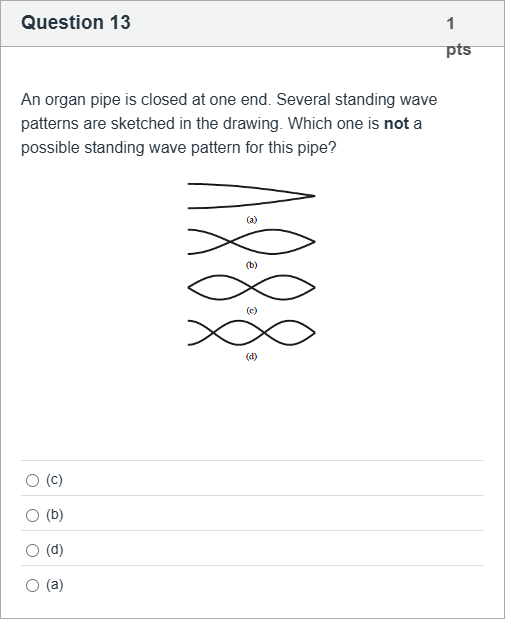
An organ pipe is closed at one end. Several standing wave patterns are sketched in the drawing. Which one is not a possible standing wave pattern for this pipe?
Options
A.(c)
B.(b)
C.(d)
D.(a)

View Explanation
Verified Answer
Please login to view
Step-by-Step Analysis
Question restatement: An organ pipe is closed at one end. Several standing wave patterns are sketched. Which one is not a possible standing wave pattern for this pipe?
Options provided: (a), (b), (c), (d)
Let's analyze the constraints for a pipe closed at one end. In a closed-end (node) pipe, the displacement must be zero (a node) at the closed end, and at the open end there is a displacement antinode (maximum). The permissible standing-wave patterns therefore must begin with a node at the closed end and end with an antinode at the open end. Additionally, the allowed patterns correspond to odd multiples of λ/4 along the length, giving modes with 1, 3, 5, ... quarter-wavelengths fitting into the pipe length.
Optio......Login to view full explanationLog in for full answers
We've collected over 50,000 authentic exam questions and detailed explanations from around the globe. Log in now and get instant access to the answers!
Similar Questions
A string that is fixed at both ends has a length of 2.36 m. When the string vibrates at a frequency of 77.0 Hz, a standing wave with five loops is formed. What is the wavelength of the waves that travel on the string?
The first harmonic of a closed pipe of length L is 300 Hz. To play the same note on an open pipe the length of the pipe could be
The fundamental frequency of a pipe closed at one end is f. What is the frequency of the third harmonic?
A standing wave is oscillating at 690 Hz on a string, as shown in the figure. What is the wave speed?
More Practical Tools for Students Powered by AI Study Helper
Making Your Study Simpler
Join us and instantly unlock extensive past papers & exclusive solutions to get a head start on your studies!