Still overwhelmed by exam stress? You've come to the right place!
We know exam season has you totally swamped. To support your studies, access Gold Membership for FREE until December 31, 2025! Normally £29.99/month. Just Log In to activate – no strings attached.
Let us help you ace your exams efficiently!

Questions
GEOL0012_25-26 **********GEOL0012 Moodle Test (unassessed) 2025/26**********
Multiple fill-in-the-blank
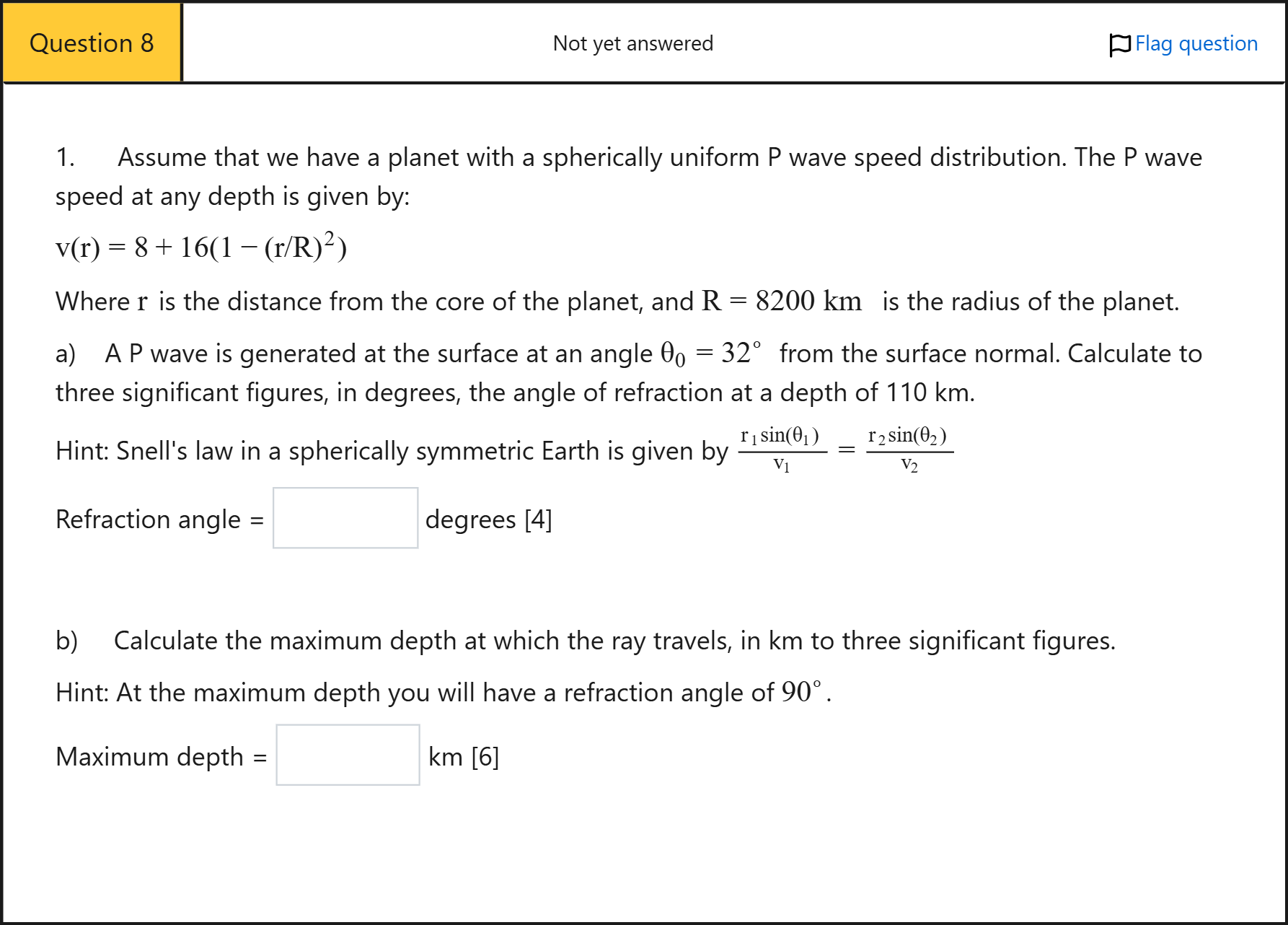
Question text1. Assume that we have a planet with a spherically uniform P wave speed distribution. The P wave speed at any depth is given by: [math: v(r)=8+16(1−(r/R)2)] Where [math: r] is the distance from the core of the planet, and [math: R=8200km] is the radius of the planet. a) A P wave is generated at the surface at an angle [math: θ0=32∘] from the surface normal. Calculate to three significant figures, in degrees, the angle of refraction at a depth of 110 km. Hint: Snell's law in a spherically symmetric Earth is given by [math: r1sin(θ1)v1=r2sin(θ2)v2] Refraction angle = Answer 1 Question 8[input] degrees [4] b) Calculate the maximum depth at which the ray travels, in km to three significant figures. Hint: At the maximum depth you will have a refraction angle of [math: 90∘].Maximum depth = Answer 2 Question 8[input] km [6]

View Explanation
Standard Answer
Please login to view
Approach Analysis
We begin by restating the problem and the given data so we can apply the appropriate wave-s propagation relations step by step.
- The P-wave speed distribution is v(r) = 8 + 16(1 − (r/R)^2), with R = 8200 km. The radial coordinate r is measured from the planet’s center, so at the surface r = R and at a depth d below the surface we have r = R − d.
- An initial P-wave ray is generated at the surface at an angle θ0 = 32° from the surface normal.
- We are asked to (a) find the angle of refraction θ2 at a depth of 110 km, and (b) find the maximum depth that the ray reaches (where the refraction angle would be 90°).
- Snell’s law in a spherically symmetric Earth can be written in the form r1 sin(θ1) / v1 = r2 sin(θ2) / v2, where r is the distance from t......Login to view full explanationLog in for full answers
We've collected over 50,000 authentic exam questions and detailed explanations from around the globe. Log in now and get instant access to the answers!
Similar Questions
Question at position 1 Given the figure below where light travels from one medium to another, and with Snell's Law in mind as well as the difference between the angles apparent; what is the relationship between the refractive indices n_1 and n_2? n_1 > n_2n_1 < n_2n_1 = n_2Not enough information
A light ray passes from water (refractive index ( n1 = 1.33 )) into diamond (refractive index ( n2 = 2.42 )). If the angle of incidence in water is ( 300 ), what is the angle of refraction in diamond?
Which of the following statements best describes Snell's Law and its application in determining the path of light as it passes from one medium to another?
A light ray in glass arrives at the glass-water interface at an angle of θ = 48° with the normal. The refracted ray in water makes an angle φ = 72° with the normal, as shown in the figure. The index of refraction of water is 1.33. The angle of incidence is now changed to θ = 37°. What is the new angle of refraction φ in the water? Hint: Start by calculating the index of refraction of the glass.
More Practical Tools for International Students
Making Your Study Simpler
To make preparation and study season easier for more international students, we've decided to open up Gold Membership for a limited-time free trial until December 31, 2025!