
Questions
SPHY001 Practice Quiz - Unit 16 | LA056
Single choice
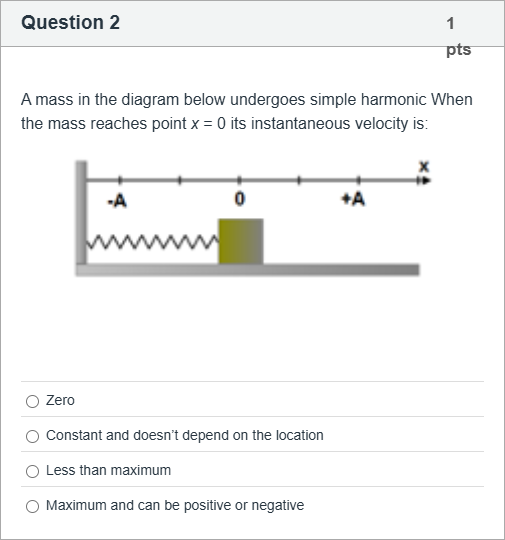
A mass in the diagram below undergoes simple harmonic When the mass reaches point x = 0 its instantaneous velocity is:
Options
A.Zero
B.Constant and doesn’t depend on the location
C.Less than maximum
D.Maximum and can be positive or negative

View Explanation
Verified Answer
Please login to view
Step-by-Step Analysis
In simple harmonic motion, the velocity is given by v = ±ω√(A^2 − x^2), where A is the amplitude and x is the displacement from equilibrium. At the equilibrium position x = 0, the expression becomes v = ±ωA, which has the largest magnitude possi......Login to view full explanationLog in for full answers
We've collected over 50,000 authentic exam questions and detailed explanations from around the globe. Log in now and get instant access to the answers!
Similar Questions
To double the period of a simple harmonic oscillator, by what factor should the amplitude change?
In the above system the spring constant is k = 25 N/m and the mass on the spring is 100 grams. What are the angular velocity and the harmonic frequency if we triple the mass? Round your answer to one (1) decimal place. Do not enter units. Example: 33.4
A mass in the diagram below undergoes simple harmonic When the mass reaches point x = 0 its instantaneous acceleration is:
A mass attached to a very light spring executes simple harmonic motion. If you want to double its total energy, you should
More Practical Tools for Students Powered by AI Study Helper
Making Your Study Simpler
Join us and instantly unlock extensive past papers & exclusive solutions to get a head start on your studies!