
Questions
Multiple fill-in-the-blank
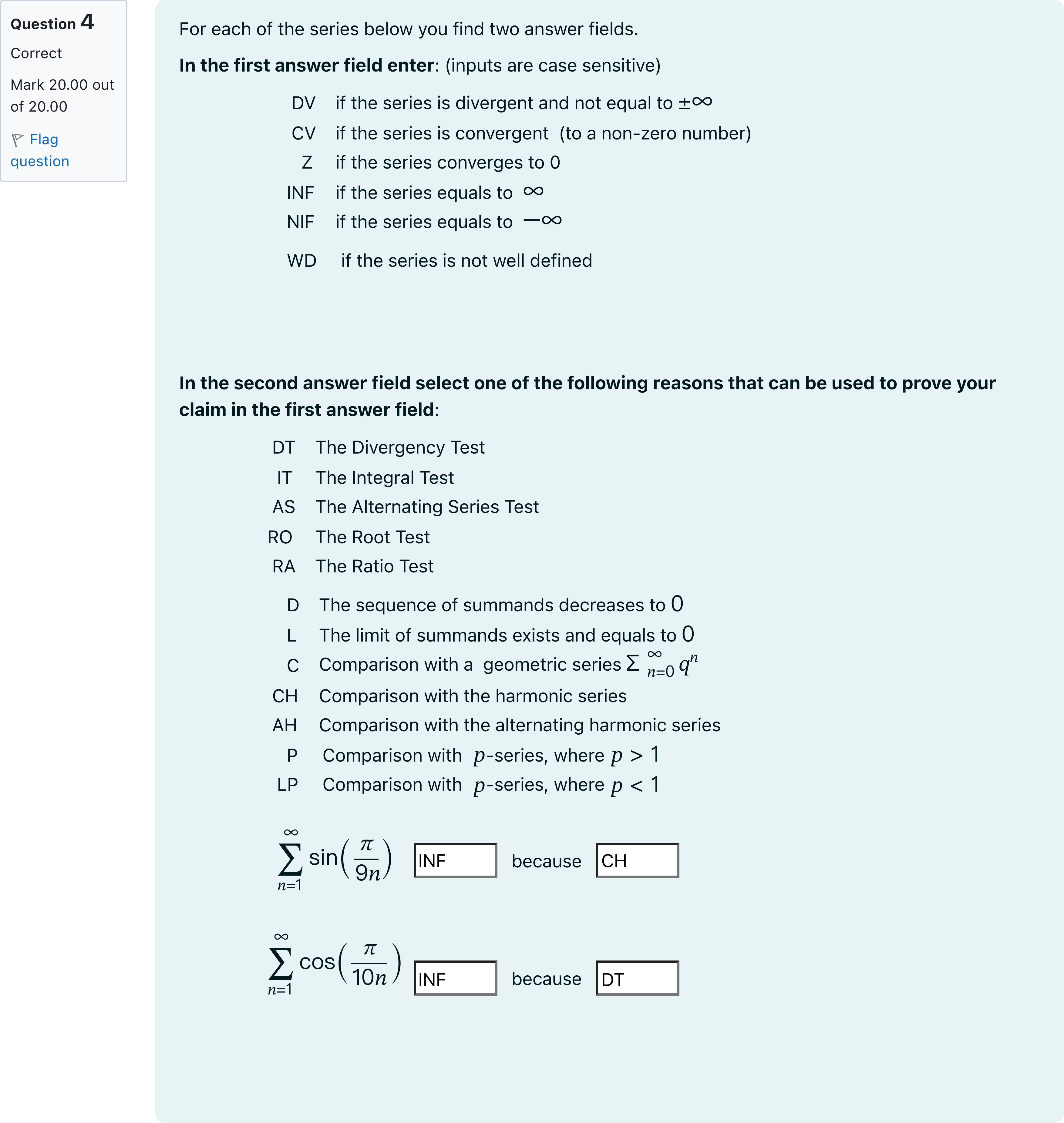
Question textFor each of the series below you find two answer fields. In the first answer field enter: (inputs are case sensitive) [table] DV | | if the series is divergent and not equal to ±∞±∞\pm\infty CV | | if the series is convergent (to a non-zero number) Z | | if the series converges to 0 INF | | if the series equals to ∞∞ \infty NIF | | if the series equals to −∞−∞ -\infty [/table] [table] WD | | if the series is not well defined | | [/table] In the second answer field select one of the following reasons that can be used to prove your claim in the first answer field: [table] DT | | The Divergency Test IT | | The Integral Test AS | | The Alternating Series Test RO | | The Root Test RA | | The Ratio Test [/table] [table] D | | The sequence of summands decreases to 00 0 L | | The limit of summands exists and equals to 00 0 C | | Comparison with a geometric series ∑∞𝑛=0𝑞𝑛∑n=0∞qn \sum_{n=0}^{\infty}q^n CH | | Comparison with the harmonic series AH | | Comparison with the alternating harmonic series [/table] [table] P | | Comparison with 𝑝pp-series, where 𝑝>1p>1p > 1 LP | | Comparison with 𝑝pp-series, where 𝑝<1p<1p < 1 [/table] [table] ∑𝑛=1∞sin(𝜋9𝑛)∑n=1∞sin(π9n) \sum_{n=1}^\infty \sin\left( \frac{\pi }{ {9} n } \right) | | because ∑𝑛=1∞cos(𝜋10𝑛)∑n=1∞cos(π10n) \sum\limits_{n=1}^{\infty} \cos\left( \frac{\pi }{ {10} n } \right) | | because [/table]

View Explanation
Verified Answer
Please login to view
Step-by-Step Analysis
Question restatement and options:
- In the first answer field enter the category for the series: DV, CV, Z, INF, NIF, WD, with the second field selecting a justification from DT, IT, AS, RO, RA, followed by a second pair of selections (D, L, C, CH, AH, P, LP) and finally two target series to classify.
- For the given response, the first blank is INF and the second blank is INF, with the reasons provided as CH and DT respectively.
Analysis of the first claim: INF because CH
- The statement INF indicates the series diverges to infinity. A common approach to justify this is by a Comparison with a geometric-like or harmonic-like divergent benchma......Login to view full explanationLog in for full answers
We've collected over 50,000 authentic exam questions and detailed explanations from around the globe. Log in now and get instant access to the answers!
Similar Questions
Question textFor each of the series below you find two answer fields. In the first answer field enter: (inputs are case sensitive) [table] DV | | if the series is divergent and not equal to ±∞±∞\pm\infty CV | | if the series is convergent (to a non-zero number) Z | | if the series converges to 0 INF | | if the series equals to ∞∞ \infty NIF | | if the series equals to −∞−∞ -\infty [/table] [table] WD | | if the series is not well defined | | [/table] In the second answer field select one of the following reasons that can be used to prove your claim in the first answer field: [table] DT | | The Divergency Test IT | | The Integral Test AS | | The Alternating Series Test RO | | The Root Test RA | | The Ratio Test [/table] [table] D | | The sequence of summands decreases to 00 0 L | | The limit of summands exists and equals to 00 0 C | | Comparison with a geometric series ∑∞𝑛=0𝑞𝑛∑n=0∞qn \sum_{n=0}^{\infty}q^n CH | | Comparison with the harmonic series AH | | Comparison with the alternating harmonic series [/table] [table] P | | Comparison with 𝑝pp-series, where 𝑝>1p>1p > 1 LP | | Comparison with 𝑝pp-series, where 𝑝<1p<1p < 1 [/table] [table] ∑𝑛=1∞(𝑛+1)7(8⋅𝑛!)2(2𝑛)!∑n=1∞(n+1)7(8⋅n!)2(2n)! \sum_{n=1}^\infty (n+1)^{{7}} \,\, \frac{({8}\cdot n!)^2 }{ (2n)! } | | because ∑𝑛=1∞(1−6𝑛)2𝑛2∑n=1∞(1−6n)2n2 \sum\limits_{n=1}^{\infty} \left(1- \frac{{6} }{ n } \right)^{ {2}n^2} | | because [/table]
Question textFor each of the series below you find two answer fields. In the first answer field enter: (inputs are case sensitive) [table] DV | | if the series is divergent and not equal to ±∞±∞\pm\infty CV | | if the series is convergent (to a non-zero number) Z | | if the series converges to 0 INF | | if the series equals to ∞∞ \infty NIF | | if the series equals to −∞−∞ -\infty [/table] [table] WD | | if the series is not well defined | | [/table] In the second answer field select one of the following reasons that can be used to prove your claim in the first answer field: [table] DT | | The Divergency Test IT | | The Integral Test AS | | The Alternating Series Test RO | | The Root Test RA | | The Ratio Test [/table] [table] D | | The sequence of summands decreases to 00 0 L | | The limit of summands exists and equals to 00 0 C | | Comparison with a geometric series ∑∞𝑛=0𝑞𝑛∑n=0∞qn \sum_{n=0}^{\infty}q^n CH | | Comparison with the harmonic series AH | | Comparison with the alternating harmonic series [/table] [table] P | | Comparison with 𝑝pp-series, where 𝑝>1p>1p > 1 LP | | Comparison with 𝑝pp-series, where 𝑝<1p<1p < 1 [/table] [table] ∑𝑛=1∞3𝑛3+15𝑛12+1‾‾‾‾‾‾‾√3+𝑛∑n=1∞3n3+15n12+13+n \sum_{n=1}^\infty \frac{{3}n^{3}+1}{{5}\sqrt[{3}]{ n^{12}+1}+n} | | because ∑𝑛=1∞(𝑛ln𝑛)24𝑛∑n=1∞(nlnn)24n \sum\limits_{n=1}^{\infty} \frac{(n \ln n)^{2}}{{4}^n} | | because [/table]
Question textFor each of the series below you find two answer fields. In the first answer field enter: (inputs are case sensitive) [table] DV | | if the series is divergent CV | | if the series is convergent (to a number ∉{0,1,tan(1/6)}∉{0,1,tan(1/6)}\not\in \{0, 1, \tan(1/{6}) \}) Z | | if the series converges to 0 ON | | if the series converges to 111 IN | | if the series equals to tan(1/6)tan(1/6)\tan(1/{6}) [/table] [table] WD | | if the series is not well defined | | [/table] In the second answer field select one of the following reasons that can be used to prove your claim in the first answer field: [table] DT | | The Divergency Test IT | | The Integral Test AST | | The Alternating Series Test RO | | The Root Test RA | | The Ratio Test [/table] [table] D | | The sequence of summands decreases to 00 0 L | | The limit of summands exists and equals to 00 0 C | | Comparison with a geometric series ∑∞𝑛=0𝑞𝑛∑n=0∞qn \sum_{n=0}^{\infty}q^n CH | | Comparison with the harmonic series AH | | Comparison with the alternating harmonic series [/table] [table] P | | Comparison with 𝑝pp-series, where 𝑝>1p>1p > 1 LP | | Comparison with 𝑝pp-series, where 𝑝<1p<1p < 1 [/table] [table] ∑𝑛=1∞(−1)𝑛tan(16𝑛)∑n=1∞(−1)ntan(16n) \sum\limits_{n=1}^{\infty} (-1)^n \tan \left(\frac{1}{{6} n}\right) | | because ∑𝑛=1∞(−1)𝑛(1−7𝑛)𝑛∑n=1∞(−1)n(1−7n)n\sum\limits_{n=1}^{\infty} (-1)^n \left(1-\frac{{7}}{n}\right)^n | | because [/table]
Question textFor each of the series below you find two answer fields. In the first answer field enter: (inputs are case sensitive) [table] DV | | if the series is divergent CV | | if the series is convergent (to a number ∉{0,1,5‾√}∉{0,1,5}\not\in \{0, 1, \sqrt{{5}} \}) Z | | if the series converges to 0 ON | | if the series converges to 111 IN | | if the series equals to 5‾√5\sqrt{{5}} [/table] [table] WD | | if the series is not well defined | | [/table] In the second answer field select one of the following reasons that can be used to prove your claim in the first answer field: [table] DT | | The Divergency Test IT | | The Integral Test AST | | The Alternating Series Test RO | | The Root Test RA | | The Ratio Test [/table] [table] D | | The sequence of summands decreases to 00 0 L | | The limit of summands exists and equals to 00 0 C | | Comparison with a geometric series ∑∞𝑛=0𝑞𝑛∑n=0∞qn \sum_{n=0}^{\infty}q^n CH | | Comparison with the harmonic series AH | | Comparison with the alternating harmonic series [/table] [table] P | | Comparison with 𝑝pp-series, where 𝑝>1p>1p > 1 LP | | Comparison with 𝑝pp-series, where 𝑝<1p<1p < 1 [/table] [table] ∑𝑛=3∞(−1)𝑛5−4𝑛2‾‾‾‾‾‾‾√∑n=3∞(−1)n5−4n2 \sum\limits_{n=3}^{\infty} (-1)^n\sqrt{ {5}-\frac{ {4}}{n^2} } | | because ∑𝑛=1∞(−1)𝑛ln(1+17𝑛)∑n=1∞(−1)nln(1+17n) \sum\limits_{n=1}^{\infty} (-1)^n \, \ln\left(1 + \frac{{17}}{n}\right) | | because [/table]
More Practical Tools for Students Powered by AI Study Helper
Making Your Study Simpler
Join us and instantly unlock extensive past papers & exclusive solutions to get a head start on your studies!