
Questions
CVEN90051_2025_SM2 Exam: Civil Hydraulics (CVEN90051_2025_SM2)- Requires Respondus LockDown Browser
Single choice
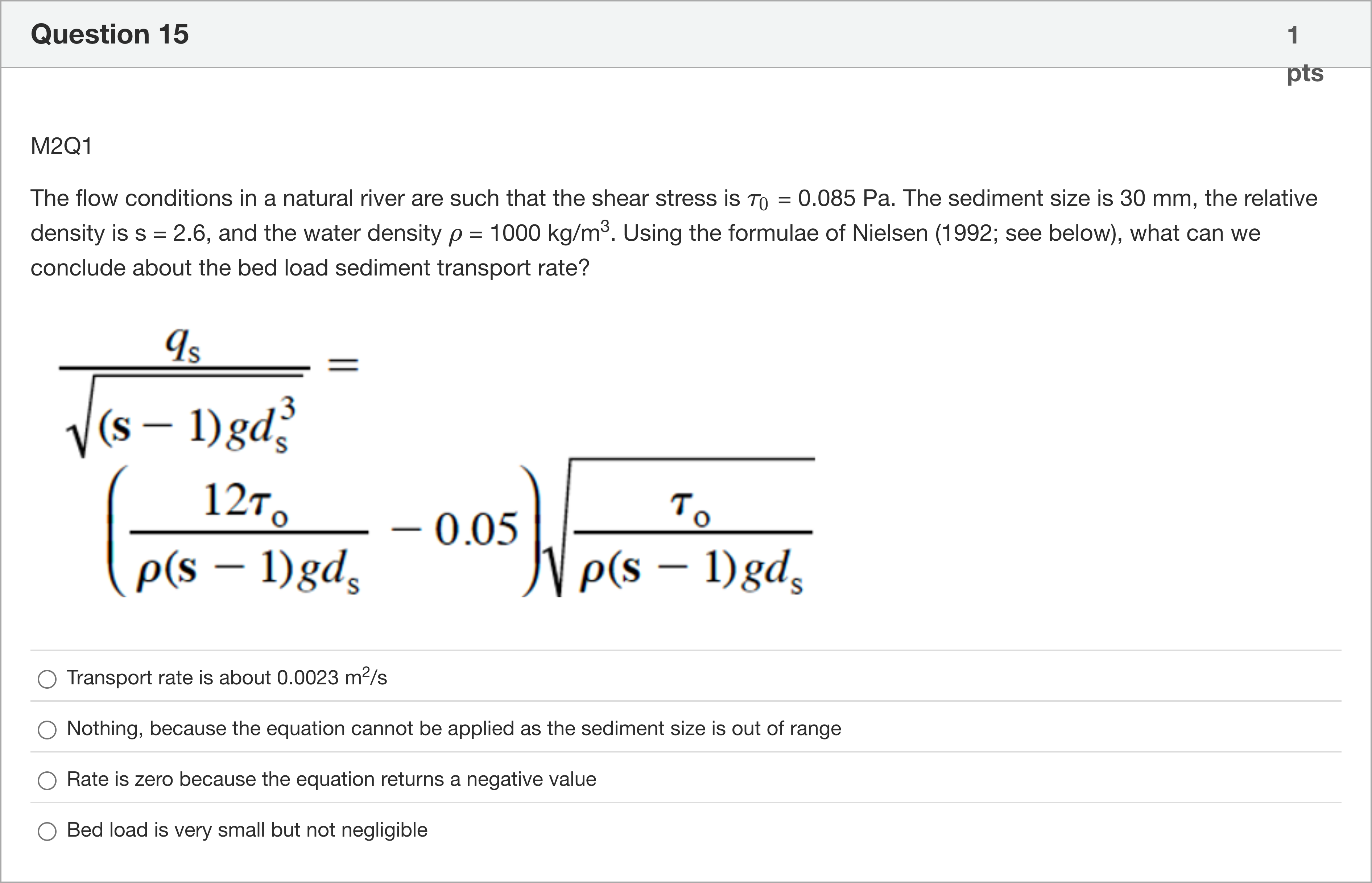
M2Q1 The flow conditions in a natural river are such that the shear stress is 𝜏 0 = 0.085 Pa. The sediment size is 30 mm, the relative density is s = 2.6, and the water density 𝜌 = 1000 kg/m3. Using the formulae of Nielsen (1992; see below), what can we conclude about the bed load sediment transport rate?
Options
A.Transport rate is about 0.0023 m2/s
B.Nothing, because the equation cannot be applied as the sediment size is out of range
C.Rate is zero because the equation returns a negative value
D.Bed load is very small but not negligible

View Explanation
Verified Answer
Please login to view
Step-by-Step Analysis
Restating the problem in my own words: we have flow conditions with shear stress tau0 = 0.085 Pa in a natural river. The sediment size is 30 mm, relative density s = 2.6, water density rho = 1000 kg/m^3. Using Nielsen (1992) formulas, we must determine the bed load transport rate q_s.
Option A: Transport rate is about 0.0023 m^2/s. This would imply a finite, positive bed load rate predicted by the equation. To accept this, the right-hand side of Nielsen’s expression must yield a positive value large enough to give q_s / sqrt((s-1) g d_s^3) ≈ some positive number. However, whether this specific numerical value is obtained depends on plugging in the g......Login to view full explanationLog in for full answers
We've collected over 50,000 authentic exam questions and detailed explanations from around the globe. Log in now and get instant access to the answers!
Similar Questions
M2Q9 PART #1 (Numerical Answer) The discharge in a river is 32 m3/s. The river width is 10 m, and the uniform depth is 2.9m (Manning's coefficient n = 0.031 and slope = 0.0007). The depth-averaged suspended sediment concentration Cs = 0.76% and the d50 at the river bed is 0.6 mm. PART #1 (numerical calculation): What is the suspended sediment transport rate? (Assume the relative density s = 2.6, water density 𝜌 = 1000 kg/m3, viscosity 10-6 m2/s). (Use the modified shield diagram below if necessary). (Answer in m2/s).
M2Q10 PART #1 (Numerical Answer) A river has a width B = 3 m and an average normal depth dn = 0.87 m. The characteristic sediment size is ds = 92 mm. The riverbed exhibits bedforms such that skin friction contributes 60% of the total bed shear and the remaining 40% is due to form drag. PART #1 (numerical calculations): Assuming uniform flow, what is the minimum slope to initiate bed load motion of the sediment? (Use the Shield diagram below if necessary; assume the relative density s = 2.6, water density 𝜌 = 1000 kg/m3, viscosity 10-6 m2/s). (Answer with three decimal digits, e.g. 0.999).
M2Q3 Consider water flow over a natural river bed with a characteristic sediment size ds = 1 mm. Using the modified Shields diagram below, with water density 𝜌 = 1000 kg/m3 and viscosity 𝜈 = 10-6 m2/s, and without any other inputs, which of the following statements represents realistic conditions if the Shields parameter 𝜏 ∗ = 0.75?
M2Q10 PART #1 (METHOD) A river has a width B = 3 m and an average normal depth dn = 0.87 m. The characteristic sediment size is ds = 92 mm. The riverbed exhibits bedforms such that skin friction contributes 60% of the total bed shear and the remaining 40% is due to form drag. PART #2 (method): Which approach correctly describes how the minimum slope was estimated to mobilise the sediment?
More Practical Tools for Students Powered by AI Study Helper
Making Your Study Simpler
Join us and instantly unlock extensive past papers & exclusive solutions to get a head start on your studies!