
Questions
BIOL3612.MERGED.202610 Activity Questions from the Literature 4B: Proteins with bound lipids and carbohydrates
Single choice
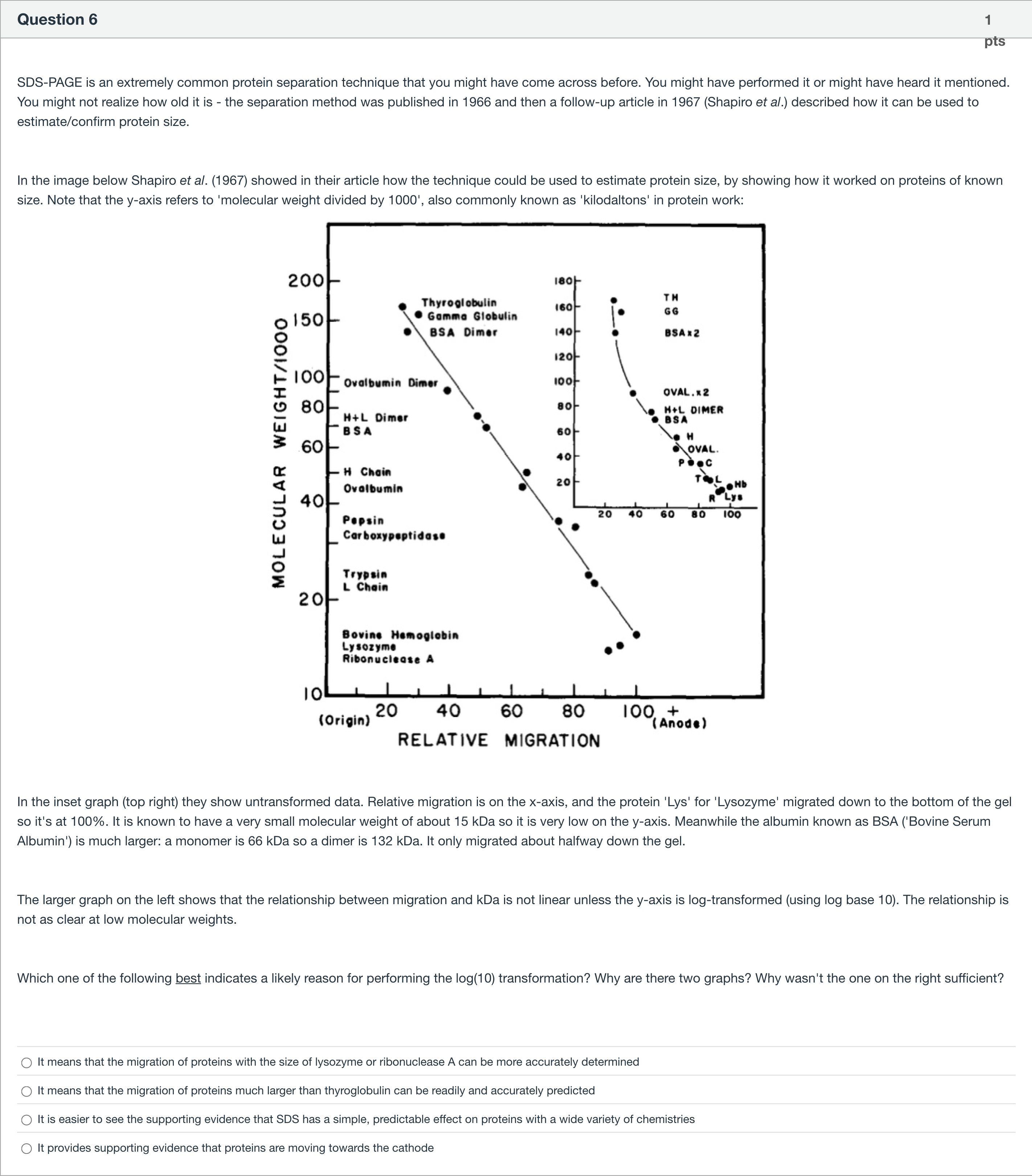
SDS-PAGE is an extremely common protein separation technique that you might have come across before. You might have performed it or might have heard it mentioned. You might not realize how old it is - the separation method was published in 1966 and then a follow-up article in 1967 (Shapiro et al.) described how it can be used to estimate/confirm protein size. In the image below Shapiro et al. (1967) showed in their article how the technique could be used to estimate protein size, by showing how it worked on proteins of known size. Note that the y-axis refers to 'molecular weight divided by 1000', also commonly known as 'kilodaltons' in protein work: In the inset graph (top right) they show untransformed data. Relative migration is on the x-axis, and the protein 'Lys' for 'Lysozyme' migrated down to the bottom of the gel so it's at 100%. It is known to have a very small molecular weight of about 15 kDa so it is very low on the y-axis. Meanwhile the albumin known as BSA ('Bovine Serum Albumin') is much larger: a monomer is 66 kDa so a dimer is 132 kDa. It only migrated about halfway down the gel. The larger graph on the left shows that the relationship between migration and kDa is not linear unless the y-axis is log-transformed (using log base 10). The relationship is not as clear at low molecular weights. Which one of the following best indicates a likely reason for performing the log(10) transformation? Why are there two graphs? Why wasn't the one on the right sufficient?
Options
A.It means that the migration of proteins with the size of lysozyme or ribonuclease A can be more accurately determined
B.It means that the migration of proteins much larger than thyroglobulin can be readily and accurately predicted
C.It is easier to see the supporting evidence that SDS has a simple, predictable effect on proteins with a wide variety of chemistries
D.It provides supporting evidence that proteins are moving towards the cathode

View Explanation
Verified Answer
Please login to view
Step-by-Step Analysis
The question asks: Which option best explains why Shapiro et al. presented two graphs and discussed log(10) transformation in the context of SDS-PAGE data? We will evaluate each statement for correctness and clarity.
Option 1: 'It means that the migration of proteins with the size of lysozyme or ribonuclease A can be more accurately determined.' This is not the primary reason for the log transformation. The issue is not about increasing accuracy for a single small set of proteins, but about linearizing a broad relationship between migration and molecular weight across a wide range of ......Login to view full explanationLog in for full answers
We've collected over 50,000 authentic exam questions and detailed explanations from around the globe. Log in now and get instant access to the answers!
Similar Questions
Which technique comes right before a western blot, according to the video?
Shapiro et al. (1967) noted that SDS-PAGE separation could be used for a wide variety of proteins, including those with multiple subunits, those with disulfide bonds, and those with a wide range of pI values, where low pI indicates high proportion of acidic residues and high pI indicates high proportion of highly basic residues. They said that "despite the choice of a group of proteins with a range of isoelectric points from 4 to 11... all points approximated the fitted curves, suggesting that SDS minimizes the native charge differences and that all proteins migrate as anions as the result of complex formation with SDS. The extensive disruption of hydrogen, hydrophobic, and disulfide linkages by SDS and [beta-mercaptoethanol] results in the quantitative solubilization of many insoluble proteins. These factors and the ease of the polyacrylamide technique strongly recommend it as the electrophoretic method of choice." It must have seemed quite surprising that SDS would be so effective at overwhelming the inherent and variable charge that proteins have! Review SDS structure here Links to an external site. if needed. All of the following might be interactions that SDS makes with proteins as it helps to unfold and coat them except:
What causes the proteins to have a similar mass:charge ratio to each other?
To identify the green fluorescent protein on the SDS-PAGE gel, we were trying to
More Practical Tools for Students Powered by AI Study Helper
Making Your Study Simpler
Join us and instantly unlock extensive past papers & exclusive solutions to get a head start on your studies!