
Questions
BPS3021 S1 2025 CYL | Cloning into a vector
Single choice
You have treated a plasmid with different restriction enzymes. Given the plasmid map and gel below, answer the following questions: Which lane corresponds to treating the plasmid with EcoRI?
Options
A.a. I
B.b. II
C.c. III
D.d. IV
E.e. V
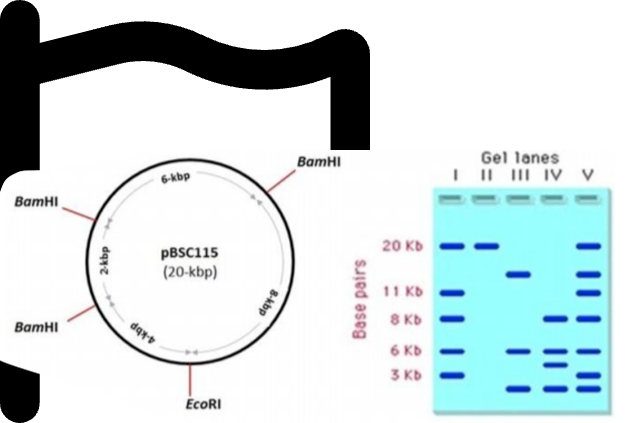

View Explanation
Verified Answer
Please login to view
Step-by-Step Analysis
Here is the step-by-step analysis of each answer option for the question about which lane corresponds to treating the plasmid with EcoRI.
Option a. I: Evaluate what EcoRI does to the plasmid map. If Lane I does not show the expected EcoRI restriction pattern (e.g., not the characteristic fragment sizes or banding) then this lane would be unlikely to......Login to view full explanationLog in for full answers
We've collected over 50,000 authentic exam questions and detailed explanations from around the globe. Log in now and get instant access to the answers!
Similar Questions
The image below shows the restriction map of a circular plasmid that is 2981 base pairs long. The recognition sites of 3 restriction endonucleases are shown in base pairs from the origin of replication (0 bp). Link to image. Links to an external site. What is the size of the smallest fragment in base pairs, produced by digestion of the plasmid with PvuI and Xmn1?
he image below shows the restriction map of a circular plasmid that is 2981 base pairs long. The recognition sites of 3 restriction endonucleases are shown in base pairs from the origin of replication (0 bp). Link to image. Links to an external site. What is the size of the largest fragment in base pairs, produced by digestion of the plasmid with PvuI and Xmn1?
The image below shows the restriction map of a circular plasmid that is 2981 base pairs long. The recognition sites of 3 restriction endonucleases are shown in base pairs from the origin of replication (0 bp). Link to image. Links to an external site. What is the size of the largest fragment in base pairs, produced by digestion of the plasmid with PvuI?
The image below shows the restriction map of a circular plasmid that is 2981 base pairs long. The recognition sites of 3 restriction endonucleases are shown in base pairs from the origin of replication (0 bp). Link to image. Links to an external site. What is the size of the largest fragment in base pairs, produced by digestion of the plasmid with EcoR1?
More Practical Tools for Students Powered by AI Study Helper
Making Your Study Simpler
Join us and instantly unlock extensive past papers & exclusive solutions to get a head start on your studies!