
Questions
ART H 200 A First Exam
True/False
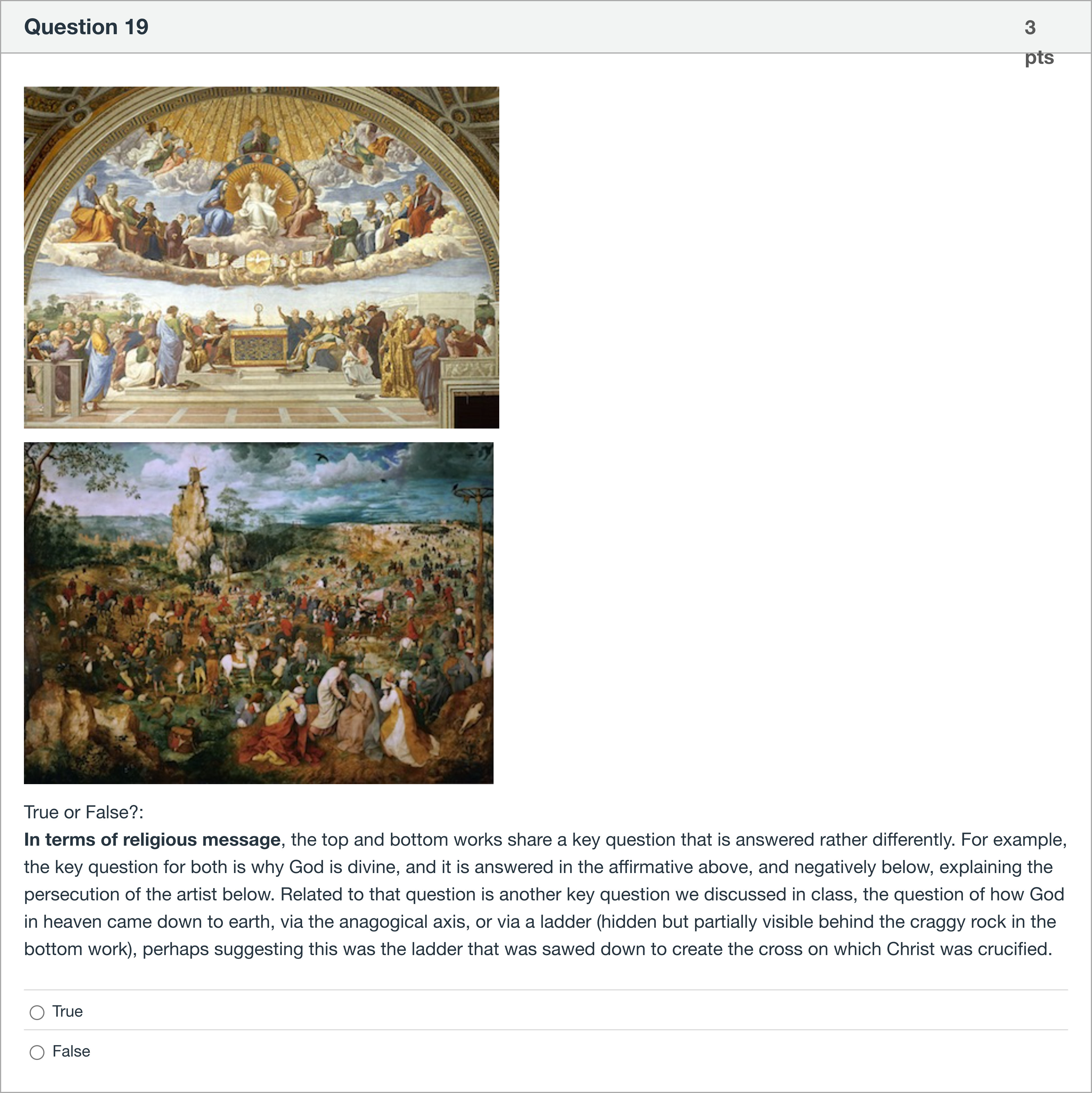
True or False?: In terms of religious message, the top and bottom works share a key question that is answered rather differently. For example, the key question for both is why God is divine, and it is answered in the affirmative above, and negatively below, explaining the persecution of the artist below. Related to that question is another key question we discussed in class, the question of how God in heaven came down to earth, via the anagogical axis, or via a ladder (hidden but partially visible behind the craggy rock in the bottom work), perhaps suggesting this was the ladder that was sawed down to create the cross on which Christ was crucified.
Options
A.True
B.False

View Explanation
Verified Answer
Please login to view
Step-by-Step Analysis
The prompt presents a true/false statement about two religious artworks and the questions they raise, with the claim that both share a key question that is answered differently.
Option 1 (True): We assess whether the statement that the top and bottom works share a key question about why God is divine, and that this question is answered in the affirmative in the top work and negatively in the bottom work (relating to persecution of the artist), is consistent with the described analysis. The t......Login to view full explanationLog in for full answers
We've collected over 50,000 authentic exam questions and detailed explanations from around the globe. Log in now and get instant access to the answers!
Similar Questions
In this painting by Parmigianino, the Madonna and Child foreshadow...
True or False?: In terms of religious message, the top and bottom works share a key question that is answered rather differently. For example, the top scene stages a debate or dispute about the nature of the Eucharistic sacrament, shown in the vanishing point, a message showing so clearly that there is a direct link between the Eucharistic wafer of bread and Christ’s body that there really is no dispute (despite the title). In the composition at bottom, the message of Christ's sacrifice is all but lost to the people around him, and graspable as important only to a viewer who is attentive to the composition as a whole because Christ is located in the dead center. Here, the connection with the bread tenuous (not secure), only suggested by the mill high on a craggy rock. If this artist was a member of the Family of Love, he may thus covertly (secretly) suggest that it is time to stop killing Christians over questions raised about a piece of bread.
This picture was rejected by the church fathers for:
Who is depicted in the center of the composition of the marble panel from Nicola Pisano's pulpit in Pisa depicting the Annunciation, Nativity, and Adoration of the Shepherds?
More Practical Tools for Students Powered by AI Study Helper
Making Your Study Simpler
Join us and instantly unlock extensive past papers & exclusive solutions to get a head start on your studies!