
Questions
MUF0042 Chemistry Unit 2 - Semester 2, 2025 10.13 Quiz: Balancing Redox Reactions
Single choice
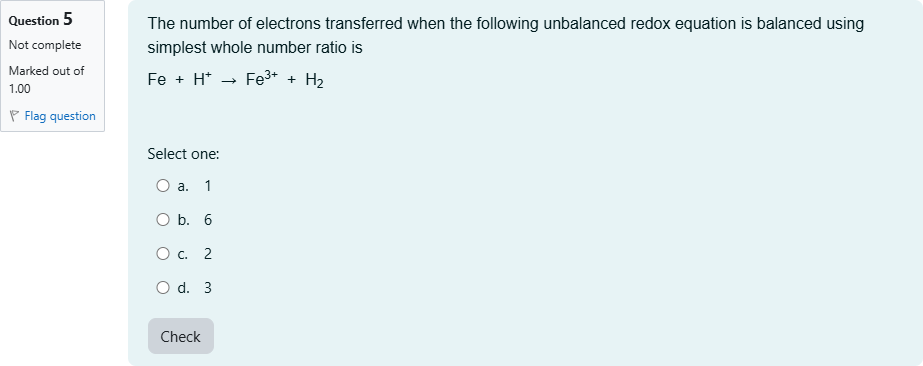
The number of electrons transferred when the following unbalanced redox equation is balanced using simplest whole number ratio is Fe + H+ → Fe3+ + H2
Options
A.a. 1
B.b. 6
C.c. 2
D.d. 3

View Explanation
Verified Answer
Please login to view
Step-by-Step Analysis
The problem asks about the number of electrons transferred when the unbalanced redox equation Fe + H+ → Fe3+ + H2 is balanced in the simplest whole-number ratio.
First, consider the oxidation half-reaction: Fe → Fe3+ + 3 e-. This shows that iron is losing 3 electrons (oxidation).
Next, consider the reduction half-reaction......Login to view full explanationLog in for full answers
We've collected over 50,000 authentic exam questions and detailed explanations from around the globe. Log in now and get instant access to the answers!
Similar Questions
Redox (reduction/oxidation) reactions are those where a transfer of electrons has occurred. One species is oxidised (lost electrons) and other species must be reduced (gain electrons). Consider the following reaction and identify which species is oxidised (loses electrons) and which is reduced (gains electrons). Na(s) + ½Cl2(g) → NaCl(s) Hint: considering the oxidation numbers of each species before and after might be helpful. If oxidation number increases oxidation has occured, if oxidation has decreased, reduction has occurred.
Which of the below is the correctly balanced redox reaction of ammonium ion (NH4+) to the nitrite ion (NO2−).
During redox reactions:
The number of electrons transferred when the following unbalanced redox equation is balanced using simplest whole number ratio is Cu+(aq) + Fe(s) → Cu(s) + Fe3+(aq)
More Practical Tools for International Students
Making Your Study Simpler
Join us and instantly unlock extensive past papers & exclusive solutions to get a head start on your studies!