
Questions
Single choice
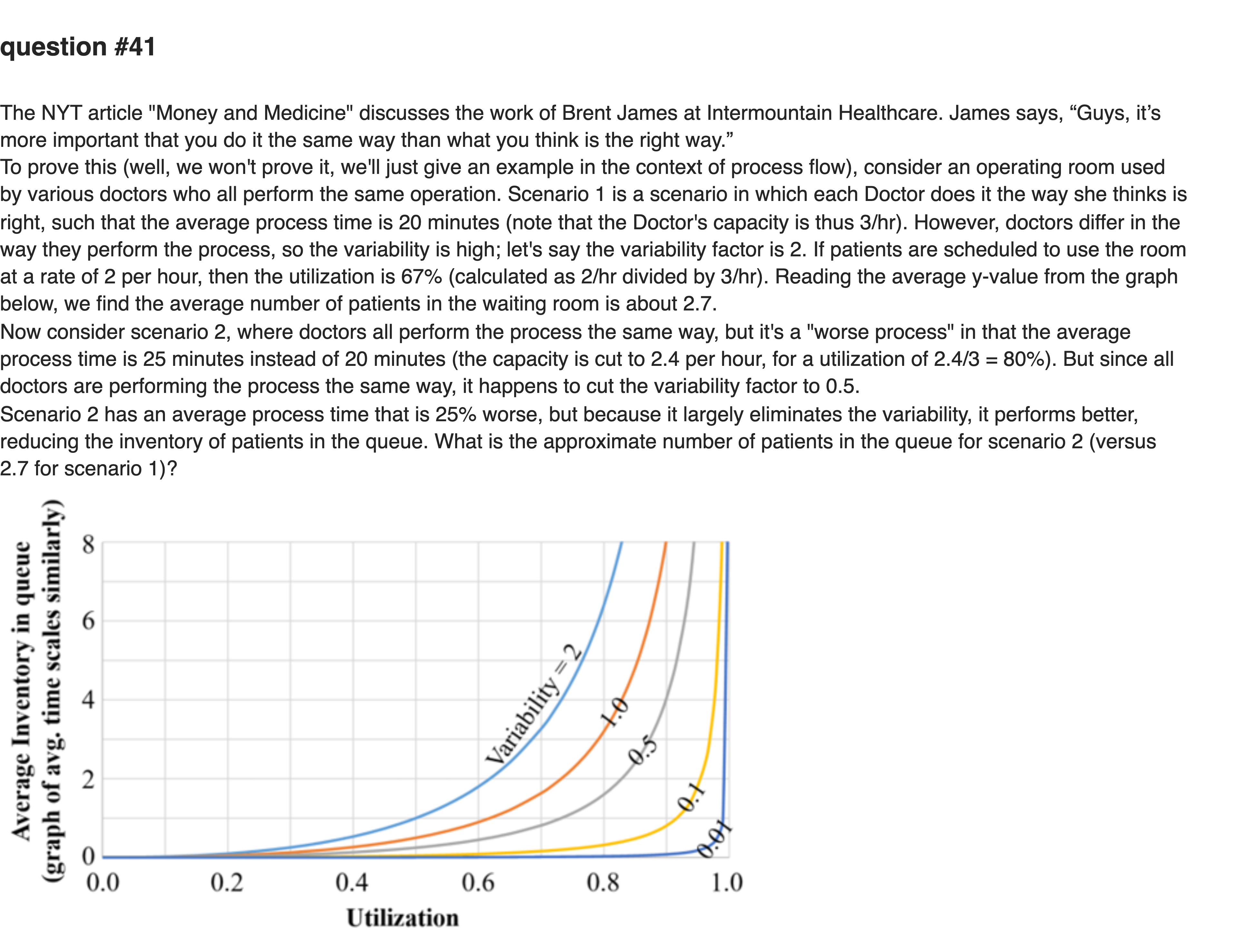
question #41 The NYT article "Money and Medicine" discusses the work of Brent James at Intermountain Healthcare. James says, “Guys, it’s more important that you do it the same way than what you think is the right way.” To prove this (well, we won't prove it, we'll just give an example in the context of process flow), consider an operating room used by various doctors who all perform the same operation. Scenario 1 is a scenario in which each Doctor does it the way she thinks is right, such that the average process time is 20 minutes (note that the Doctor's capacity is thus 3/hr). However, doctors differ in the way they perform the process, so the variability is high; let's say the variability factor is 2. If patients are scheduled to use the room at a rate of 2 per hour, then the utilization is 67% (calculated as 2/hr divided by 3/hr). Reading the average y-value from the graph below, we find the average number of patients in the waiting room is about 2.7. Now consider scenario 2, where doctors all perform the process the same way, but it's a "worse process" in that the average process time is 25 minutes instead of 20 minutes (the capacity is cut to 2.4 per hour, for a utilization of 2.4/3 = 80%). But since all doctors are performing the process the same way, it happens to cut the variability factor to 0.5. Scenario 2 has an average process time that is 25% worse, but because it largely eliminates the variability, it performs better, reducing the inventory of patients in the queue. What is the approximate number of patients in the queue for scenario 2 (versus 2.7 for scenario 1)? quiz41
Options
A.About 1 patient in the queue
B.About 2.5 patients in the queue
C.About 1.6 patients in the queue
D.About 0.3 patients in the queue

View Explanation
Verified Answer
Please login to view
Step-by-Step Analysis
Let's walk through each answer choice by considering how changes in process time and variability affect queue length in a queuing context.
Option 1: About 1 patient in the queue
This option aligns with the intuition that, although the average process time worsens (25 minutes vs 20), the dramatic reduction in variability (factor from 2 to 0.5) can lead to a more predictable and smoother flow. With higher utilization (2.4/3 = 0.80) but much less variability, the system can keep more pati......Login to view full explanationLog in for full answers
We've collected over 50,000 authentic exam questions and detailed explanations from around the globe. Log in now and get instant access to the answers!
Similar Questions
Question at position 7 Customer priority sequencing allows some customers to be served before others even if they arrived later.TrueFalse
Why does pooling multiple queues typically reduce total average waiting time?
Cont. from previous questions. The market is evaluating an innovative technology that helps reduce the variation in the checkout process (i.e., CVp), 6. Will the adoption of the new technology bring down the average customer waiting time?
Cont. from previous questions. The market is evaluating an innovative technology that helps reduce the variation in the checkout process (i.e., CVp), 5. Will the adoption of the new technology bring down the utilization of the checkout line?
More Practical Tools for Students Powered by AI Study Helper
Making Your Study Simpler
Join us and instantly unlock extensive past papers & exclusive solutions to get a head start on your studies!