
Questions
BIOL3612.MERGED.202610 Activity Questions from the Literature 5B: Harvesting and using electrons
Single choice
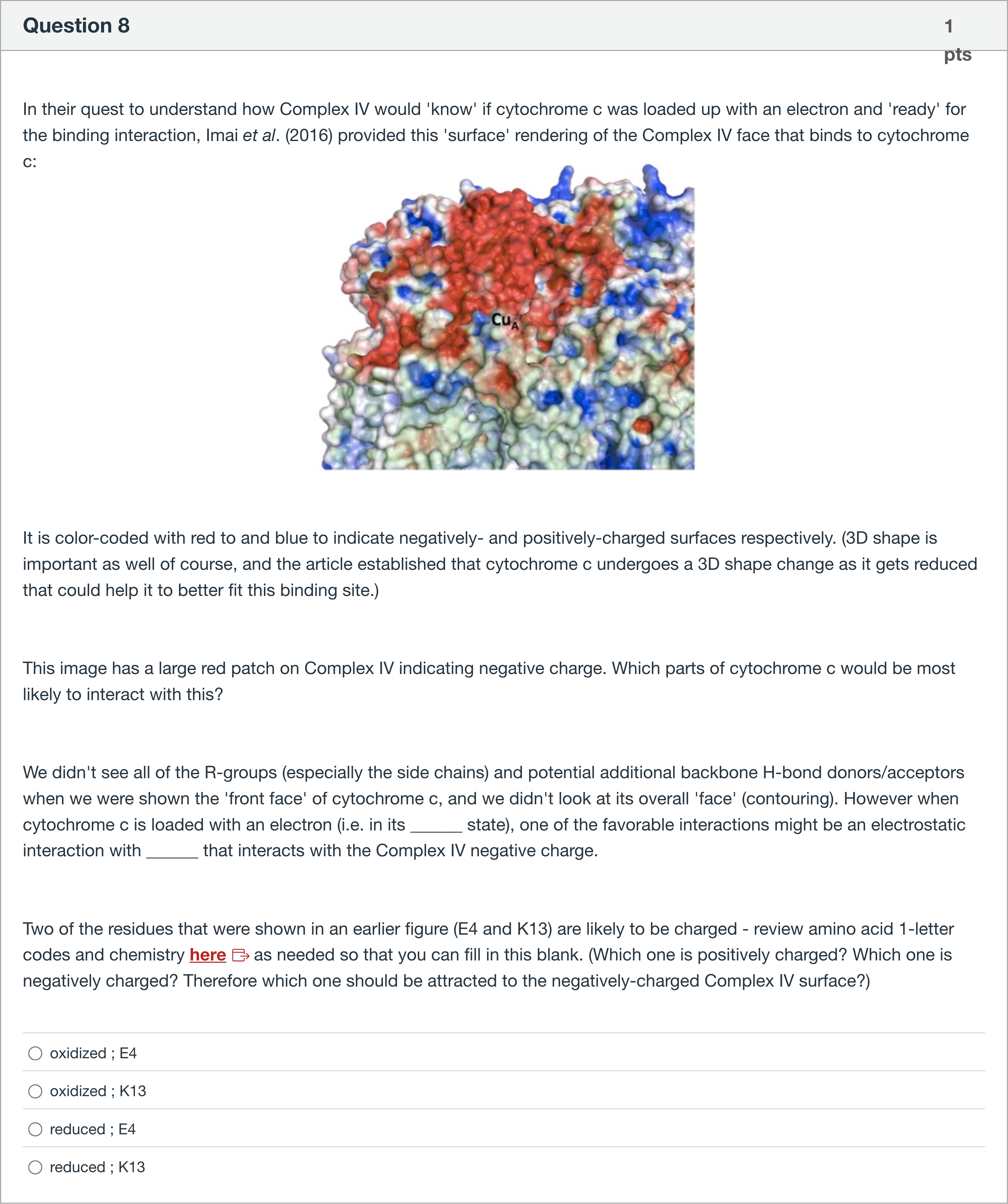
In their quest to understand how Complex IV would 'know' if cytochrome c was loaded up with an electron and 'ready' for the binding interaction, Imai et al. (2016) provided this 'surface' rendering of the Complex IV face that binds to cytochrome c: It is color-coded with red to and blue to indicate negatively- and positively-charged surfaces respectively. (3D shape is important as well of course, and the article established that cytochrome c undergoes a 3D shape change as it gets reduced that could help it to better fit this binding site.) This image has a large red patch on Complex IV indicating negative charge. Which parts of cytochrome c would be most likely to interact with this? We didn't see all of the R-groups (especially the side chains) and potential additional backbone H-bond donors/acceptors when we were shown the 'front face' of cytochrome c, and we didn't look at its overall 'face' (contouring). However when cytochrome c is loaded with an electron (i.e. in its ______ state), one of the favorable interactions might be an electrostatic interaction with ______ that interacts with the Complex IV negative charge. Two of the residues that were shown in an earlier figure (E4 and K13) are likely to be charged - review amino acid 1-letter codes and chemistry here Links to an external site. as needed so that you can fill in this blank. (Which one is positively charged? Which one is negatively charged? Therefore which one should be attracted to the negatively-charged Complex IV surface?)
Options
A.oxidized ; E4
B.oxidized ; K13
C.reduced ; E4
D.reduced ; K13

View Explanation
Verified Answer
Please login to view
Step-by-Step Analysis
Let's break down the prompt and each answer option to understand the reasoning behind the correct pair.
First, the question asks: which state of cytochrome c and which residue would interact with the negatively charged patch on Complex IV? The key ideas are:
- The Complex IV surface is negatively charged (red patch).
- An attractive electrostatic interaction would occur with a positively charged residue on cytochrome c.
- The binding context described involves cytochrome c being loaded with an electron, i.e., cytochrome c in its reduced state, ......Login to view full explanationLog in for full answers
We've collected over 50,000 authentic exam questions and detailed explanations from around the globe. Log in now and get instant access to the answers!
Similar Questions
In a consumer society, many adults channel creativity into buying things
Economic stress and unpredictable times have resulted in a booming industry for self-help products
People born without creativity never can develop it
A product has a selling price of $20, a contribution margin ratio of 40% and fixed cost of $120,000. To make a profit of $30,000. The number of units that must be sold is: Type the number without $ and a comma. Eg: 20000
More Practical Tools for Students Powered by AI Study Helper
Making Your Study Simpler
Join us and instantly unlock extensive past papers & exclusive solutions to get a head start on your studies!