
Questions
ECON 1101 In-Class Activity 4 (Lectures): Government Policies and Efficiency of Market Outcomes
Single choice
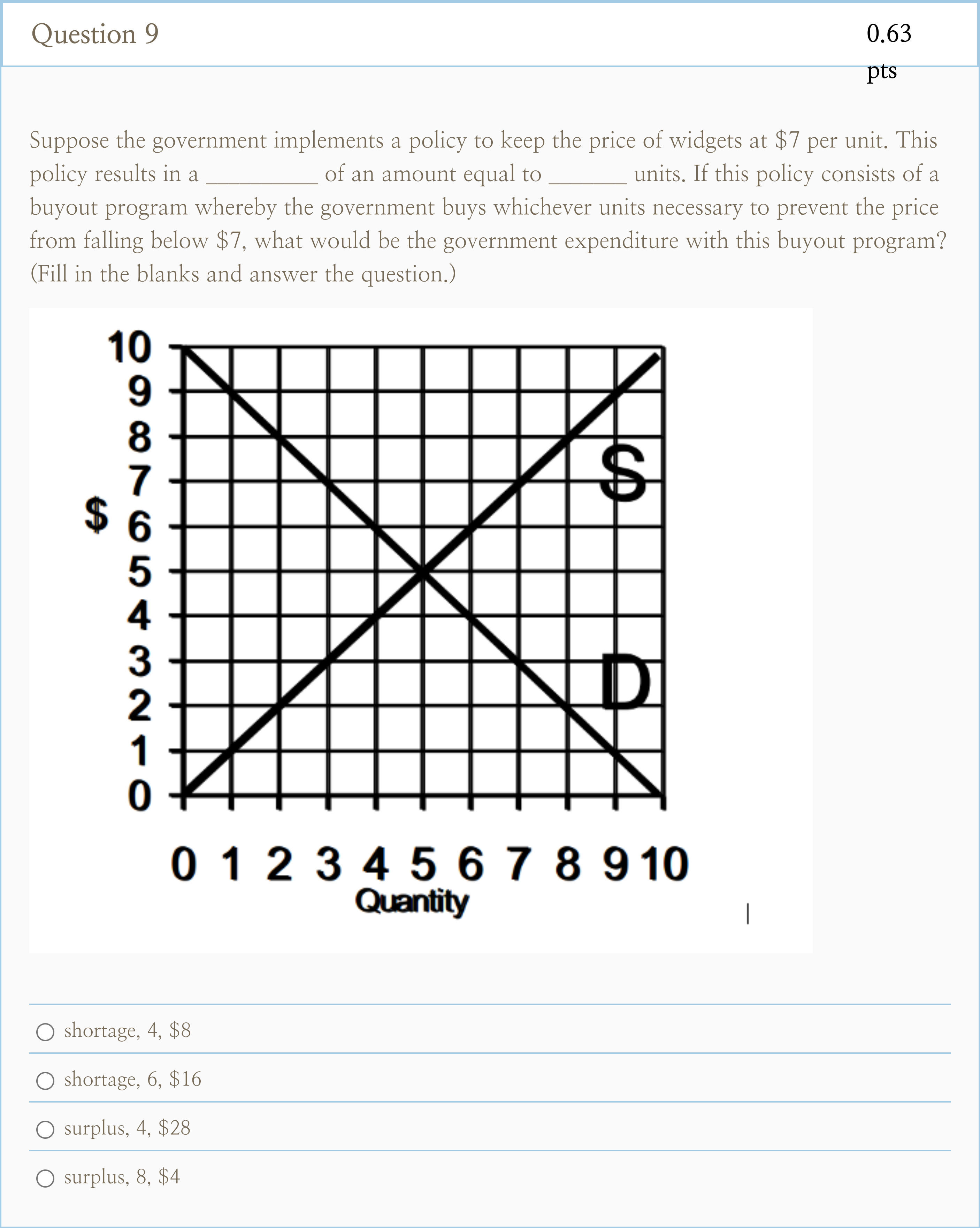
Suppose the government implements a policy to keep the price of widgets at $7 per unit. This policy results in a __________ of an amount equal to _______ units. If this policy consists of a buyout program whereby the government buys whichever units necessary to prevent the price from falling below $7, what would be the government expenditure with this buyout program? (Fill in the blanks and answer the question.)
Options
A.shortage, 4, $8
B.shortage, 6, $16
C.surplus, 4, $28
D.surplus, 8, $4

View Explanation
Verified Answer
Please login to view
Step-by-Step Analysis
To approach this problem, I’ll first identify what a price floor at $7 does in a market with standard downward-sloping demand and upward-sloping supply, using the provided graph.
Option A: short age, 4, $8 — Why this is unlikely: A price floor above equilibrium typically creates a surplus, not a shortage. Since the floor is at $7 and the equilibrium price on the graph is below 7, this option’s classifica......Login to view full explanationLog in for full answers
We've collected over 50,000 authentic exam questions and detailed explanations from around the globe. Log in now and get instant access to the answers!
Similar Questions
Figure 6-4 Graph (a) Graph (b) Refer to Figure 6-4. In graph (b), there will be
A price floor is
22. The price floor ( min price) creates excess supply (surplus)
If a price floor at P4 is set to help farmers in terms of income and government wants to assure farmers that their output will be purchased, the government would have to purchase an amount of output equal to:
More Practical Tools for Students Powered by AI Study Helper
Making Your Study Simpler
Join us and instantly unlock extensive past papers & exclusive solutions to get a head start on your studies!