
Questions
BIO 181 (001&002) FALL 2025 FA25: Cumulative Exam 4 covers the most important content from Units 1-4: You can do this!!! : ) [Grade is out of 150/900 pts, the same am't of pts for the active learning "easy points" classwork.]
Single choice
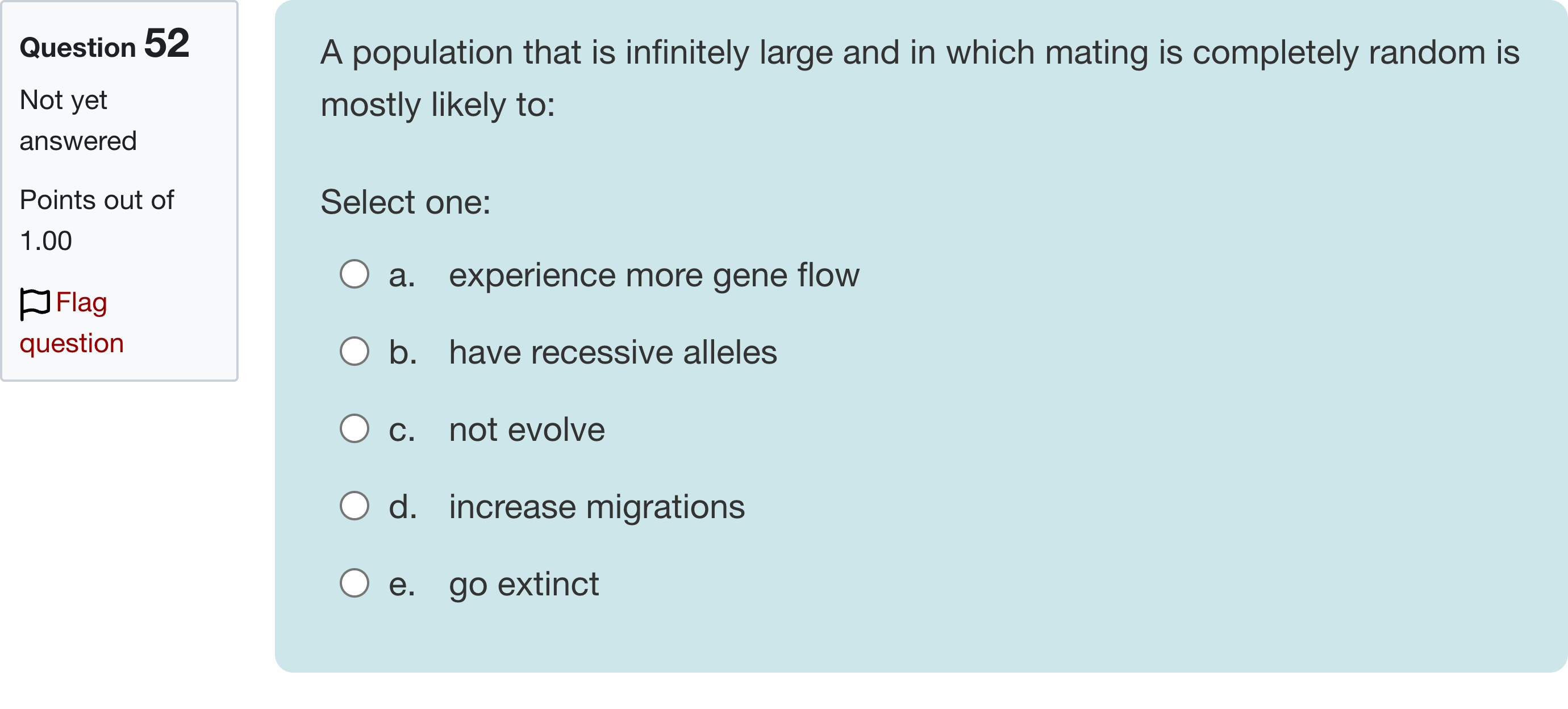
A population that is infinitely large and in which mating is completely random is mostly likely to:
Options
A.a. experience more gene flow
B.b. have recessive alleles
C.c. not evolve
D.d. increase migrations
E.e. go extinct

View Explanation
Verified Answer
Please login to view
Step-by-Step Analysis
Question restatement: A population that is infinitely large and in which mating is completely random is mostly likely to:\n\nOptions:\n a. experience more gene flow\n b. have recessive alleles\n c. not evolve\n d. increase migrations\n e. go extinct\n\nNow, let's examine each option one by one with careful reasoning:\n\nOption a: experience more gene flow. Gene flow refers to the transfer of alleles among populations via migration. In this scenario, the population is described as infinitely large and randomly mating, but there is no mention of individuals migratin......Login to view full explanationLog in for full answers
We've collected over 50,000 authentic exam questions and detailed explanations from around the globe. Log in now and get instant access to the answers!
Similar Questions
CHOOSE THE BEST ANSWER FOR EACH QUESTION As humans spread around the world, they often adapted to local conditions, especially local diseases. One example is the evolution of greater resistance to the pathogen that causes malaria. The evolution of greater resistance to malaria has been observed in human populations from three regions (South America, Western Africa, and Southeast Asia). Recent genomic studies of these populations have identified several alleles related to malaria resistance that show evidence of positive selection based on SNP analysis. SNP is short for [ Select ] "selected-nucleotide process" "single-nucleotide polymorphism" "short-nucleotide pattern" "sequenced-nucleotide partition" . What does it mean that these alleles show evidence of a "positive selection", from a genomic perspective? [ Select ] It is not possible to identify evidence of selection using SNPs. These alleles will not have identifiable SNPs because they have not undergone genetic drift. SNPs associated with these alleles will have a high frequency in these three regions relative to other regions. NPs associated with these alleles will be rare in these three regions relative to other regions.
Question at position 21 What is the most important determinant of genetic differences between populations of humans across the world?RaceEthnicityGeographic distanceLocal adaptationClear my selection
Question at position 14 Genetic diversity amongst human populations is best explained by __________.cultural differencespopulation sizeethnicityracial categorizesgeographic distanceClear my selection
Question at position 28 In accordance with the "Out-of-Africa" hypothesis, we would expect that _________ populations would have greater genetic diversity.youngeroldersmallerwiserlargerClear my selection
More Practical Tools for Students Powered by AI Study Helper
Making Your Study Simpler
Join us and instantly unlock extensive past papers & exclusive solutions to get a head start on your studies!