
Questions
MHF4U - Advanced Functions 12 (2025-26) - A
Single choice
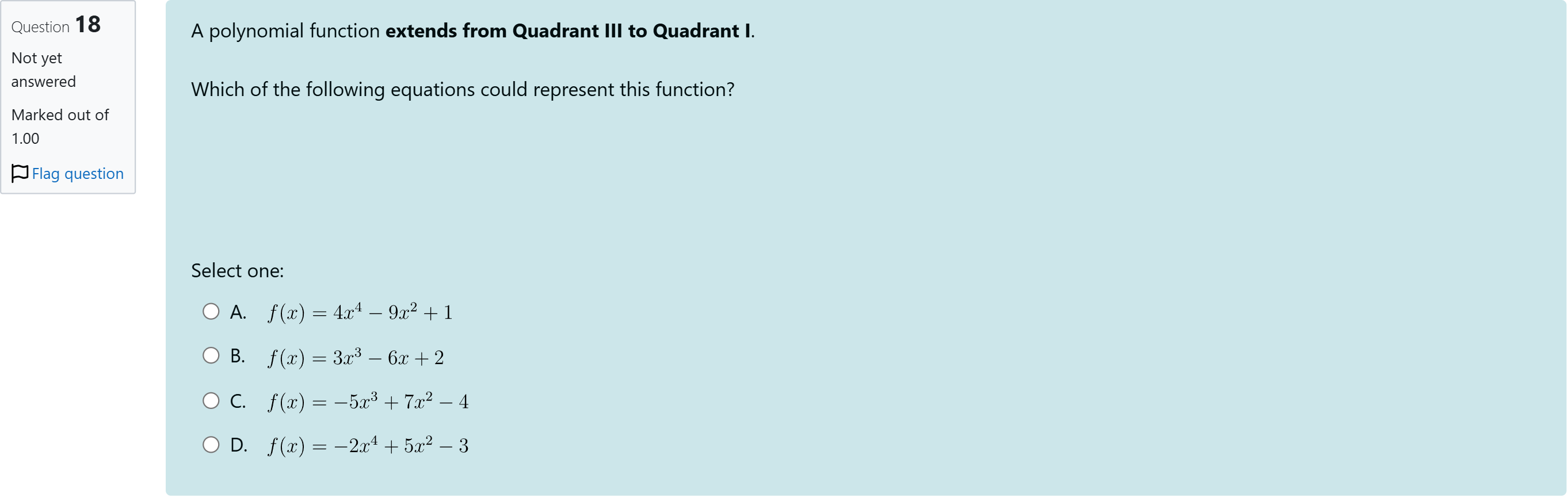
A polynomial function extends from Quadrant III to Quadrant I.Which of the following equations could represent this function?
Options
A.A. f(x) = 4x^4 - 9x^2 + 1
B.B. f(x) = 3x^3 - 6x + 2
C.C. f(x) = -5x^3 + 7x^2 - 4
D.D. f(x) = -2x^4 + 5x^2 - 3

View Explanation
Verified Answer
Please login to view
Step-by-Step Analysis
The question asks us to identify which polynomial could represent a function that extends from Quadrant III to Quadrant I.
Option A: f(x) = 4x^4 − 9x^2 + 1
This is a fourth-degree polynomial (even degree) with positive leading coefficient. As x → ±∞, the x^4 term dominates and f(x) → +∞ on both ends. That means the end behavior goes ......Login to view full explanationLog in for full answers
We've collected over 50,000 authentic exam questions and detailed explanations from around the globe. Log in now and get instant access to the answers!
Similar Questions
Part 1Graph the polynomial function f(x)equals=negative 4 left parenthesis x plus 2 right parenthesis left parenthesis x minus 2 right parenthesis cubed−4(x+2)(x−2)3 using parts (a) through (e). Part 1(a) Determine the end behavior of the graph of the function.The graph of f behaves like yequals=[input]enter your response here for large values of StartAbsoluteValue x EndAbsoluteValuex.
Determine the end behavior of the function:f(x)=−2x3+1
Determine the end behavior of the function: 𝑓 ( 𝑥 ) = − 2 𝑥 3 + 1
What is the end behavior for the polynomial function 𝑓 ( 𝑥 ) = − 𝑥 7 + 10 𝑥 + 14 ?
More Practical Tools for Students Powered by AI Study Helper
Making Your Study Simpler
Join us and instantly unlock extensive past papers & exclusive solutions to get a head start on your studies!