
Questions
Short answer
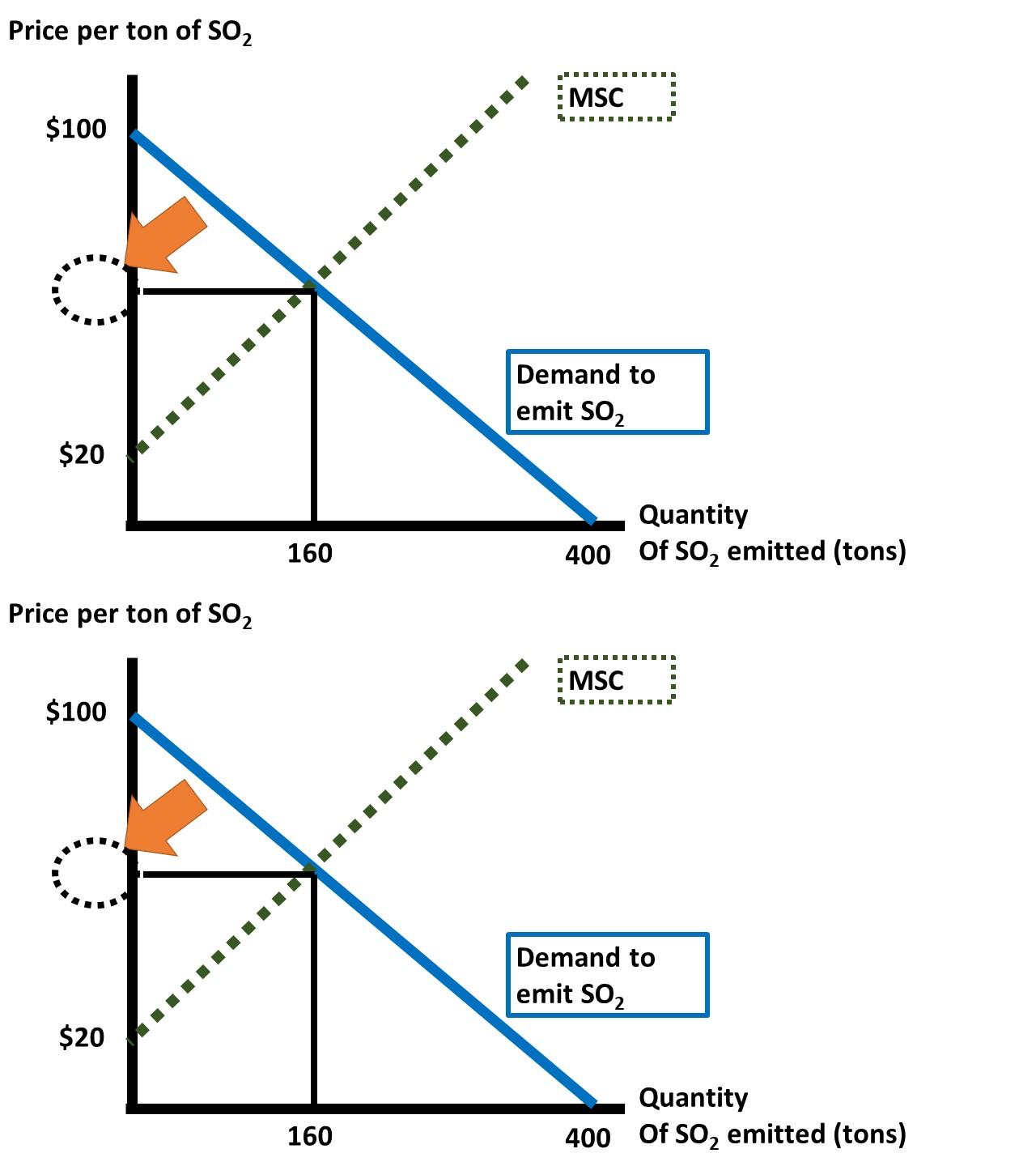
Question at position 4 Various production processes result in the emission of sulfur dioxide (SO2) gas which is a greenhouse gas and is toxic to breathe. Firms have a derived demand to emit SO2 because being able to emit the gas allows them to produce a good that has value to buyers. This allows the firm to make a profit. The demand for being able to emit SO2 is given by: QD = 400 - 4P where Q is measured in tons of gas emitted. The inverse demand function is given by: P = 100 -0.25QD. The emissions cause damages around the firms that emit SO2. The marginal social cost (MSC) of the damages from SO2 are given by: MSC = 20 +0.25Q. Determine the optimal Pigovian Tax. (Do not include "$" sign in your response.) Hint: Plug the efficient quantity into the inverse demand function.Answer Various production processes result in the emission of sulfur dioxide (SO2) gas which is a greenhouse gas and is toxic to breathe. Firms have a derived demand to emit SO2 because being able to emit the gas allows them to produce a good that has value to buyers. This allows the firm to make a profit. The demand for being able to emit SO2 is given by: QD = 400 - 4P where Q is measured in tons of gas emitted. The inverse demand function is given by: P = 100 -0.25QD. The emissions cause damages around the firms that emit SO2. The marginal social cost (MSC) of the damages from SO2 are given by: MSC = 20 +0.25Q. Determine the optimal Pigovian Tax. (Do not include "$" sign in your response.) Hint: Plug the efficient quantity into the inverse demand function.[input]
Options
A.

View Explanation
Verified Answer
Please login to view
Step-by-Step Analysis
To begin, we need to locate the socially efficient quantity where the social costs equal the marginal benefit to society.
Step 1: Write down the given equations. The private demand for emitting SO2 is QD = 400 - 4P, and the inverse demand is P = 100 - 0.25 QD. The marginal social cost of the damages from SO2......Login to view full explanationLog in for full answers
We've collected over 50,000 authentic exam questions and detailed explanations from around the globe. Log in now and get instant access to the answers!
Similar Questions
Another policy approach to externalities is for government to levy a tax or place a charge specifically on the related good.
Question at position 5 Various production processes result in the emission of sulfur dioxide (SO2) gas which is a greenhouse gas and is toxic to breathe. Firms have a derived demand to emit SO2 because being able to emit the gas allows them to produce a good that has value to buyers. This allows the firm to make a profit. The demand for being able to emit SO2 is given by: QD = 400 - 4P where Q is measured in tons of gas emitted. The inverse demand function is given by: P = 100 -0.25QD. The emissions cause damages around the firms that emit SO2. The marginal social cost (MSC) of the damages from SO2 are given by: MSC = 20 +0.25Q. The optimal Pigovian tax is $60 per ton of SO2 emitted. Determine the total tax revenue generated by the tax. (Do not include "$" sign in your response.) Hint: Multiply the tax rate by the quantity with tax.Answer Various production processes result in the emission of sulfur dioxide (SO2) gas which is a greenhouse gas and is toxic to breathe. Firms have a derived demand to emit SO2 because being able to emit the gas allows them to produce a good that has value to buyers. This allows the firm to make a profit. The demand for being able to emit SO2 is given by: QD = 400 - 4P where Q is measured in tons of gas emitted. The inverse demand function is given by: P = 100 -0.25QD. The emissions cause damages around the firms that emit SO2. The marginal social cost (MSC) of the damages from SO2 are given by: MSC = 20 +0.25Q. The optimal Pigovian tax is $60 per ton of SO2 emitted. Determine the total tax revenue generated by the tax. (Do not include "$" sign in your response.) Hint: Multiply the tax rate by the quantity with tax.[input]
Question at position 1 Various production processes result in the emission of sulfur dioxide (SO2) gas which is a greenhouse gas and is toxic to breathe. Firms have a derived demand to emit SO2 because being able to emit the gas allows them to produce a good that has value to buyers. This allows the firm to make a profit. The demand for being able to emit SO2 is given by: QD = 400 - 4P where Q is measured in tons of gas emitted. The inverse demand function is given by: P = 100 -0.25QD. Determine the quantity of emissions if there is no Pigovian Tax. Hint: Plug a price of zero into the demand function because firms do not have to pay for a good with a missing market.Answer Various production processes result in the emission of sulfur dioxide (SO2) gas which is a greenhouse gas and is toxic to breathe. Firms have a derived demand to emit SO2 because being able to emit the gas allows them to produce a good that has value to buyers. This allows the firm to make a profit. The demand for being able to emit SO2 is given by: QD = 400 - 4P where Q is measured in tons of gas emitted. The inverse demand function is given by: P = 100 -0.25QD. Determine the quantity of emissions if there is no Pigovian Tax. Hint: Plug a price of zero into the demand function because firms do not have to pay for a good with a missing market.[input]
Question at position 7 Think about the production of cattle. There are private costs to this action in raising and feeding the cattle. There are also spillover costs from the cattle in the form of methane emissions. The Total Spillover Cost of the methane is given by: TSpC = 20Q + 2Q2. The Marginal Spillover Cost of methane is given by: MSpC = 20 + 4Q. The demand for cattle is given by: QD = 50 -0.2P. The supply of cattle is given by: QS = 0.5P -27. The inverse demand function is given by: P = 250 -5Q. The inverse supply is given by: P = 54+2Q. The marginal social cost function is given by: MSC = 74 +6Q. The market quantity (QMKT)of cattle is 28 units while the efficient quantity (QE) is 16 units. The optimal Pigovian tax is $84 per unit. The supply function with tax is given by: QSTAX = 0.5P - 69. Calculate the tax revenue from the Pigovian Tax. (Do not include "$" sign in your response.) Hint: Multiply the dollar amount of the tax by the quantity with tax.Answer Think about the production of cattle. There are private costs to this action in raising and feeding the cattle. There are also spillover costs from the cattle in the form of methane emissions. The Total Spillover Cost of the methane is given by: TSpC = 20Q + 2Q2. The Marginal Spillover Cost of methane is given by: MSpC = 20 + 4Q. The demand for cattle is given by: QD = 50 -0.2P. The supply of cattle is given by: QS = 0.5P -27. The inverse demand function is given by: P = 250 -5Q. The inverse supply is given by: P = 54+2Q. The marginal social cost function is given by: MSC = 74 +6Q. The market quantity (QMKT)of cattle is 28 units while the efficient quantity (QE) is 16 units. The optimal Pigovian tax is $84 per unit. The supply function with tax is given by: QSTAX = 0.5P - 69. Calculate the tax revenue from the Pigovian Tax. (Do not include "$" sign in your response.) Hint: Multiply the dollar amount of the tax by the quantity with tax.[input]
More Practical Tools for Students Powered by AI Study Helper
Making Your Study Simpler
Join us and instantly unlock extensive past papers & exclusive solutions to get a head start on your studies!