
Questions
APBIO142-030 with labs S25 - CollegeBoard* AP Exam Prep: Multiple Choice
Single choice
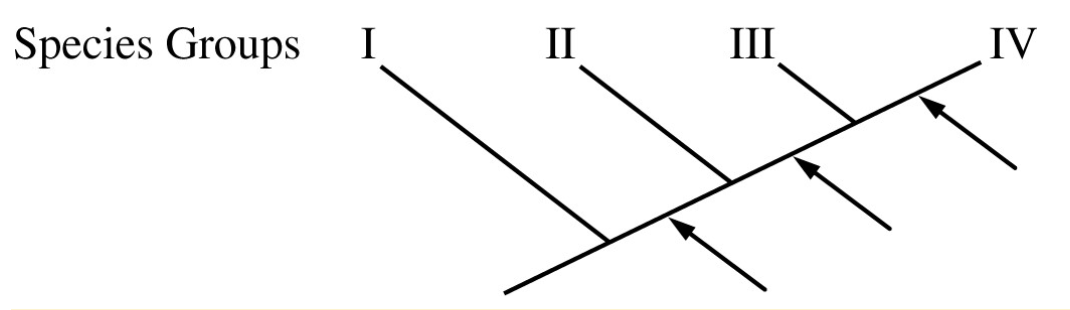
Presence (+) or absence (-) of three derived characters Plant Species Derived Characters Vascular Tissue Seeds Flowers P + + + Q - - - R + + - S + + + T - - - U + - - W + - - The table above shows the presence (+) or absence (-) of three different derived characters (vascular tissue, seeds, and flowers) for several selected plant species. The cladogram below was created based on the information in the table to represent groups of related species. The presence of the derived characters is indicated with arrows. The figure presents a cladogram with the root of the main line at the bottom left and three equally spaced branches coming off the main line. From left to right, the branches are labeled as follows: “Species Group 1,” “Species Group 2,” and “Species Group 3.” Past the third branch, the upper right end of the main line is labeled “Species Group 4.” Three arrows are drawn pointing to the main line of the cladogram. The first arrow points to the main line midway between branch 1 and branch 2. The second arrow points to the main line midway between branch 2 and branch 3. The third arrow points to the main line midway between branch 3 and the end of the main line that is labeled 4. Toxic substances often have a bitter taste that causes animals who try to eat such substances to spit them out rather than swallow them. Additional data suggest that gorilla populations have a very low frequency of nontasters. Which of the following scientific questions will best help researchers determine when the nontaster allele arose in the evolutionary history of the selected primates? Group IV of the cladogram most likely includes which of the following species?
Options
A.R and W only
B.Q and T only
C.U and W only
D.P and S only

View Explanation
Verified Answer
Please login to view
Step-by-Step Analysis
The question combines two parts: (a) understanding the distribution of derived characters (vascular tissue, seeds, flowers) across species P, Q, R, S, T, U, W, and (b) mapping which species belong to Group IV on the provided cladogram based on those derived traits.
First, restating the data:
- Derived characters per species:
- P: +, +, +
- Q: -, -, -
- R: +, +, -
- S: +, +, +
- T: -, -, -
- U: +, -, -
- W: +, -, -
Option analysis across the four choices:
- Option A: R and W only
-......Login to view full explanationLog in for full answers
We've collected over 50,000 authentic exam questions and detailed explanations from around the globe. Log in now and get instant access to the answers!
Similar Questions
Please use this image to answer the following questions. 1: The sister taxa to humans. ____ 2: The lizard is most closely related to ____. ____ 3: The outgroup ____
Hair on humans and other hominids is _____ .
Use the phylogenetic tree below to answer the following: True or False? Plants are more closely related to protists than they are to fungi.
Use a specific one-word answer to receive credit.Ideally, when making phylogenetic trees, the taxa in the tree should be ___ .Please double check your spelling to make sure the word is spelled correctly. Thank you!
More Practical Tools for Students Powered by AI Study Helper
Making Your Study Simpler
Join us and instantly unlock extensive past papers & exclusive solutions to get a head start on your studies!