
Questions
BU.220.610.51.FA25 M7 Practice Quiz
Single choice
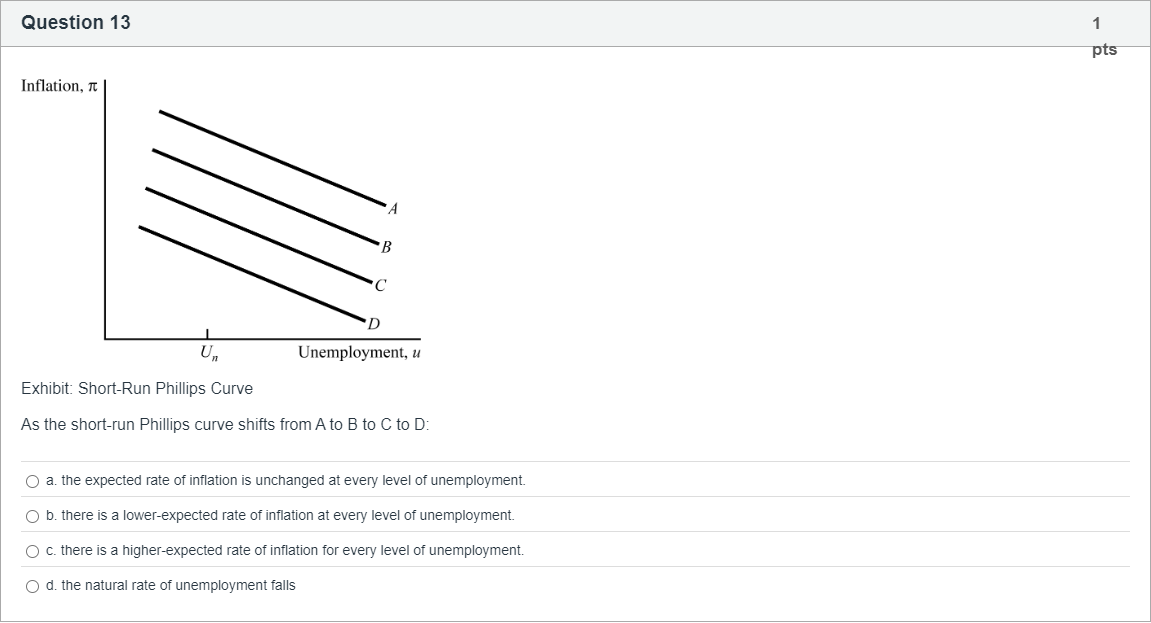
Exhibit: Short-Run Phillips Curve As the short-run Phillips curve shifts from A to B to C to D:
Options
A.a. the expected rate of inflation is unchanged at every level of unemployment.
B.b. there is a lower-expected rate of inflation at every level of unemployment.
C.c. there is a higher-expected rate of inflation for every level of unemployment.
D.d. the natural rate of unemployment falls

View Explanation
Verified Answer
Please login to view
Step-by-Step Analysis
Consider the concept of the short-run Phillips Curve (SRPC), which relates inflation to unemployment for a given expected inflation rate. When the SRPC shifts downward—from A to B to C to D—the entire relationship moves to reflect a lower expected inflation at any given unemployment level.
Option a: 'the expected rate of inflation is un......Login to view full explanationLog in for full answers
We've collected over 50,000 authentic exam questions and detailed explanations from around the globe. Log in now and get instant access to the answers!
Similar Questions
An open economy is fully characterized by the following IS curve, monetary policy rule, and Phillips curve: IS: 𝑌 ~ 𝑡 = 𝑎 ¯ − ( 𝑏 ¯ 𝑖 + 𝑏 ¯ 𝑛 𝑥 ) ( 𝑅 𝑡 − 𝑟 ¯ ) + 𝑏 ¯ 𝑛 𝑥 ( 𝑅 𝑡 ∗ − 𝑟 ¯ ) , where 𝑅 𝑡 ∗ is the real interest abroad, 𝑎 ¯ = 𝑎 ¯ 𝑐 + 𝑎 ¯ 𝑖 + 𝑎 ¯ 𝑔 + 𝑎 ¯ 𝑛 𝑥 − 1 , and 𝑎 ¯ 𝑛 𝑥 = 𝑎 ¯ 𝑒 𝑥 − 𝑎 ¯ 𝑖 𝑚 . Monetary policy rule: 𝑅 𝑡 − 𝑟 ¯ = 𝑚 ¯ ( 𝜋 𝑡 − 𝜋 ¯ ) Phillips curve: 𝜋 𝑡 = 𝜋 𝑡 − 1 + 𝑣 ¯ 𝑌 ~ 𝑡 + 𝑜 ¯ 𝑡 Assume that 𝑎 ¯ = 0 , 𝑎 ¯ 𝑛 𝑥 = 0 , 𝑏 ¯ 𝑖 = 𝑏 ¯ 𝑛 𝑥 = 0.2 , 𝑣 ¯ = 0.5 , 𝑅 𝑡 ∗ = 0.04 , 𝑟 ¯ = 0.03 , 𝜋 𝑡 − 1 = 𝜋 ¯ = 0.02 , 𝑚 ¯ = 1 , and 𝑜 ¯ 𝑡 = 0.025 . Calculate 𝜋 𝑡 = ______ percent. Round your answer to the nearest tenth of a percent. Note: Calculate your answers for this one and the next three questions in a spreadsheet application. Enter rounded numbers in the answer box for each question. Do not, however, round your intermediate answers in the spreadsheet.
An open economy is fully characterized by the following IS curve, monetary policy rule, and Phillips curve: IS: 𝑌 ~ 𝑡 = 𝑎 ¯ − ( 𝑏 ¯ 𝑖 + 𝑏 ¯ 𝑛 𝑥 ) ( 𝑅 𝑡 − 𝑟 ¯ ) + 𝑏 ¯ 𝑛 𝑥 ( 𝑅 𝑡 ∗ − 𝑟 ¯ ) , where 𝑅 𝑡 ∗ is the real interest abroad, 𝑎 ¯ = 𝑎 ¯ 𝑐 + 𝑎 ¯ 𝑖 + 𝑎 ¯ 𝑔 + 𝑎 ¯ 𝑛 𝑥 − 1 , and 𝑎 ¯ 𝑛 𝑥 = 𝑎 ¯ 𝑒 𝑥 − 𝑎 ¯ 𝑖 𝑚 . Monetary policy rule: 𝑅 𝑡 − 𝑟 ¯ = 𝑚 ¯ ( 𝜋 𝑡 − 𝜋 ¯ ) Phillips curve: 𝜋 𝑡 = 𝜋 𝑡 − 1 + 𝑣 ¯ 𝑌 ~ 𝑡 + 𝑜 ¯ 𝑡 Assume that 𝑎 ¯ = 0 , 𝑎 ¯ 𝑛 𝑥 = 0 , 𝑏 ¯ 𝑖 = 𝑏 ¯ 𝑛 𝑥 = 0.2 , 𝑣 ¯ = 0.5 , 𝑅 𝑡 ∗ = 0.04 , 𝑟 ¯ = 0.03 , 𝜋 𝑡 − 1 = 𝜋 ¯ = 0.02 , 𝑚 ¯ = 1 , and 𝑜 ¯ 𝑡 = 0.045 . Calculate 𝜋 𝑡 = ______ percent. Round your answer to the nearest tenth of a percent. Note: Calculate your answers for this one and the next three questions in a spreadsheet application. Enter rounded numbers in the answer box for each question. Do not, however, round your intermediate answers in the spreadsheet.
Suppose the Federal Reserve decreases interest rates from 4% to 3%, which shifts aggregate demand and increases short-run output to 5.0%. If there are no other shocks to the economy, and the resulting change in inflation is 2.0 percentage points, what is the value of the parameter 𝜈 ¯ ? Round your answer to the nearest tenth.
Suppose the Federal Reserve decreases interest rates from 4% to 3%, which shifts aggregate demand and increases short-run output to 3.0%. If there are no other shocks to the economy, and the resulting change in inflation is 1.5 percentage point, what is the value of the parameter 𝜈 ¯ ? Round your answer to the nearest tenth.
More Practical Tools for Students Powered by AI Study Helper
Making Your Study Simpler
Join us and instantly unlock extensive past papers & exclusive solutions to get a head start on your studies!