
Questions
Single choice
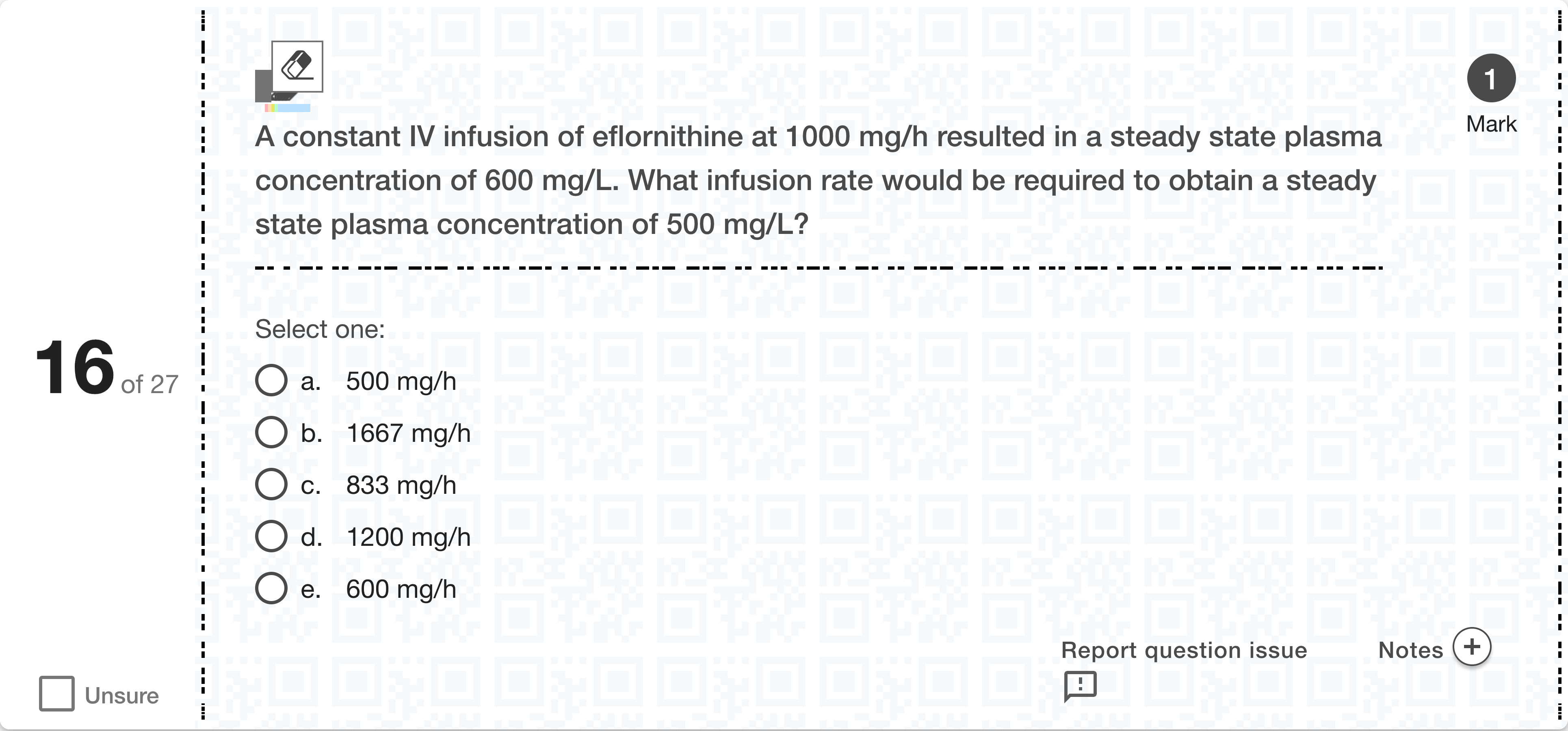
A constant IV infusion of eflornithine at 1000 mg/h resulted in a steady state plasma concentration of 600 mg/L. What infusion rate would be required to obtain a steady state plasma concentration of 500 mg/L?[Fill in the blank]
Options
A.a. 500 mg/h
B.b. 1667 mg/h
C.c. 833 mg/h
D.d. 1200 mg/h
E.e. 600 mg/h

View Explanation
Verified Answer
Please login to view
Step-by-Step Analysis
To approach this, recognize that at steady state for a constant IV infusion, the plasma concentration is proportional to the infusion rate, assuming clearance remains constant.
Option a: 500 mg/h. If we reduce the rate to 500 mg/h from 1000 mg/h, the steady-state concentration would roughly halve from 600 mg/L to about 300 mg/L, not 500 mg/L. Thus this op......Login to view full explanationLog in for full answers
We've collected over 50,000 authentic exam questions and detailed explanations from around the globe. Log in now and get instant access to the answers!
Similar Questions
Which of the following statements accurately describe the relationship between individual half-life and initial ("baseline") serum ChromoBzAc concentration?
Louise was given a single IV dose of 100 mg tramadol after the surgery for her wrist fracture. Blood samples were taken at various time intervals, and the plasma concentration-time data are given below. [table] Time (hr) | Plasma concentration (µg/mL) 0.25 | 11.1 0.5 | 10.7 1 | 10.0 3 | 7.5 6 | 4.9 12 | 2.1 [/table][Fill in the blank] Does tramadol display one or two compartment pharmacokinetics?[Fill in the blank] What is the plasma concentration at time zero?[Fill in the blank] What is the elimination rate constant?[Fill in the blank] Estimate the volume of distribution and elimination half-life.[Fill in the blank] What is the clearance?[Fill in the blank] If the fraction of tramadol excreted (fe) is 0.3, what is the renal clearance and hepatic clearance?[Fill in the blank] How much drug would be left in the body after 3 hours of dosing?[Fill in the blank] How long would it take for 99.9% of this drug to be eliminated?[Fill in the blank]
Clotgone® is first in class anti-coagulant for patients with atrial fibrillation to reduce the risk of clots forming and pulmonary embolisms and strokes. The pharmaceutical company who discovered and developed Clotgone® have produced population PK/PD modelling that demonstrates that the 40mg dose achieves therapeutic drug concentrations at the EC50 for all patients. The relationship between concentration and effect is immediate and reversible. They also describe via this population analysis that the population half-life of Clotgone is 4 hours. From this population PK analysis, the FDA approved dosing schedule for Clotgone ® is 40mg every 8 hours. You are presenting Clotgone® to a group of prescribers who will start using this new anti-coagulant in their patients. Please answer the following questions using pharmacokinetic/pharmacodynamic principles:[Fill in the blank] If I prescribe double the dose i.e. 80mg will I get double the anti-coagulation and therefore reduced risk of clotting?[Fill in the blank] If I give double the dose i.e.80mg, will I get double the duration of anticoagulation?[Fill in the blank] We know that there is greater compliance when people take medicines once daily. Also, all other anticoagulants on the market are currently a single daily dose. Would you get the same anti-coagulation relief if I prescribed 120mg (3 x 40mg tablets) once daily vs 40mg every 8 hours?[Fill in the blank]
Drug A and drug B each are administered as the same type of formulation (immediate-release table) and both have an elimination half-life of 3h. Drug B is affected by a genetic polymorphism while drug A is not. What can you conclude about the desired dosing interval?[Fill in the blank]
More Practical Tools for Students Powered by AI Study Helper
Making Your Study Simpler
Join us and instantly unlock extensive past papers & exclusive solutions to get a head start on your studies!