
Questions
ETX5900 - S2 2025 Take Home Quiz Week 10 (due on 17th of October)
Single choice
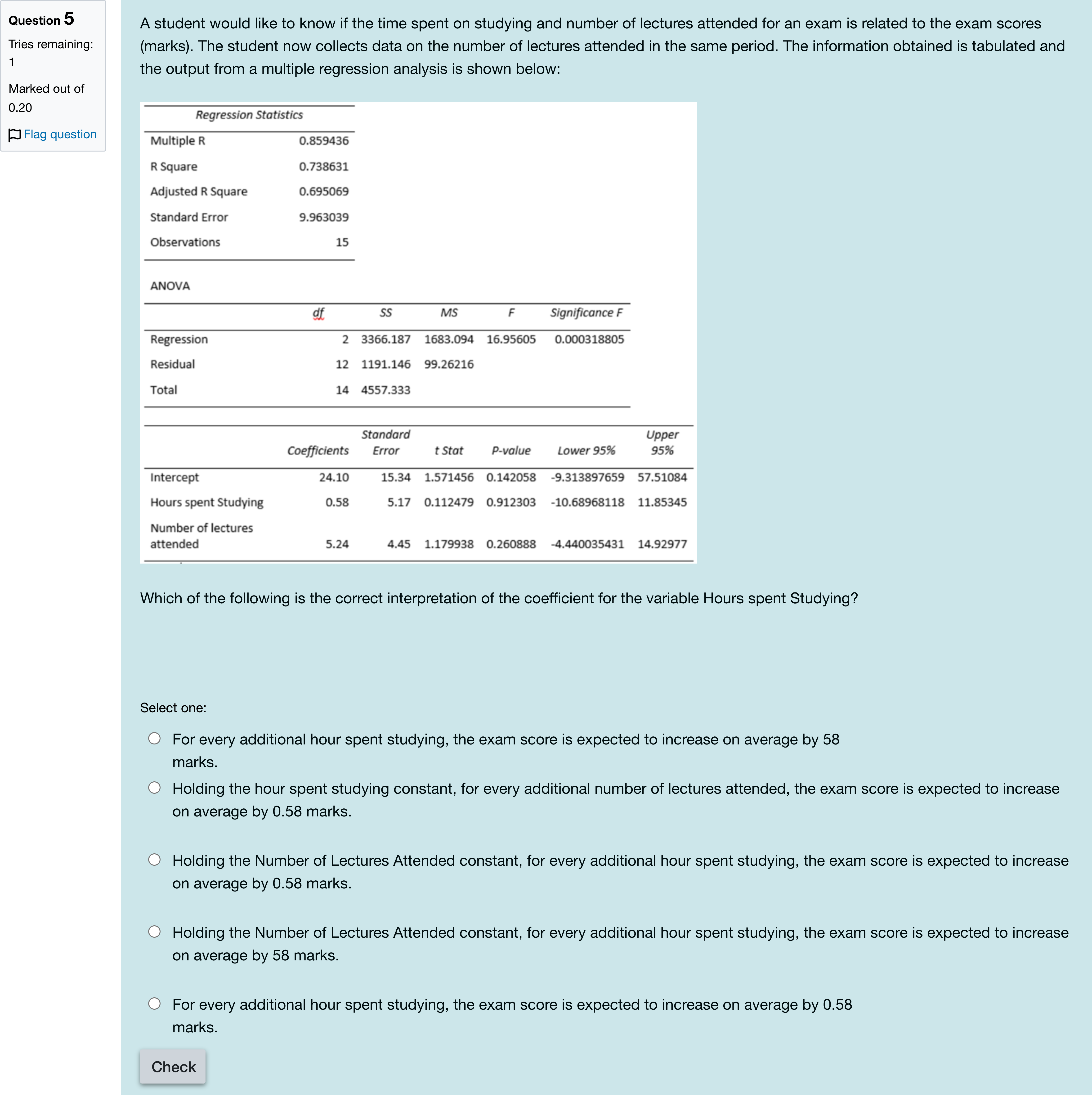
A student would like to know if the time spent on studying and number of lectures attended for an exam is related to the exam scores (marks). The student now collects data on the number of lectures attended in the same period. The information obtained is tabulated and the output from a multiple regression analysis is shown below: Which of the following is the correct interpretation of the coefficient for the variable Hours spent Studying?
Options
A.For every additional hour spent studying, the exam score is expected to increase on average by 58 marks.
B.Holding the hour spent studying constant, for every additional number of lectures attended, the exam score is expected to increase on average by 0.58 marks.
C.Holding the Number of Lectures Attended constant, for every additional hour spent studying, the exam score is expected to increase on average by 0.58 marks.
D.Holding the Number of Lectures Attended constant, for every additional hour spent studying, the exam score is expected to increase on average by 58 marks.
E.For every additional hour spent studying, the exam score is expected to increase on average by 0.58 marks.

View Explanation
Verified Answer
Please login to view
Step-by-Step Analysis
To begin, let’s identify what the question is asking: interpret the regression coefficient for Hours spent Studying in the multiple regression output, considering the role of other variables in the model.
Option 1 asserts that each additional hour increases the score by 58 marks. This is overly large and ignores the decimal 0.58; it misreads the coefficient magnitude and would imply an unrealistic jump in scores. In regression results, coefficients are not expressed as whole numbers like 58 unless the unit scale dictates so, ......Login to view full explanationLog in for full answers
We've collected over 50,000 authentic exam questions and detailed explanations from around the globe. Log in now and get instant access to the answers!
Similar Questions
Below are the results of an association study conducted by Saha, Morris and Kang (2019):Adjusted R2 = 0.689 Which of the following is incorrect?
Question8 Including irrelevant regressors in multiple regression typically: Select one alternative: a) Increases variance of estimates b) Biases coefficients c) Reduces variance of estimates d) Leaves [math] unchanged ResetMaximum marks: 0.5 Flag question undefined
In the multiple regression model, [math: yi=β1+β2xi+β3zi+ui]y_i=\beta _1+\beta _2x_i +\beta _3z_i+u_i, which of the following leads to improved precision on the estimates [math: β^2]\hatβ_2, (that is, smaller [math: se(β^2|x,z)]se(\hat{\beta}_2|x,\,z)?[Fill in the blank]
What is the consequence of including irrelevant variables (those that have no direct effect on the dependent variable) in your regression model?[Fill in the blank]
More Practical Tools for Students Powered by AI Study Helper
Making Your Study Simpler
Join us and instantly unlock extensive past papers & exclusive solutions to get a head start on your studies!