
Questions
ECON0015_ECON0013_ECON0014_25-26 Quiz 3b
Numerical
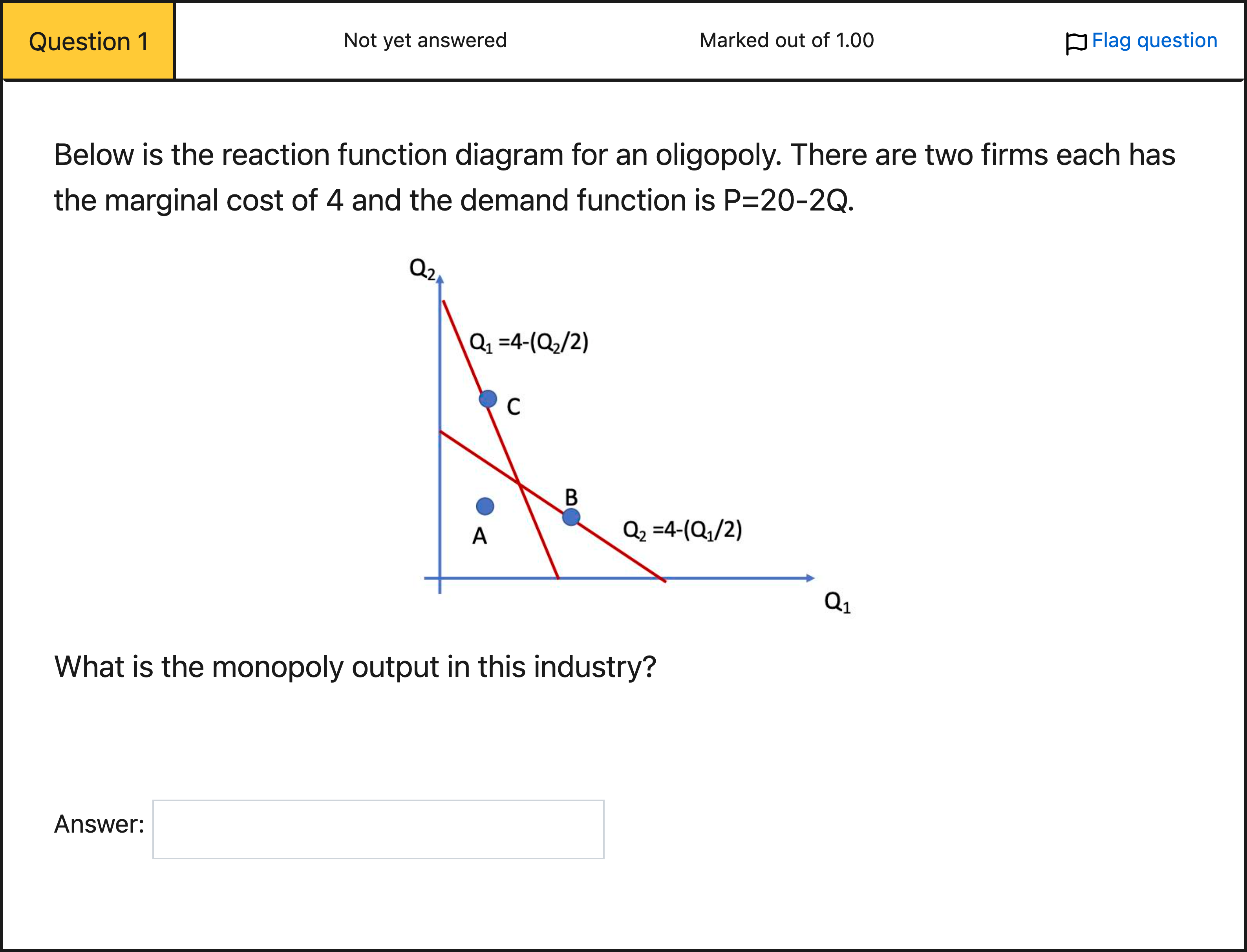
Below is the reaction function diagram for an oligopoly. There are two firms each has the marginal cost of 4 and the demand function is P=20-2Q.What is the monopoly output in this industry?

View Explanation
Verified Answer
Please login to view
Step-by-Step Analysis
The question asks for the monopoly output in a market described by the demand P = 20 − 2Q, where Q is the total quantity (Q = Q1 + Q2), and each firm has a marginal cost of 4.
First, treat the industry as a single monopolist facing the overal......Login to view full explanationLog in for full answers
We've collected over 50,000 authentic exam questions and detailed explanations from around the globe. Log in now and get instant access to the answers!
Similar Questions
Part 1Barbara owns a truck stop on the prairies, miles from anywhere. The graph shows her marginal revenue and marginal cost curves and the demand curve she faces. How many fewer meals does Barbara serve than she would if the market were perfectly competitive? Part 1Barbara serves [input]enter your response here fewer meals a week than she would if the market were perfectly competitive. Part 1 0204060801001201401600123456Quantity (meals per week)Price and cost (dollars per meal)Upper DDMCMCMRMR Edit coordinates (0,0) x y graph
Alpha Inc. and Beta Corp. compete in the market for smallgoods (processed meats). The smallgoods produced by the two firms are homogeneous, and the firms compete in Cournot (quantity) competition. Inverse demand in the market for smallgoods is given by the function, 𝑃 = 100 − 𝑄 𝐴 24 − 𝑄 𝐵 24 , where 𝑄 𝐴 is the quantity of smallgoods produced by Alpha, and 𝑄 𝐵 is the quantity of smallgoods produced by Beta. Alpha Inc.'s marginal cost is 𝑀 𝐶 𝐴 = $ 20 , and Beta Corp.'s marginal cost is 𝑀 𝐶 𝐵 = $ 10 . If Alpha Inc. were a monopolist, what quantity would it choose to produce?
Table 18-1 Imagine a small town in which only two residents, Rochelle and Alec, own wells that produce safe drinking water. Each week Rochelle and Alec work together to decide how many gallons of water to pump. They bring the water to town and sell it at whatever price the market will bear. To keep things simple, suppose that Rochelle and Alec can pump as much water as they want without cost so that the marginal cost of water equals zero. The town's weekly demand schedule and total revenue schedule for water is shown in the following table: Quantity (Gallons) Price (Dollars per gallon) Total Revenue and Total Profit (Dollars) 0 60 0 100 55 5,500 200 50 10,000 300 45 13,500 400 40 16,000 500 35 17,500 600 30 18,000 700 25 17,500 800 20 16,000 900 15 13,500 1,000 10 10,000 1,100 5 5,500 1,200 0 0 Refer to Table 18-1. If Rochelle and Alec operate as a profit-maximizing monopoly in the market for water, how many gallons of water will be produced and sold?
In a consumer society, many adults channel creativity into buying things
More Practical Tools for Students Powered by AI Study Helper
Making Your Study Simpler
Join us and instantly unlock extensive past papers & exclusive solutions to get a head start on your studies!